ವೈದ್ಯಕೀಯ ವಿದ್ಯಾರ್ಥಿಗಳಿಗೆ ನಿರಾಳತೆ: NEET-UG 2026 ಶುಲ್ಕ ಮರುಪಾವತಿ ಸಲ್ಲಿಕೆ ಗಡುವು ಜೂನ್ 22ರವರೆಗೆ ವಿಸ್ತರಣೆ

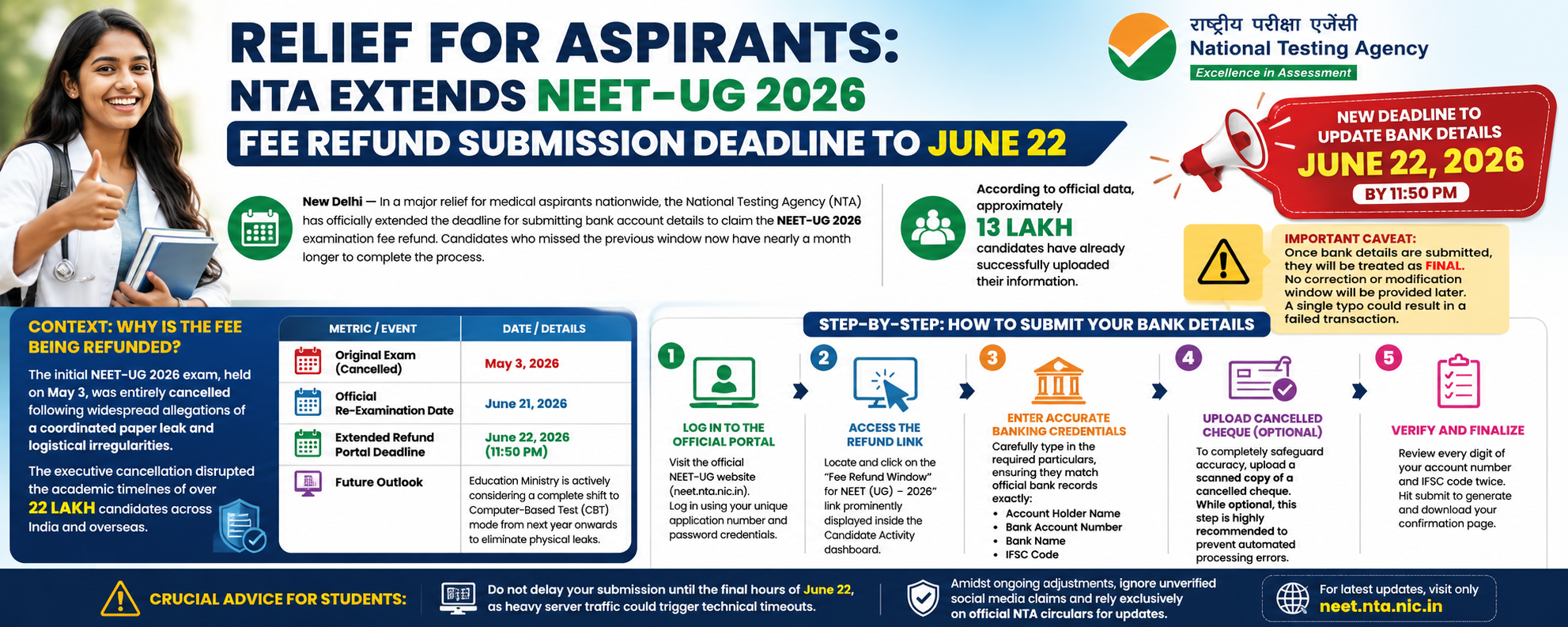
ನವದೆಹಲಿ — ದೇಶದಾದ್ಯಂತದ ವೈದ್ಯಕೀಯ ಪ್ರವೇಶಾಕಾಂಕ್ಷಿಗಳಿಗೆ ಮಹತ್ವದ ನಿರಾಳತೆಯಾಗಿ, ರಾಷ್ಟ್ರೀಯ ಪರೀಕ್ಷಾ ಸಂಸ್ಥೆ (NTA) NEET-UG 2026 ಪರೀಕ್ಷಾ ಶುಲ್ಕ ಮರುಪಾವತಿಗಾಗಿ ಬ್ಯಾಂಕ್ ಖಾತೆ ವಿವರಗಳನ್ನು ಸಲ್ಲಿಸುವ ಅಂತಿಮ ದಿನಾಂಕವನ್ನು ಅಧಿಕೃತವಾಗಿ ವಿಸ್ತರಿಸಿದೆ. ಮೊದಲು ಅವಕಾಶ ತಪ್ಪಿಸಿಕೊಂಡ ಅಭ್ಯರ್ಥಿಗಳಿಗೆ ಇದೀಗ ಸುಮಾರು ಒಂದು ತಿಂಗಳ ಹೆಚ್ಚುವರಿ ಸಮಯ ಲಭಿಸಿದೆ.

ಹೊಸ ಗಡುವಿನ ಪ್ರಕಾರ, ಅಭ್ಯರ್ಥಿಗಳು ತಮ್ಮ ಬ್ಯಾಂಕ್ ವಿವರಗಳನ್ನು ಜೂನ್ 22, 2026 ರಾತ್ರಿ 11:50ರವರೆಗೆ ಅಧಿಕೃತ ಪೋರ್ಟಲ್‌ನಲ್ಲಿ ಅಪ್‌ಡೇಟ್ ಮಾಡಬಹುದು.

ಮರುಪಾವತಿ ಪಡೆಯಲು ಹೆಚ್ಚುವರಿ ಅವಕಾಶ

ಹಿಂದಿನ ಗಡುವು ಮೇ 27, 2026ರಂದು ಕೊನೆಗೊಳ್ಳಬೇಕಾಗಿತ್ತು. ಹಲವಾರು ವಿದ್ಯಾರ್ಥಿಗಳು ಸರಿಯಾದ ಬ್ಯಾಂಕ್ ವಿವರಗಳನ್ನು ಸಂಗ್ರಹಿಸಲು ಹೆಚ್ಚಿನ ಸಮಯ ಅಗತ್ಯವಿದೆ ಎಂದು ಮನವಿ ಮಾಡಿದ ಹಿನ್ನೆಲೆಯಲ್ಲಿ, NTA ಈ ಗಡುವನ್ನು ವಿಸ್ತರಿಸಿದೆ. ಸಂಸ್ಥೆ ಬಿಡುಗಡೆ ಮಾಡಿದ ಅಧಿಕೃತ ಮಾಹಿತಿಯ ಪ್ರಕಾರ, ಈಗಾಗಲೇ ಸುಮಾರು 13 ಲಕ್ಷ ಅಭ್ಯರ್ಥಿಗಳು ತಮ್ಮ ಬ್ಯಾಂ್ ಮಾಹಿತಿ ಯಶಸ್ವಿಯಾಗಿ ಅಪ್‌ಲೋಡ್ ಮಾಡಿದ್ದಾರೆ.

ಆದರೆ, NTA ಮಹತ್ವದ ಎಚ್ಚರಿಕೆಯನ್ನು ನೀಡಿದೆ — ಒಮ್ಮೆ ಬ್ಯಾಂಕ್ ವಿವರಗಳನ್ನು ಸಲ್ಲಿಸಿದ ನಂತರ ಯಾವುದೇ ತಿದ್ದುಪಡಿ ಅಥವಾ ಬದಲಾವಣೆಗೆ ಅವಕಾಶ ಇರುವುದಿಲ್ಲ. ಖಾತೆ ಸಂಖ್ಯೆ ಅಥವಾ IFSC ಕೋಡ್‌ನಲ್ಲಿ ಸಣ್ಣ ತಪ್ಪು ಸಹ ಮರುಪಾವತಿ ವಿಫಲವಾಗುವ ಸಾಧ್ಯತೆಯಿದೆ. ಆದ್ದರಿಂದ ಪ್ರತಿಯೊಂದು ಮಾಹಿತಿಯನ್ನು ಎರಡು ಬಾರಿ ಪರಿಶೀಲಿಸುವುದು ಅತ್ಯಗತ್ಯ.

ಬ್ಯಾಂಕ್ ವಿವರಗಳನ್ನು ಸಲ್ಲಿಸುವ ವಿಧಾನ

ಬಹುತೇಕ ವಿದ್ಯಾರ್ಥಿಗಳು ತಮ್ಮ ನೋಂದಣಿಯನ್ನು ಸೈಬರ್ ಕಫೆ, ಕಾಮನ್ ಸರ್ವಿಸ್ ಸೆಂಟರ್ ಅಥವಾ ತೃತೀಯ ವ್ಯಕ್ತಿ ಡಿಜಿಟಲ್ ವಾಲೆಟ್ ಮೂಲಕ ಮಾಡಿಕೊಂಡಿದ್ದರಿಂದ, ಮರುಪಾವತಿ ಯಾವ ಖಾತೆಗೆ ಜಮಾ ಮಾಡಬೇಕು ಎಂಬುದನ್ನು ಅಭ್ಯರ್ಥಿಗಳು ಸ್ಪಷ್ಟವಾಗಿ ನಮೂದಿಸಬೇಕು ಎಂದು NTA ಸೂಚಿಸಿದೆ.

ಹಂತ 1: ಅಧಿಕೃತ ವೆಬ್‌ಸೈಟ್‌ಗೆ ಲಾಗಿನ್ ಆಗಿ

ಅಭ್ಯರ್ಥಿಗಳು neet.nta.nic.in ವೆಬ್‌ಸೈಟ್‌ಗೆ ಭೇಟಿ ನೀಡಿ, ತಮ್ಮ ಅಪ್ಲಿಕೇಶನ್ ಸಂಖ್ಯೆ ಮತ್ತು ಪಾಸ್‌ವರ್ಡ್ ಬಳಸಿ ಲಾಗಿನ್ ಆಗಬೇಕು.

ಹಂತ 2: Refund Link ಆಯ್ಕೆಮಾಡಿ

Candidate Activity ವಿಭಾಗದಲ್ಲಿ ಕಾಣುವ “Fee Refund Window for NEET (UG) – 2026” ಲಿಂಕ್ ಮೇಲೆ ಕ್ಲಿಕ್ ಮಾಡಬೇಕು.

ಹಂತ 3: ಬ್ಯಾಂಕ್ ವಿವರಗಳನ್ನು ನಮೂದಿಸಿ

ಕೆಳಗಿನ ಮಾಹಿತಿಗಳನ್ನು ಬ್ಯಾಂಕ್ ದಾಖಲೆಗಳಿಗೆ ಹೊಂದುವಂತೆ ಸರಿಯಾಗಿ ನಮೂದಿಸಬೇಕು:

  • ಖಾತೆದಾರರ ಹೆಸರು
  • ಬ್ಯಾಂಕ್ ಖಾತೆ ಸಂಖ್ಯೆ
  • ಬ್ಯಾಂಕ್ ಹೆಸರು
  • IFSC ಕೋಡ್

ಹಂತ 4: Cancelled Cheque ಅಪ್‌ಲೋಡ್ (ಐಚ್ಛಿಕ)

ತಪ್ಪುಗಳನ್ನು ತಪ್ಪಿಸಲು ಸ್ಕ್ಯಾನ್ ಮಾಡಿದ cancelled cheque ಅನ್ನು ಅಪ್‌ಲೋಡ್ ಮಾಡುವುದನ್ನು ಶಿಫಾರಸು ಮಾಡಲಾಗಿದೆ. ಇದು ಸ್ವಯಂಚಾಲಿತ ಪ್ರಕ್ರಿಯೆಯಲ್ಲಿ ದೋಷಗಳನ್ನು ಕಡಿಮೆ ಮಾಡುತ್ತದೆ.

ಹಂತ 5: ಪರಿಶೀಲಿಸಿ ಮತ್ತು Submit ಮಾಡಿ

ಖಾತೆ ಸಂಖ್ಯೆ ಮತ್ತು IFSC ಕೋಡ್ ಅನ್ನು ಮತ್ತೊಮ್ಮೆ ಪರಿಶೀಲಿಸಿ Submit ಮಾಡಿ. ಬಳಿಕ Confirmation Page ಡೌನ್‌ಲೋಡ್ ಮಾಡಿಕೊಂಡು ಸುರಕ್ಷಿತವಾಗಿ ಉಳಿಸಿಕೊಳ್ಳಬೇಕು.

ಶುಲ್ಕ ಮರುಪಾವತಿಯ ಹಿನ್ನೆಲೆ ಏನು?

ಮೇ 3, 2026ರಂದು ನಡೆದ ಮೂಲ NEET-UG ಪರೀಕ್ಷೆ ಪ್ರಶ್ನೆಪತ್ರಿಕೆ ಸೋರಿಕೆ ಹಾಗೂ ವಿವಿಧ ಅಕ್ರಮಗಳ ಆರೋಪಗಳ ಹಿನ್ನೆಲೆಯಲ್ಲಿ ಸಂಪೂರ್ಣವಾಗಿ ರದ್ದುಗೊಂಡಿತ್ತು. ಈ ಬೆಳವಣಿಗೆಯಿಂದ ದೇಶದಾದ್ಯಂತ ಹಾಗೂ ವಿದೇಶಗಳಲ್ಲಿ ಪರೀಕ್ಷೆ ಬರೆದ 22 ಲಕ್ಷಕ್ಕೂ ಹೆಚ್ಚು ವಿದ್ಯಾರ್ಥಿಗಳ ಶೈಕ್ಷಣಿಕ ವೇಳಾಪಟ್ಟಿಗೆ ದೊಡ್ಡ ಅಡ್ಡಿ ಉಂಟಾಯಿತು.

ನ್ಯಾಯಸಮ್ಮತ ಪರೀಕ್ಷಾ ಪ್ರಕ್ರಿಯೆಯನ್ನು ಖಚಿತಪಡಿಸಲು, ಮರುಪರೀಕ್ಷೆಯನ್ನು ಜೂನ್ 21, 2026ರಂದು ನಡೆಸಲು ಅಧಿಕೃತವಾಗಿ ಘೋಷಿಸಲಾಗಿದೆ.

ಪ್ರಮುಖ ದಿನಾಂಕಗಳು

  • ಮೂಲ ಪರೀಕ್ಷೆ (ರದ್ದು): ಮೇ 3, 2026
  • ಮರುಪರೀಕ್ಷೆ ದಿನಾಂಕ: ಜೂನ್ 21, 2026
  • Refund Portal ಅಂತಿಮ ದಿನಾಂಕ: ಜೂನ್ 22, 2026 ರಾತ್ರಿ 11:50

ಭವಿಷ್ಯದ ಯೋಜನೆ

ಶಿಕ್ಷಣ ಸಚಿವಾಲಯವು ಮುಂದಿನ ವರ್ಷದಿಂದ NEET ಪರೀಕ್ಷೆಯನ್ನು ಸಂಪೂರ್ಣ Computer-Based Test (CBT) ಮಾದರಿಯಲ್ಲಿ ನಡೆಸುವ ಕುರಿತು ಗಂಭೀರವಾಗಿ ಚಿಂತನೆ ನಡೆಸುತ್ತಿದೆ. ಇದರಿಂದ ಭೌತಿಕ ಪ್ರಶ್ನೆಪತ್ರಿಕೆ ಸೋರಿಕೆ ಪ್ರಕರಣಗಳನ್ನು ಸಂಪೂರ್ಣವಾಗಿ ತಡೆಯುವ ಉದ್ದೇಶವಿದೆ.

ವಿದ್ಯಾರ್ಥಿಗಳಿಗೆ ಮಹತ್ವದ ಸಲಹೆ

ಅಭ್ಯರ್ಥಿಗಳು ಕೊನೆಯ ದಿನದವರೆಗೆ ಕಾಯದೇ ಸಾಧ್ಯವಾದಷ್ಟು ಬೇಗ ಬ್ಯಾಂಕ್ ವಿವರಗಳನ್ನು ಸಲ್ಲಿಸುವುದು ಒಳಿತು. ಅಂತಿಮ ಕ್ಷಣದಲ್ಲಿ ಅಧಿಕ ಸಂಖ್ಯೆಯ ಲಾಗಿನ್‌ಗಳಿಂದ ಸರ್ವರ್ ಸಮಸ್ಯೆಗಳು ಉಂಟಾಗುವ ಸಾಧ್ಯತೆ ಇದೆ.

ಇದೇ ವೇಳೆ, ಸಾಮಾಜಿಕ ಜಾಲತಾಣಗಳಲ್ಲಿ ಹರಡುತ್ತಿರುವ ಅಪರಿಶೀಲಿತ ಮಾಹಿತಿಗಳನ್ನು ನಂಬದೆ, ಮರುಪಾವತಿ ಹಾಗೂ ಮರುಪರೀಕ್ಷೆಗೆ ಸಂಬಂಧಿಸಿದ ಎಲ್ಲಾ ಮಾಹಿತಿಯನ್ನು NTAಯ ಅಧಿಕೃತ ಪ್ರಕಟಣೆಗಳಿಂದ ಮಾತ್ರ ಪಡೆಯುವಂತೆ ವಿದ್ಯಾರ್ಥಿಗಳಿಗೆ ಸಲಹೆ ನೀಡಲಾಗಿದೆ.
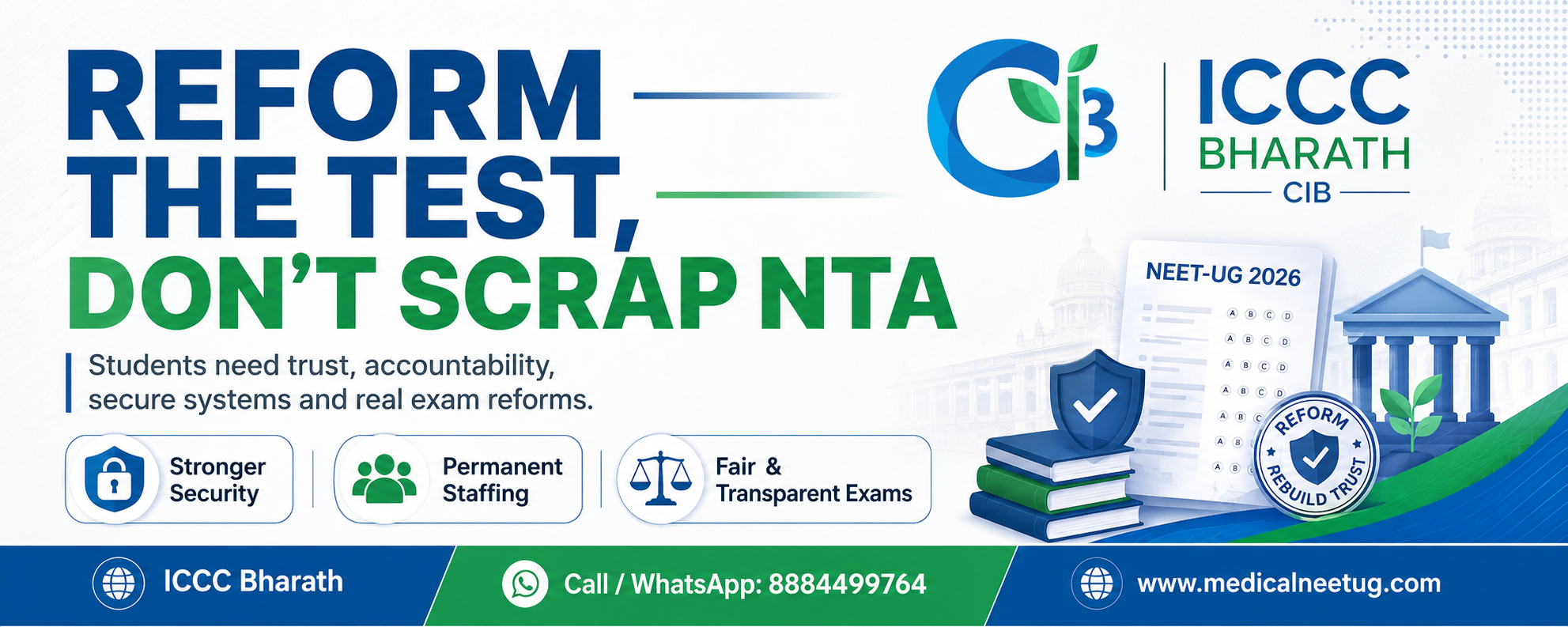
Reform the Exam System, Don’t Scrap NTA

The NEET-UG 2026 paper leak controversy has once again shaken the confidence of students and parents across India. For lakhs of families, NEET is not just an entrance exam. It is years of sacrifice, coaching fees, hostel life, sleepless nights, emotional pressure and one dream — to become a doctor.

When such an exam is cancelled due to paper leak allegations, the pain is not only academic. It is emotional, financial and psychological. Students who prepared honestly feel punished for no mistake of theirs. Parents feel helpless. The system loses trust.

But at this point, the question should not only be whether NTA should be scrapped. The bigger question is: How do we reform the examination system so deeply that students never face this trauma again?

NTA Handles a Huge Examination Ecosystem

The National Testing Agency does not conduct only one exam. It manages several major national-level examinations, including NEET-UG, JEE Main, CUET, UGC-NET and other specialised tests for ministries, regulators and institutions.

This means NTA handles lakhs and even crores of test events every year across multiple languages, thousands of centres, rural and urban regions, and different academic streams.

Such a large testing ecosystem cannot be run casually. It requires permanent leadership, trained manpower, strong technology, clear protocols, real-time monitoring and strict accountability.

NEET-UG 2026 Exposed the Weakest Link

NEET-UG is still conducted in pen-and-paper mode. At this scale, a physical paper system becomes highly vulnerable.

The question paper has to be prepared, translated, printed, packed, stored, transported, opened and distributed at thousands of centres. Every physical step becomes a possible weak point.

For honest students, even one weak link can destroy months of preparation.

This is why reform is urgent. The system cannot depend only on trust. It must be protected by technology, law, accountability and professional management.

CBT Can Reduce Some Risks

Computer-Based Tests are not risk-free, but they reduce many dangers linked to physical paper movement.

In CBT mode, question papers can be delivered through encrypted systems. Access can be controlled. Sessions can be monitored digitally. Audit trails can be maintained. If a problem happens in one centre or one shift, that session can be isolated and corrected without cancelling the entire examination for lakhs of students.

This is one reason why NEET-UG should gradually move towards a secure CBT or hybrid model, with proper infrastructure and support for rural students.

But CBT alone is not enough. Technology must come with honest governance.

The Real Problem Is Weak Structure and Accountability

The NEET crisis is not only about a paper leak. It also exposes deeper administrative problems.

If an agency is conducting exams for more than one crore test events in a year, it cannot run with vacant posts, temporary arrangements, outsourced dependency and unclear responsibility.

Reports of senior vacancies and lack of permanent manpower inside NTA raise serious concerns. A national testing body must have competent people in technology, cybersecurity, logistics, examination law, data management, audit, finance and grievance redressal.

Appointments should not be influenced by lobbying or convenience. They must be based on proven experience, integrity and capability.

India has enough talented professionals. The problem is not lack of people. The problem is lack of transparent selection and serious institutional planning.

Reform Should Be Serious, Not Cosmetic

After every controversy, committees are formed, reports are written and promises are made. But students need more than statements.

India needs real reform:

Clear responsibility at every level
Permanent and qualified manpower
Strict exam security protocols
Digital tracking of question paper movement
Encrypted paper transmission systems
Biometric and face authentication
AI-based anomaly detection
Independent audit of exam processes
Strong cybercrime coordination
Faster grievance redressal
Public accountability after every failure

The Radhakrishnan Committee recommendations should not remain on paper. They must be implemented with deadlines, monitoring and public reporting.

Do Not Punish Honest Students Again and Again

The worst part of any paper leak is that honest students suffer the most.

A student may have travelled hundreds of kilometres. A family may have spent money on coaching, rent, food, exam travel and emotional support. Many students are repeaters who have already given one or two years of their life to this exam.

When the system fails, their pain cannot be dismissed as a technical issue.

Students need assurance that their hard work matters more than money, contacts or manipulation.

Reform NTA, Strengthen It, Make It Accountable

Scrapping an institution may sound attractive during anger, but the real need is to rebuild it with stronger legal and administrative foundations.

NTA should be made more accountable, more transparent and more professional. If needed, it should be given statutory backing through Parliament, with clear responsibility, audit power and public reporting.

The agency must not become a body that conducts exams but avoids accountability when things go wrong.

A national testing agency must be independent, competent and answerable.

Conclusion

The NEET-UG 2026 crisis is a painful reminder that India’s examination system needs urgent reform. But reform should be thoughtful, practical and student-centric.

The goal should not be only to blame NTA or defend NTA. The goal should be to build an examination system that students can trust.

India’s students deserve fair exams. Parents deserve peace of mind. Honest preparation deserves protection.

Reform the test. Strengthen the system. Fix accountability. Protect students.

NEET-UG ಪ್ರಶ್ನೆಪತ್ರಿಕೆ ಸೋರಿಕೆ ವಿವಾದದ ಬಳಿಕ ಸುರಕ್ಷಿತ ಪರೀಕ್ಷೆಗಾಗಿ NTA ಪ್ರಮುಖ ಸುಧಾರಣೆಗಳನ್ನು ಘೋಷಿಸಿದೆ

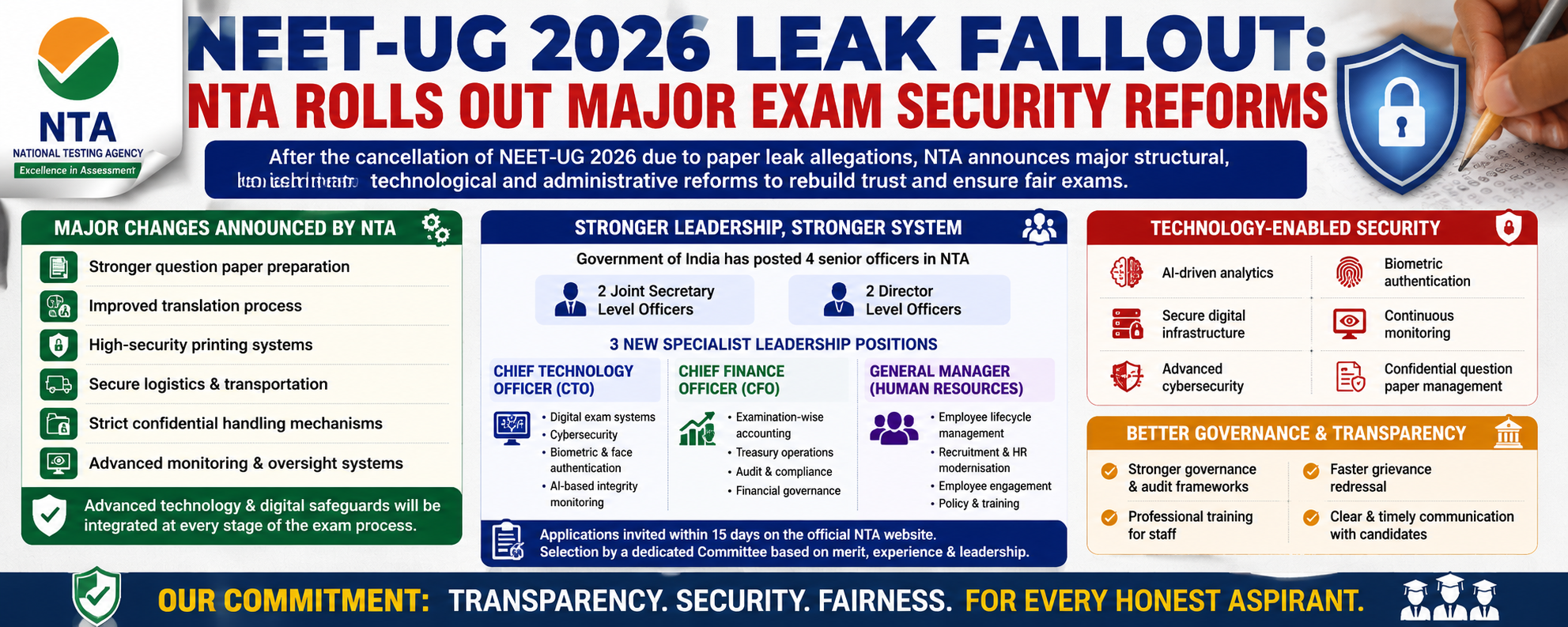
NEET-UG 2026 ಪ್ರಶ್ನೆಪತ್ರಿಕೆ ಸೋರಿಕೆ ವಿವಾದದ ಹಿನ್ನೆಲೆದಲ್ಲಿ ರಾಷ್ಟ್ರೀಯ ಪರೀಕ್ಷಾ ಸಂಸ್ಥೆ (NTA) ದೇಶದ ರಾಷ್ಟ್ರೀಯ ಮಟ್ಟದ ಪರೀಕ್ಷಾ ವ್ಯವಸ್ಥೆಯನ್ನು ಇನ್ನಷ್ಟು ಸುರಕ್ಷಿತ ಮತ್ತು ಪಾರದರ್ಶಕವಾಗಿಸಲು ಹಲವು ಪ್ರಮುಖ ಸುಧಾರಣೆಗಳನ್ನು ಘೋಷಿಸಿದೆ. ವಿದ್ಯಾರ್ಥಿಗಳು, ಪೋಷಕರು ಹಾಗೂ ಶಿಕ್ಷಣ ತಜ್ಞರು ವ್ಯಕ್ತಪಡಿಸಿದ ಪರೀಕ್ಷೆಯ ಸುರಕ್ಷತೆ, ವಿಶ್ವಾಸಾರ್ಹತೆ ಮತ್ತು ಪಾರದರ್ಶಕತೆ ಕುರಿತ ಆತಂಕಗಳ ನಂತರ ಈ ಕ್ರಮ ಕೈಗೊಳ್ಳಲಾಗಿದೆ.

NEET-UG 2026 ಮೇ 3ರಂದು ನಡೆದಿತ್ತು. ಆದರೆ ಹಲವು ರಾಜ್ಯಗಳಲ್ಲಿ ಪ್ರಶ್ನೆಪತ್ರಿಕೆ ಸೋರಿಕೆ ಮತ್ತು ಅಕ್ರಮಗಳ ಆರೋಪಗಳು ಕೇಳಿಬಂದ ಹಿನ್ನೆಲೆಯಲ್ಲಿ ಪರೀಕ್ಷೆಯನ್ನು ರದ್ದುಪಡಿಸಲಾಯಿತು. ಈ ನಿರ್ಧಾರದಿಂದ ದೇಶದಾದ್ಯಂತ ಸುಮಾರು 22 ಲಕ್ಷಕ್ಕೂ ಹೆಚ್ಚು ವಿದ್ಯಾರ್ಥಿಗಳು ಪರಿಣಾಮಕ್ಕೆ ಒಳಗಾದರು.

ಭವಿಷ್ಯದಲ್ಲಿ ಇಂತಹ ಘಟನೆಗಳು ಮರುಕಳಿಸದಂತೆ ತಡೆಯಲು ಕೇಂದ್ರ ಸರ್ಕಾರ ಉನ್ನತ ಮಟ್ಟದ ತಜ್ಞರ ಸಮಿತಿಯನ್ನು ರಚಿಸಿತು. ಸಮಿತಿಯ ಶಿಫಾರಸುಗಳ ಆಧಾರದ ಮೇಲೆ NTA ಈಗ ತಾಂತ್ರಿಕ, ಆಡಳಿತಾತ್ಮಕ ಮತ್ತು ರಚನಾತ್ಮಕ ಬದಲಾವಣೆಗಳನ್ನು ಜಾರಿಗೆ ತರುತ್ತಿದೆ.

ಪ್ರಮುಖ ಸುಧಾರಣೆಗಳ ಕ್ಷೇತ್ರಗಳು

NTA ಪ್ರಕಟಣೆಯ ಪ್ರಕಾರ, ಪ್ರಶ್ನೆಪತ್ರಿಕೆ ತಯಾರಿ, ಭಾಷಾಂತರ, ಮುದ್ರಣ, ಸಾಗಣೆ, ಗೌಪ್ಯ ನಿರ್ವಹಣೆ, ಮೇಲ್ವಿಚಾರಣೆ ಹಾಗೂ ಆಡಳಿತ ವ್ಯವಸ್ಥೆಗಳನ್ನು ಬಲಪಡಿಸುವತ್ತ ವಿಶೇಷ ಗಮನ ಹರಿಸಲಾಗುತ್ತದೆ.

ಪರೀಕ್ಷಾ ಪ್ರಕ್ರಿಯೆಯಲ್ಲಿ ಪ್ರಶ್ನೆಪತ್ರಿಕೆ ಸೋರಿಕೆ, ತಿದ್ದುಪಡಿ ಅಥವಾ ಅನಧಿಕೃತ ಪ್ರವೇಶದ ಅಪಾಯ ಕಡಿಮೆ ಮಾಡಲು ಅತ್ಯಾಧುನಿಕ ತಂತ್ರಜ್ಞಾನ ಮತ್ತು ಡಿಜಿಟಲ್ ಸುರಕ್ಷತಾ ಕ್ರಮಗಳನ್ನು ಅಳವಡಿಸಲಾಗುತ್ತದೆ.

NTAಗೆ ಹಿರಿಯ ಅಧಿಕಾರಿಗಳ ನೇಮಕ

ಸುಧಾರಣೆಗಳ ಭಾಗವಾಗಿ NTAಗೆ ನಾಲ್ವರು ಹಿರಿಯ ಅಧಿಕಾರಿಗಳನ್ನು ನೇಮಿಸಲಾಗಿದೆ. ಇದರಲ್ಲಿ ಇಬ್ಬರು ಜಂಟಿ ಕಾರ್ಯದರ್ಶಿ ಮಟ್ಟದ ಅಧಿಕಾರಿಗಳು ಹಾಗೂ ಇಬ್ಬರು ನಿರ್ದೇಶಕ ಮಟ್ಟದ ಅಧಿಕಾರಿಗಳು ಸೇರಿದ್ದಾರೆ.

ರಾಧಾಕೃಷ್ಣನ್ ಸಮಿತಿಯ ಶಿಫಾರಸುಗಳಂತೆ, ಜಂಟಿ ಕಾರ್ಯದರ್ಶಿ ಮಟ್ಟದ ಅಧಿಕಾರಿಗಳು ಹೆಚ್ಚುವರಿ ಮಹಾನಿರ್ದೇಶಕರಾಗಿ ಕಾರ್ಯನಿರ್ವಹಿಸಲಿದ್ದಾರೆ. ಅವರ ಆಡಳಿತ ಅನುಭವವು ಕಾರ್ಯಕ್ಷಮತೆ ಮತ್ತು ಹೊಣೆಗಾರಿಕೆಯನ್ನು ಹೆಚ್ಚಿಸುವ ನಿರೀಕ್ಷೆಯಿದೆ.

ಹೊಸ ತಜ್ಞ ಹುದ್ದೆಗಳು

NTA ಮೂರು ಪ್ರಮುಖ ತಜ್ಞ ಹುದ್ದೆಗಳಿಗೆ ಅರ್ಜಿಗಳನ್ನು ಆಹ್ವಾನಿಸಿದೆ:

  • ಮುಖ್ಯ ತಂತ್ರಜ್ಞಾನ ಅಧಿಕಾರಿ (Chief Technology Officer)
  • ಮುಖ್ಯ ಹಣಕಾಸು ಅಧಿಕಾರಿ (Chief Finance Officer)
  • ಮಾನವ ಸಂಪನ್ಮೂಲ ಪ್ರಧಾನ ವ್ಯವಸ್ಥಾಪಕ (General Manager – Human Resources)

ಮುಖ್ಯ ತಂತ್ರಜ್ಞಾನ ಅಧಿಕಾರಿ ಡಿಜಿಟಲ್ ಪರೀಕ್ಷಾ ವ್ಯವಸ್ಥೆ, ಸೈಬರ್ ಸುರಕ್ಷತೆ, ಬಯೋಮೆಟ್ರಿಕ್ ದೃಢೀಕರಣ, ಮುಖ ಗುರುತಿಸುವಿಕೆ ಮತ್ತು AI ಆಧಾರಿತ ಮೇಲ್ವಿಚಾರಣೆಯ ಜವಾಬ್ದಾರಿ ವಹಿಸಲಿದ್ದಾರೆ.

ತಂತ್ರಜ್ಞಾನ ಆಧಾರಿತ ಸುರಕ್ಷತೆ

ರಾಷ್ಟ್ರೀಯ ಪರೀಕ್ಷೆಗಳಲ್ಲಿ AI ಆಧಾರಿತ ವಿಶ್ಲೇಷಣೆ, ಬಯೋಮೆಟ್ರಿಕ್ ದೃಢೀಕರಣ, ಸುರಕ್ಷಿತ ಡಿಜಿಟಲ್ ಮೂಲಸೌಕರ್ಯ, ನಿರಂತರ ಮೇಲ್ವಿಚಾರಣೆ ಮತ್ತು ಬಲವಾದ ಸೈಬರ್ ಸುರಕ್ಷತಾ ವ್ಯವಸ್ಥೆಗಳನ್ನು ಬಳಸಲು ಯೋಜಿಸಲಾಗಿದೆ.

ಇದರಿಂದ ಪರೀಕ್ಷಾ ಪ್ರಕ್ರಿಯೆ ಇನ್ನಷ್ಟು ಸುರಕ್ಷಿತ, ಪಾರದರ್ಶಕ ಮತ್ತು ಜವಾಬ್ದಾರಿಯುತವಾಗುವ ನಿರೀಕ್ಷೆಯಿದೆ.

ಉತ್ತಮ ಆಡಳಿತ ಮತ್ತು ವಿದ್ಯಾರ್ಥಿ ಸಂಪರ್ಕ

NTA ಉತ್ತಮ ಆಡಳಿತ, ವೇಗವಾದ ದೂರು ಪರಿಹಾರ ವ್ಯವಸ್ಥೆ, ಸಿಬ್ಬಂದಿಗೆ ವೃತ್ತಿಪರ ತರಬೇತಿ ಹಾಗೂ ವಿದ್ಯಾರ್ಥಿಗಳೊಂದಿಗೆ ಸ್ಪಷ್ಟ ಸಂವಹನ ವ್ಯವಸ್ಥೆಯನ್ನು ಒದಗಿಸುವ ಭರವಸೆ ನೀಡಿದೆ.

ಹೆಚ್ಚಿನ ಒತ್ತಡದ ಪರೀಕ್ಷಾ ಸಂದರ್ಭಗಳಲ್ಲಿ ತಡವಾದ ಪ್ರಕಟಣೆಗಳು ಮತ್ತು ತಪ್ಪು ಮಾಹಿತಿಯಿಂದ ವಿದ್ಯಾರ್ಥಿಗಳು ಗೊಂದಲಕ್ಕೊಳಗಾಗುವುದನ್ನು ಕಡಿಮೆ ಮಾಡಲು ಇದು ಸಹಾಯಕವಾಗಲಿದೆ.

ಈ ಸುಧಾರಣೆಗಳ ಮಹತ್ವ

NEET-UG 2026 ಪ್ರಶ್ನೆಪತ್ರಿಕೆ ಸೋರಿಕೆ ಪ್ರಕರಣವು ಭಾರತದ ಪರೀಕ್ಷಾ ವ್ಯವಸ್ಥೆಗೆ ತಾತ್ಕಾಲಿಕ ಪರಿಹಾರವಲ್ಲ, ಬದಲಾಗಿ ಆಳವಾದ ಸುಧಾರಣೆ ಅಗತ್ಯವಿದೆ ಎಂಬುದನ್ನು ತೋರಿಸಿದೆ.

ವಿದ್ಯಾರ್ಥಿಗಳಿಗೆ NEET ಕೇವಲ ಒಂದು ಪರೀಕ್ಷೆಯಲ್ಲ. ಅದು ಅವರ ಹಲವು ವರ್ಷಗಳ ಪರಿಶ್ರಮ, ಕುಟುಂಬದ ತ್ಯಾಗ ಮತ್ತು ವೈದ್ಯರಾಗುವ ಕನಸಿನ ಪ್ರತೀಕವಾಗಿದೆ.

ಸಮಾರೋಪ

NEET-UG 2026 ಪ್ರಶ್ನೆಪತ್ರಿಕೆ ಸೋರಿಕೆ ಪ್ರಕರಣದ ಬಳಿಕ ಘೋಷಿಸಲಾದ NTA ಸುಧಾರಣೆಗಳು ರಾಷ್ಟ್ರೀಯ ಮಟ್ಟದ ಪರೀಕ್ಷೆಗಳ ಮೇಲಿನ ವಿಶ್ವಾಸ ಮರುಸ್ಥಾಪಿಸಲು ಮಹತ್ವದ ಹೆಜ್ಜೆಯಾಗಿದೆ. ಆದರೆ ಈ ಸುಧಾರಣೆಗಳ ನಿಜವಾದ ಯಶಸ್ಸು ಅವುಗಳ ಪರಿಣಾಮಕಾರಿ ಅನುಷ್ಠಾನದಲ್ಲಿದೆ.

ವಿದ್ಯಾರ್ಥಿಗಳು ಮತ್ತು ಪೋಷಕರು ಈಗ ಈ ಬದಲಾವಣೆಗಳು ಭವಿಷ್ಯದ ಪರೀಕ್ಷೆಗಳನ್ನು ನಿಜವಾಗಿಯೂ ಸುರಕ್ಷಿತ, ಪಾರದರ್ಶಕ ಮತ್ತು ನ್ಯಾಯಸಮ್ಮತವಾಗಿಸುತ್ತವೆಯೇ ಎಂಬುದನ್ನು ಗಮನದಿಂದ ನೋಡಲಿದ್ದಾರೆ.

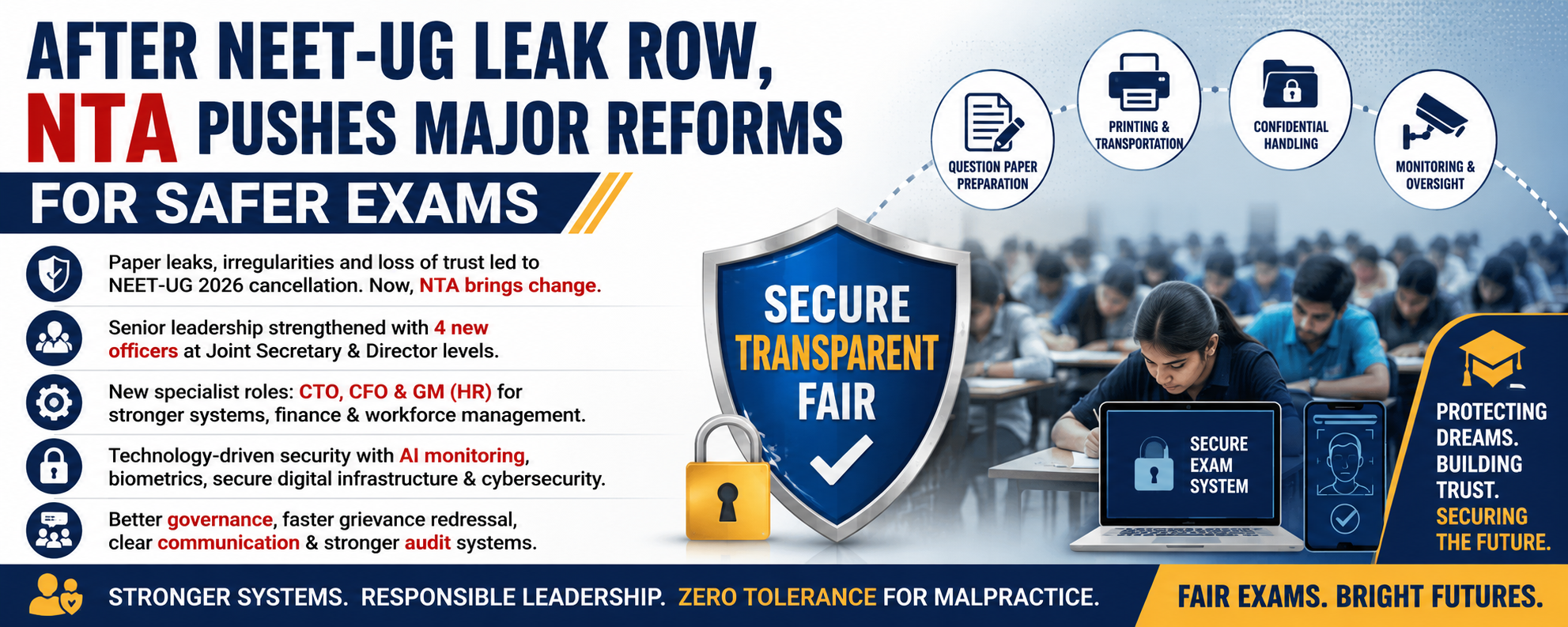
After NEET-UG Leak Row, NTA Pushes Major Reforms for Safer Exams

After the cancellation of NEET-UG 2026 due to the paper leak controversy, the National Testing Agency has announced a series of major reforms to strengthen India’s national-level examination system. The move comes after serious concerns were raised by students, parents and education experts regarding the safety, transparency and credibility of the examination process.

NEET-UG 2026 was conducted on May 3 but was later cancelled following allegations of question paper leaks and irregularities across multiple states. More than 22 lakh students were affected by the decision, creating anxiety and uncertainty among medical aspirants across the country.

To prevent such incidents in future, the Government of India formed a high-level expert committee to review the examination system and suggest stronger safeguards. Based on the recommendations, NTA has now started implementing structural, technological and administrative changes.

Major Areas of Reform

According to the NTA statement, the reforms will focus on strengthening key stages of the examination process, including question paper preparation, translation, printing, transportation, confidential handling, monitoring and oversight.

The agency has said that advanced technology and digital safeguards will be added at different levels to reduce the risk of paper leaks, tampering and unauthorised access.

Senior Officers Posted in NTA

As part of the reform process, four senior officers have been posted to the NTA to improve leadership and administrative capacity. These include two Joint Secretary-level officers and two Director-level officers.

Following the Radhakrishnan Committee recommendations, the Joint Secretary-level officers will function as Additional Director Generals in the agency. Their administrative experience is expected to improve coordination, accountability and operational efficiency.

New Specialist Positions

NTA has also invited applications for three important specialist posts:

Chief Technology Officer, Chief Finance Officer and General Manager for Human Resources.

The Chief Technology Officer will handle digital examination systems, candidate portals, cybersecurity, confidential question paper management, biometric verification, face authentication and AI-based integrity monitoring.

The Chief Finance Officer will supervise examination-wise accounts, audit systems, treasury operations and financial governance.

The General Manager for Human Resources will manage regular, deputation-based and contractual staff, along with recruitment, employee policy, training and workforce modernisation.

Technology-Enabled Security

The reforms will also bring stronger use of technology in national examinations. NTA is expected to use AI-driven analytics, biometric authentication, secure digital infrastructure, continuous monitoring and improved cybersecurity systems.

These steps are aimed at making the examination process more secure, traceable and accountable.

Better Governance and Candidate Communication

NTA has also promised stronger governance, better audit mechanisms, professional training of staff, faster grievance redressal and improved communication with candidates.

This is important because students often face confusion due to delayed notices, unclear updates and misinformation during high-pressure examination periods.

Why These Reforms Matter

The NEET-UG 2026 paper leak controversy has shown that India’s examination system needs deep reform, not temporary fixes. For students, NEET is not just an exam. It represents years of preparation, family sacrifice and the dream of becoming a doctor.

A secure and transparent exam system is necessary to protect honest students and restore public trust.

Conclusion

The NTA reforms announced after the NEET-UG 2026 paper leak are a major step towards rebuilding confidence in national-level examinations. However, the real test will be in implementation.

Students and parents will now closely watch whether these reforms lead to stronger security, better transparency, faster communication and fair conduct of future examinations.

The message is clear: national exams must be protected with strong systems, responsible leadership and zero tolerance for malpractice

NEET-UG 2026 ಮರುಪರೀಕ್ಷೆ ಜೂನ್ 21ರಂದು: ಸಿದ್ಧತೆಗಳ ಪರಿಶೀಲನೆ ನಡೆಸಿದ ಶಿಕ್ಷಣ ಸಚಿವರು, ದೋಷರಹಿತ ಪರೀಕ್ಷೆಗೆ ಸೂಚನೆ

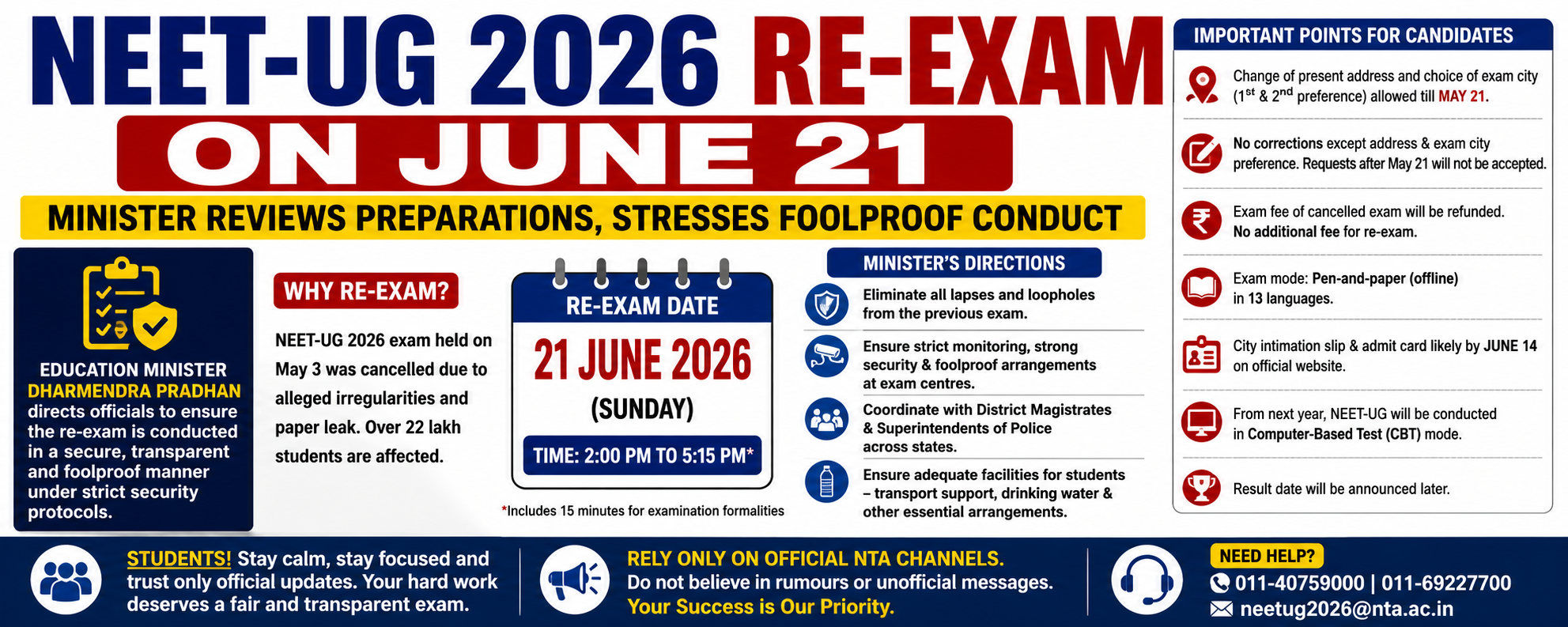
ಕೇಂದ್ರ ಶಿಕ್ಷಣ ಸಚಿವ Dharmendra Pradhan ಅವರು ಜೂನ್ 21, ಭಾನುವಾರ ನಡೆಯಲಿರುವ NEET-UG 2026 ಮರುಪರೀಕ್ಷೆಯ ಸಿದ್ಧತೆಗಳ ಕುರಿತು ಉನ್ನತ ಮಟ್ಟದ ಪರಿಶೀಲನಾ ಸಭೆ ನಡೆಸಿದರು.

ಮೇ 3ರಂದು ನಡೆದ NEET-UG 2026 ಪರೀಕ್ಷೆಯಲ್ಲಿ ಅಕ್ರಮಗಳು ಮತ್ತು ಪ್ರಶ್ನೆಪತ್ರಿಕೆ ಸೋರಿಕೆ ಆರೋಪಗಳು ಕೇಳಿಬಂದ ಹಿನ್ನೆಲೆಯಲ್ಲಿ ಪರೀಕ್ಷೆಯನ್ನು ರದ್ದುಪಡಿಸಲಾಗಿತ್ತು. 22 ಲಕ್ಷಕ್ಕೂ ಹೆಚ್ಚು ವಿದ್ಯಾರ್ಥಿಗಳು ಪರೀಕ್ಷೆ ಬರೆದಿದ್ದರಿಂದ ಮರುಪರೀಕ್ಷೆ ರಾಷ್ಟ್ರಮಟ್ಟದ ಮಹತ್ವ ಪಡೆದಿದೆ.

ಸಚಿವರ ಸ್ಪಷ್ಟ ಸೂಚನೆ: ಯಾವುದೇ ಲೋಪ ಇರಬಾರದು

ಪರಿಶೀಲನಾ ಸಭೆಯಲ್ಲಿ ಸಚಿವರು ಮರುಪರೀಕ್ಷೆಯನ್ನು ಸಂಪೂರ್ಣ ಸುರಕ್ಷಿತ, ಪಾರದರ್ಶಕ ಮತ್ತು ದೋಷರಹಿತವಾಗಿ ನಡೆಸುವಂತೆ ಅಧಿಕಾರಿಗಳಿಗೆ ಸೂಚನೆ ನೀಡಿದರು.

ಹಿಂದಿನ ಪರೀಕ್ಷಾ ಪ್ರಕ್ರಿಯೆಯಲ್ಲಿ ಕಂಡುಬಂದ ಎಲ್ಲಾ ಲೋಪಗಳು ಮತ್ತು ದುರ್ಬಲತೆಗಳನ್ನು ಗುರುತಿಸಿ ಅವನ್ನು ಸಂಪೂರ್ಣವಾಗಿ ನಿವಾರಿಸಬೇಕು ಎಂದು ಅವರು ಒತ್ತಿ ಹೇಳಿದರು.

ಈ ಬಾರಿ ಪರೀಕ್ಷೆಯ ವಿಶ್ವಾಸಾರ್ಹತೆಗೆ ಯಾವುದೇ ರೀತಿಯ ರಾಜಿ ಇರಬಾರದು ಎಂಬುದು ಅವರ ಸಂದೇಶವಾಗಿತ್ತು.

ಪರೀಕ್ಷಾ ಕೇಂದ್ರಗಳಲ್ಲಿ ಕಠಿಣ ಭದ್ರತೆ ಮತ್ತು ಮೇಲ್ವಿಚಾರಣೆ

ಪರೀಕ್ಷಾ ಕೇಂದ್ರಗಳಲ್ಲಿ ಮೇಲ್ವಿಚಾರಣಾ ವ್ಯವಸ್ಥೆಯನ್ನು ಮತ್ತಷ್ಟು ಬಲಪಡಿಸುವಂತೆ ಸಚಿವರು ಸೂಚಿಸಿದರು. ಜೊತೆಗೆ ವಿವಿಧ ರಾಜ್ಯಗಳ ಜಿಲ್ಲಾಧಿಕಾರಿಗಳು ಮತ್ತು ಪೊಲೀಸ್ ಅಧಿಕಾರಿಗಳೊಂದಿಗೆ ಸಮನ್ವಯ ಸಾಧಿಸಲು ಅಧಿಕಾರಿಗಳಿಗೆ ಸೂಚನೆ ನೀಡಿದರು.

ಇದರಿಂದ:

  • ಕೇಂದ್ರ ಮಟ್ಟದಲ್ಲಿ ಬಲವಾದ ಮೇಲ್ವಿಚಾರಣೆ
  • ಕಠಿಣ ಭದ್ರತಾ ತಪಾಸಣೆ
  • ಉತ್ತಮ ಜನಸಂದಣಿ ನಿರ್ವಹಣೆ
  • ಅನುಮಾನಾಸ್ಪದ ಚಟುವಟಿಕೆಗಳಿಗೆ ತ್ವರಿತ ಕ್ರಮ
  • ಪರೀಕ್ಷೆಯ ಸುಗಮ ನಿರ್ವಹಣೆ

ಸಾಧ್ಯವಾಗಲಿದೆ.

ವಿದ್ಯಾರ್ಥಿ ಸೌಲಭ್ಯಗಳ ಮೇಲೂ ಗಮನ

ಭದ್ರತೆಯ ಜೊತೆಗೆ ವಿದ್ಯಾರ್ಥಿಗಳ ಸೌಲಭ್ಯಗಳ ಮೇಲೂ ಸಚಿವರು ಒತ್ತು ನೀಡಿದರು.

ಪರೀಕ್ಷಾ ಕೇಂದ್ರಗಳಲ್ಲಿ ಕೆಳಗಿನ ಮೂಲಭೂತ ಸೌಲಭ್ಯಗಳನ್ನು ಕಲ್ಪಿಸುವಂತೆ ಸೂಚಿಸಲಾಗಿದೆ:

  • ಕುಡಿಯುವ ನೀರು
  • ಸಾರಿಗೆ ವ್ಯವಸ್ಥೆಗೆ ಸಹಾಯ
  • ಅಗತ್ಯ ಸೌಲಭ್ಯಗಳು

ಮೇ 3ರಂದು ಈಗಾಗಲೇ ಪರೀಕ್ಷೆ ಬರೆದಿರುವ ಅನೇಕ ವಿದ್ಯಾರ್ಥಿಗಳು ಮತ್ತೊಮ್ಮೆ ಪ್ರಯಾಣಿಸಬೇಕಾಗಿರುವುದರಿಂದ ಇದು ಮಹತ್ವದ್ದಾಗಿದೆ.

ವಿದ್ಯಾರ್ಥಿಗಳಿಗೆ ಮುಖ್ಯ ಮಾಹಿತಿ

  • NEET-UG 2026 ಮರುಪರೀಕ್ಷೆ: ಜೂನ್ 21, 2026
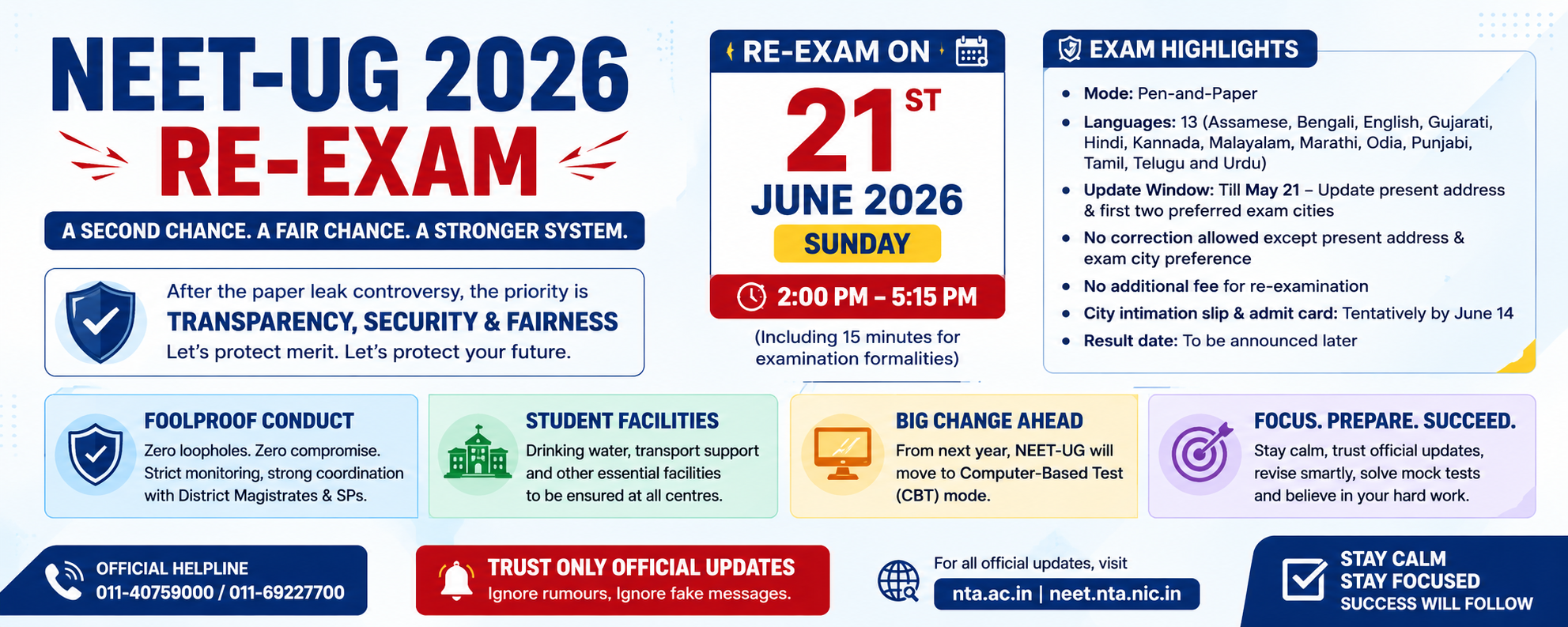
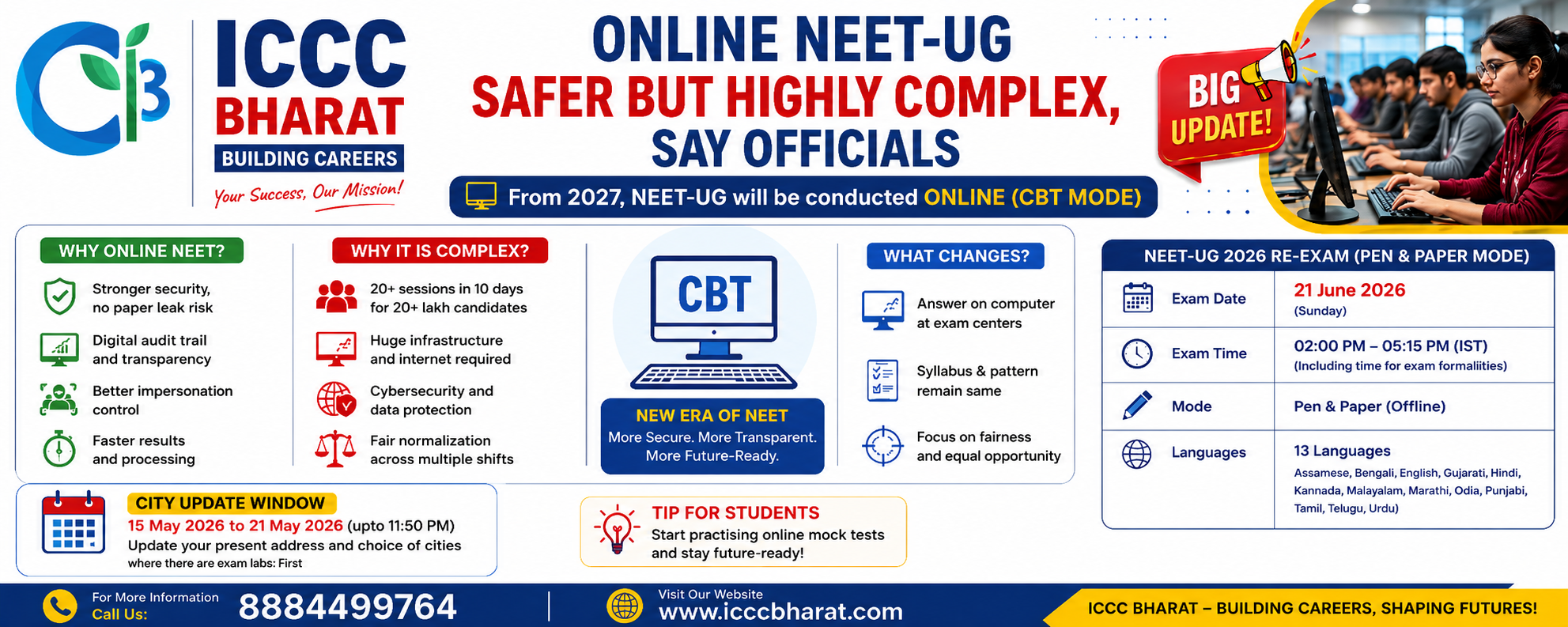
  • ಪರೀಕ್ಷೆ ಸಮಯ: ಮಧ್ಯಾಹ್ನ 2:00 ರಿಂದ ಸಂಜೆ 5:15ರವರೆಗೆ
  • ಪರೀಕ್ಷೆ ಪೆನ್-ಅಂಡ್-ಪೇಪರ್ ವಿಧಾನದಲ್ಲೇ ನಡೆಯಲಿದೆ
  • ಪರೀಕ್ಷೆ 13 ಭಾಷೆಗಳಲ್ಲಿ ನಡೆಯಲಿದೆ: ಅಸ್ಸಾಮಿ, ಬೆಂಗಾಲಿ, ಇಂಗ್ಲಿಷ್, ಗುಜರಾತಿ, ಹಿಂದಿ, ಕನ್ನಡ, ಮಲಯಾಳಂ, ಮರಾಠಿ, ಒಡಿಯಾ, ಪಂಜಾಬಿ, ತಮಿಳು, ತೆಲುಗು ಮತ್ತು ಉರ್ದು
  • ವಿದ್ಯಾರ್ಥಿಗಳು ಮೇ 21ರವರೆಗೆ ತಮ್ಮ ಪ್ರಸ್ತುತ ವಿಳಾಸ ಮತ್ತು ಮೊದಲ ಎರಡು ಪರೀಕ್ಷಾ ನಗರ ಆಯ್ಕೆಗಳನ್ನು ಬದಲಾಯಿಸಬಹುದು
  • ಬೇರೆ ಯಾವುದೇ ತಿದ್ದುಪಡಿಗೆ ಅವಕಾಶ ಇರುವುದಿಲ್ಲ
  • ನಗರ ಆಯ್ಕೆ ಬದಲಾಯಿಸದಿದ್ದರೆ ಹಿಂದಿನ ಆಯ್ಕೆಯೇ ಮುಂದುವರಿಯುತ್ತದೆ
  • ಮರುಪರೀಕ್ಷೆಗೆ ಹೆಚ್ಚುವರಿ ಶುಲ್ಕ ಇರುವುದಿಲ್ಲ
  • ಸಿಟಿ ಇಂಟಿಮೇಷನ್ ಸ್ಲಿಪ್ ಮತ್ತು ಅಡ್ಮಿಟ್ ಕಾರ್ಡ್‌ಗಳು ಜೂನ್ 14ರೊಳಗೆ ಬಿಡುಗಡೆಯಾಗುವ ಸಾಧ್ಯತೆ ಇದೆ
  • ಫಲಿತಾಂಶ ದಿನಾಂಕವನ್ನು ನಂತರ ಪ್ರಕಟಿಸಲಾಗುತ್ತದೆ

ಮುಂದಿನ ವರ್ಷದಿಂದ CBT ಮಾದರಿಯಲ್ಲಿ NEET

ಮುಂದಿನ ವರ್ಷದಿಂದ NEET-UG ಪರೀಕ್ಷೆಯನ್ನು ಕಂಪ್ಯೂಟರ್ ಆಧಾರಿತ ಪರೀಕ್ಷೆ (CBT) ವಿಧಾನದಲ್ಲಿ ನಡೆಸಲಾಗುವುದು ಎಂದು NTA ತಿಳಿಸಿದೆ.

ಇದರಿಂದ:

  • ಪರೀಕ್ಷಾ ಭದ್ರತೆ ಹೆಚ್ಚಾಗುವುದು
  • ಪ್ರಶ್ನೆಪತ್ರಿಕೆ ನಿರ್ವಹಣೆಯ ಅಪಾಯ ಕಡಿಮೆಯಾಗುವುದು

ಆದರೆ ಗ್ರಾಮೀಣ ಹಾಗೂ ಆರ್ಥಿಕವಾಗಿ ಹಿಂದುಳಿದ ವಿದ್ಯಾರ್ಥಿಗಳಿಗೆ ಸಮಾನ ಅವಕಾಶ ಕಲ್ಪಿಸಲು ಉತ್ತಮ ಡಿಜಿಟಲ್ ಮೂಲಸೌಕರ್ಯ ಅಗತ್ಯವಿದೆ.

ವಿದ್ಯಾರ್ಥಿಗಳಿಗೆ ಸಂದೇಶ

ಈ ಮರುಪರೀಕ್ಷೆ ಪ್ರಾಮಾಣಿಕ ವಿದ್ಯಾರ್ಥಿಗಳಿಗೆ ಶಿಕ್ಷೆಯಲ್ಲ; ಇದು ಮೆರಿಟ್, ನ್ಯಾಯ ಮತ್ತು ಶ್ರಮದ ಮೌಲ್ಯವನ್ನು ಕಾಪಾಡುವ ಎರಡನೇ ಅವಕಾಶವಾಗಿದೆ.

ವಿದ್ಯಾರ್ಥಿಗಳು ಆತಂಕಕ್ಕೊಳಗಾಗದೆ:

  • ಪುನರವಲೋಕನಕ್ಕೆ ಗಮನ ನೀಡಿ
  • ಮಾಕ್ ಟೆಸ್ಟ್‌ಗಳನ್ನು ಅಭ್ಯಾಸ ಮಾಡಿ
  • NCERT ಪರಿಕಲ್ಪನೆಗಳನ್ನು ಬಲಪಡಿಸಿ
  • ಸಮಯ ನಿರ್ವಹಣೆಗೆ ಆದ್ಯತೆ ನೀಡಿ

ಅಂತಿಮ ಸಲಹೆ

ವಿದ್ಯಾರ್ಥಿಗಳು ಮತ್ತು ಪೋಷಕರು ಅಧಿಕೃತ NTA ಮಾಹಿತಿಯನ್ನೇ ನಂಬಬೇಕು.

ಸಾಮಾಜಿಕ ಜಾಲತಾಣಗಳಲ್ಲಿನ:

  • ವದಂತಿಗಳು
  • ನಕಲಿ ಅಡ್ಮಿಟ್ ಕಾರ್ಡ್ ಮಾಹಿತಿ
  • ಅನಧಿಕೃತ ಸಂದೇಶಗಳು

ಇವನ್ನೆಲ್ಲ ನಿರ್ಲಕ್ಷಿಸಿ.

ಸಹಾಯಕ್ಕಾಗಿ:

011-40759000 / 011-69227700
Email: neetug2026@nta.ac.in

ಸಮಾರೋಪ

NEET-UG 2026 ಮರುಪರೀಕ್ಷೆ ಈಗ ವಿದ್ಯಾರ್ಥಿಗಳಿಗೆ ಮಾತ್ರವಲ್ಲ, ಪರೀಕ್ಷಾ ವ್ಯವಸ್ಥೆಗೂ ಒಂದು ದೊಡ್ಡ ಪರೀಕ್ಷೆಯಾಗಿದೆ. ಪ್ರಶ್ನೆಪತ್ರಿಕೆ ಸೋರಿಕೆ ವಿವಾದದ ನಂತರ ಸರ್ಕಾರ ಮತ್ತು NTA ಮೇಲೆ ಪಾರದರ್ಶಕತೆ, ಹೊಣೆಗಾರಿಕೆ ಮತ್ತು ಭದ್ರತೆಯೊಂದಿಗೆ ಪರೀಕ್ಷೆ ನಡೆಸುವ ಒತ್ತಡ ಹೆಚ್ಚಾಗಿದೆ.

ವಿದ್ಯಾರ್ಥಿಗಳಿಗೆ ಉತ್ತಮ ತಂತ್ರ ಒಂದೇ: ಶಾಂತವಾಗಿರಿ, ಅಧಿಕೃತ ಮಾಹಿತಿಯನ್ನೇ ನಂಬಿ ಮತ್ತು ಜೂನ್ 21ರ ಪರೀಕ್ಷೆಗೆ ಸಂಪೂರ್ಣ ಶಿಸ್ತಿನಿಂದ ಸಿದ್ಧರಾಗಿ.

NEET-UG 2026 Re-Exam on June 21: Education Minister Reviews Preparations, Calls for Foolproof Conduct

Union Education Minister Dharmendra Pradhan chaired a high-level review meeting on preparations for the NEET-UG 2026 re-examination, which is scheduled to be conducted on June 21, Sunday.

The meeting was held at a crucial time, as the earlier NEET-UG 2026 examination conducted on May 3 was cancelled following allegations of irregularities and paper leak. More than 22 lakh students had appeared for the exam, making the re-exam a matter of national importance.

Minister Stresses Zero Loopholes

During the review meeting, the Education Minister directed officials to ensure that the re-examination is conducted in a completely secure, transparent and foolproof manner.

He emphasised that all lapses and loopholes noticed in the earlier examination process must be identified and eliminated before the re-test.

The message was clear: this time, there should be no compromise on examination integrity.

Strict Security and Monitoring at Exam Centres

The Minister instructed officials to strengthen monitoring systems at examination centres. He also asked authorities to coordinate with District Magistrates and Superintendents of Police across states to ensure smooth and secure arrangements.

This coordination is expected to help in:

  • stronger centre-level supervision
  • strict security checks
  • better crowd management
  • quick response to suspicious activity
  • smooth conduct of the examination

Student Facilities Also Discussed

Apart from security, the Minister also focused on student convenience. Officials have been asked to ensure basic facilities at examination centres, including drinking water, transportation support and other essential arrangements.

This is important because many students will again have to travel for the re-exam after already appearing once on May 3.

Important Points for Students

The NEET-UG 2026 re-exam will be held on June 21, 2026.

The exam timing will be 2:00 PM to 5:15 PM, including 15 minutes for examination formalities.

The exam will continue in pen-and-paper mode.

It will be conducted in 13 languages: Assamese, Bengali, English, Gujarati, Hindi, Kannada, Malayalam, Marathi, Odia, Punjabi, Tamil, Telugu and Urdu.

Candidates can update their present address and first two preferred exam cities through the official NEET/NTA portal till May 21.

No correction will be allowed except present address and exam city preference.

Candidates who do not change their city preference will retain their earlier selected cities.

No additional fee will be charged for the re-examination.

City intimation slips and admit cards are expected to be released later on the official website, tentatively by June 14.

The result declaration date will be announced later.

NEET to Move to CBT Mode from Next Year

NTA has also announced that from next year, NEET-UG will be conducted in Computer-Based Test mode. This move is expected to improve examination security and reduce risks linked to physical question paper handling.

However, the shift to CBT will require strong digital infrastructure, proper planning and fair access for rural and economically weaker students.

Strong Line for Students

Students should remember: this re-exam is not a punishment for honest candidates; it is a second chance to protect merit, fairness and the value of hard work.

At this stage, students must avoid panic and focus on revision, mock tests, NCERT concepts and time management.

Final Advice

Students and parents should rely only on official NTA communication channels. Social media rumours, fake admit card updates and unofficial exam-related messages should be ignored.

For clarification, candidates can contact the official helpline numbers:

011-40759000 / 011-69227700
Email: neetug2026@nta.ac.in

Conclusion

The NEET-UG 2026 re-exam is now a test not only for students but also for the examination system. After the paper leak controversy, the government and NTA are under pressure to conduct the exam with absolute transparency, accountability and security.

For students, the best strategy is simple: stay calm, trust only official updates and prepare with full discipline for June 21

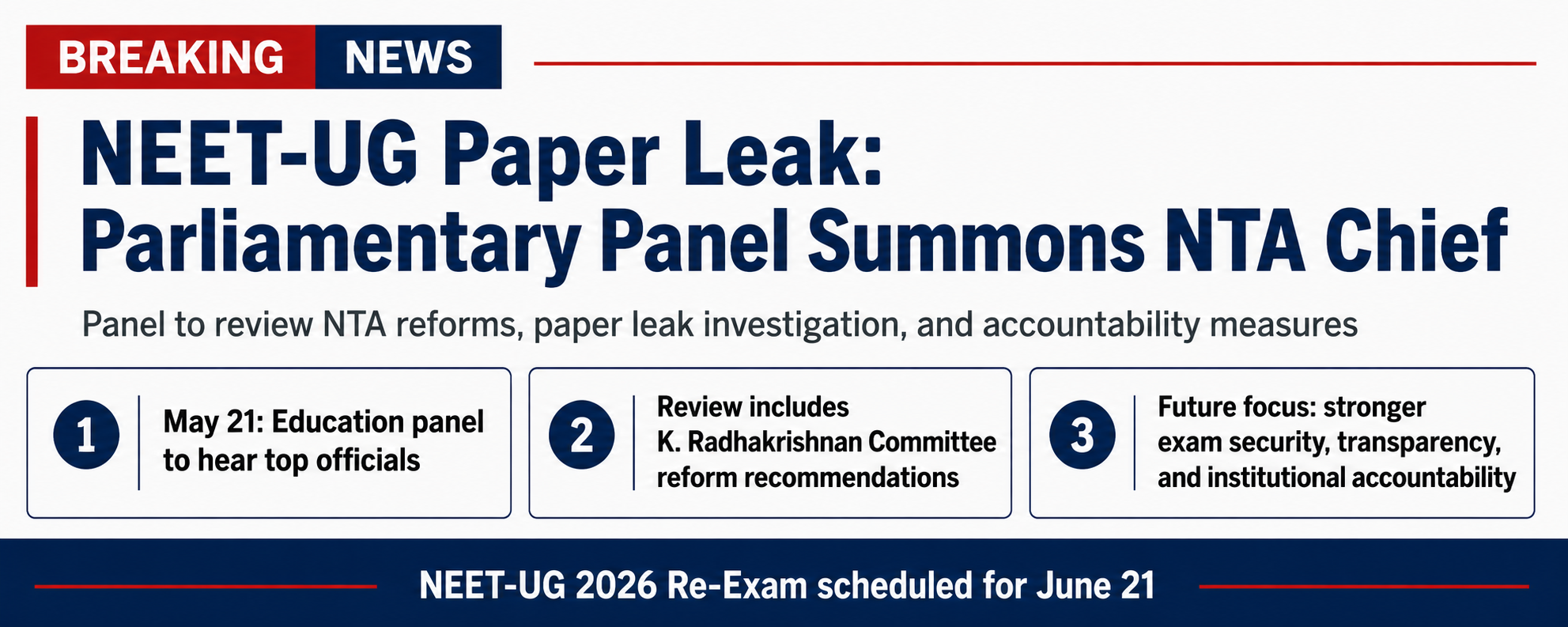
NEET-UG पेपर लीक प्रकरण: संसदीय समितिले NTA प्रमुखलाई बोलायो

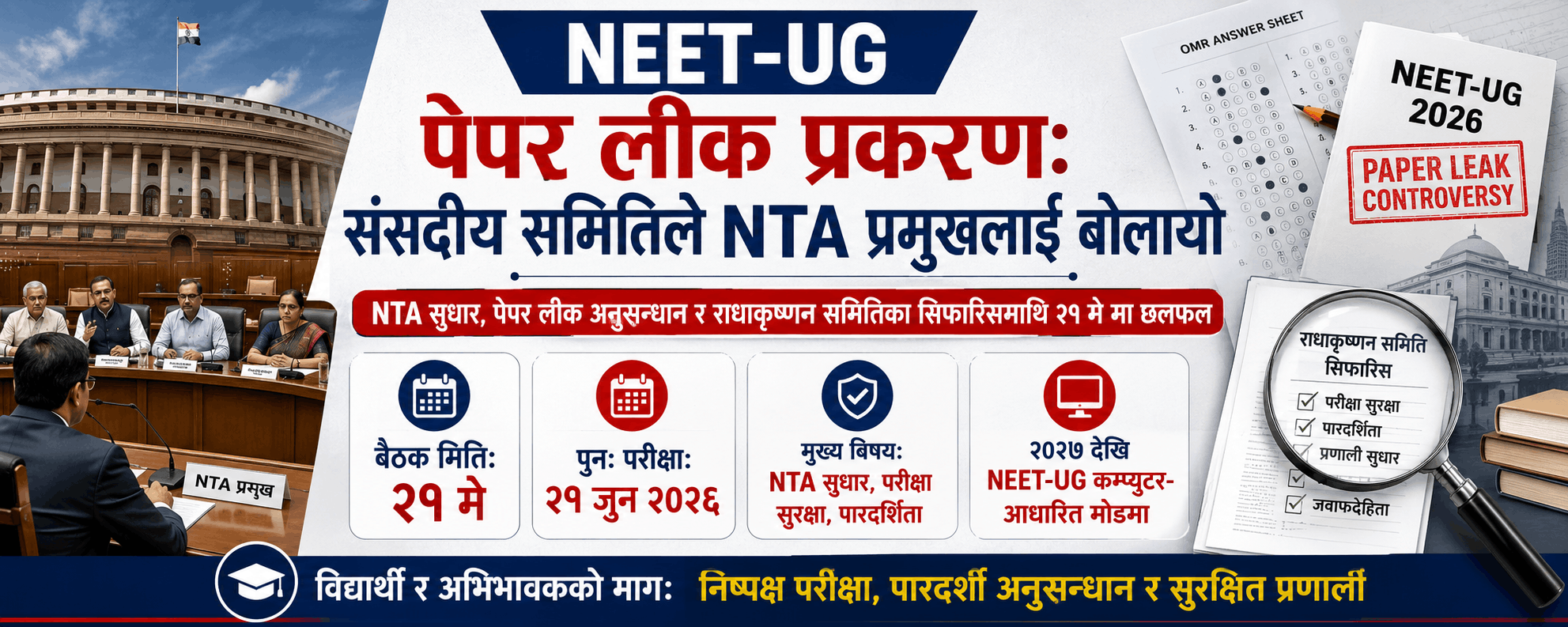
NEET-UG 2026 पेपर लीक विवाद अब संसदीय समितिसम्म पुगेको छ। राष्ट्रिय परीक्षा एजेन्सी अर्थात् NTA को कार्यप्रणाली, परीक्षा सुधार र पेपर लीक प्रकरणको अनुसन्धानबारे छलफल गर्न संसदीय स्थायी समितिले NTA अध्यक्ष प्रदीप कुमार जोशी र शिक्षा मन्त्रालयका वरिष्ठ अधिकारीहरूलाई बोलाएको छ।

यो बैठक २१ मे मा प्रस्तावित छ, जहाँ NEET-UG 2026 पेपर लीक प्रकरण, NTA सुधार र के. राधाकृष्णन समिति का सिफारिसहरूको कार्यान्वयनबारे छलफल हुनेछ।

कुन अधिकारीहरूलाई बोलाइएको छ?

संसदीय स्थायी समितिले शिक्षा मन्त्रालयअन्तर्गत उच्च शिक्षा विभागका सचिव विनीत जोशी र NTA अध्यक्ष प्रदीप कुमार जोशी लाई छलफलका लागि बोलाएको छ।

यो समितिको अध्यक्षता कांग्रेस नेता दिग्विजय सिंह ले गरिरहेका छन्।

बैठकको मुख्य एजेन्डा

समितिले मुख्य रूपमा यी विषयहरूमा छलफल गर्नेछ:

NEET-UG 2026 पेपर लीक प्रकरणको वर्तमान अवस्था

NTA सुधारको प्रगति

के. राधाकृष्णन समितिका सिफारिसहरूको कार्यान्वयन

परीक्षा प्रणालीको पारदर्शिता र सुरक्षा

भविष्यमा यस्ता घटना रोक्ने रणनीति

यो बैठक किन महत्त्वपूर्ण छ?

NEET-UG 2026 परीक्षा ३ मे मा सञ्चालन गरिएको थियो, तर पेपर लीक र अनियमितताको आरोपपछि परीक्षा रद्द गरिएको थियो। करिब २३ लाख उम्मेदवारहरूले यस परीक्षाका लागि दर्ता गरेका थिए।

NTA का अनुसार, परीक्षापछि ७ मे साँझ कथित गडबडीबारे जानकारी प्राप्त भएको थियो। त्यसपछि विषय गम्भीर बनेको र अन्ततः परीक्षा रद्द गर्ने निर्णय गरिएको थियो।

अब NEET-UG 2026 को पुनः परीक्षा २१ जुन मा सञ्चालन गरिनेछ।

2027 देखि NEET अनलाइन मोडमा

शिक्षामन्त्री धर्मेन्द्र प्रधान ले हालै घोषणा गरेका छन् कि NEET-UG लाई आगामी वर्ष अर्थात् 2027 देखि कम्प्युटर आधारित परीक्षा मोड मा लगिनेछ। यसको उद्देश्य पेपर लीकजस्ता घटनाहरू रोक्नु र परीक्षा प्रणालीलाई अझ सुरक्षित तथा पारदर्शी बनाउनु हो।

NTA सुधारमाथि ठूलो प्रश्न

पेपर लीक विवादपछि NTA को आन्तरिक व्यवस्था, कर्मचारी अभाव, आउटसोर्सिङमा निर्भरता र जवाफदेहितामाथि गम्भीर प्रश्न उठेका छन्।

के. राधाकृष्णन समितिले पहिले नै NTA लाई मजबुत बनाउने, स्थायी कर्मचारी नियुक्त गर्ने, निगरानी सुधार गर्ने र परीक्षा सुरक्षा प्रणालीलाई स्तरोन्नति गर्ने सिफारिस गरेको थियो। अब संसदीय समिति यी सुधारहरूमा कति प्रगति भयो भन्ने हेर्न चाहन्छ।

AI र शिक्षाबारे पनि छलफल

NEET र NTA सम्बन्धी मुद्दाबाहेक समितिले शिक्षामा कृत्रिम बुद्धिमत्ता अर्थात् AI को प्रभाव र विद्यार्थीहरूको रोजगारी क्षमता बढाउने रणनीतिबारे पनि छलफल गर्नेछ। यसका लागि Anthropic India, Pratham, IIT Kanpur, Infosys र IIT Madras का प्रतिनिधिहरूलाई पनि बोलाइएको छ।

निष्कर्ष

NEET-UG 2026 पेपर लीक प्रकरण अब केवल परीक्षा सम्बन्धी विवाद मात्र रहेन। यो देशको परीक्षा प्रणालीको विश्वसनीयता, विद्यार्थीहरूको विश्वास र संस्थागत जवाफदेहितासँग जोडिएको ठूलो विषय बनेको छ।

संसदीय समितिले NTA प्रमुख र शिक्षा मन्त्रालयका अधिकारीहरूलाई बोलाउनु परीक्षा सुधारबारे गम्भीर छलफल आवश्यक भएको संकेत हो।

विद्यार्थी र अभिभावकहरूको सबैभन्दा ठूलो माग यही हो कि परीक्षा निष्पक्ष होस्, अनुसन्धान पारदर्शी होस्, र भविष्यमा कुनै मेहनती विद्यार्थीको सपना पेपर लीक वा प्रणालीको कमजोरीका कारण नटुटोस्।

NEET-UG Paper Leak: Parliamentary Panel Summons NTA Chief, Review of Reforms and Accountability Begins

The NEET-UG 2026 paper leak controversy has now reached a serious parliamentary review stage. The Parliamentary Standing Committee on Education, Women, Children, Youth and Sports has summoned National Testing Agency Chairperson Pradeep Kumar Joshi and senior officials from the Education Ministry for deliberations on the alleged paper leak and the implementation of reforms in NTA.

The committee, headed by Congress leader Digvijaya Singh, is expected to seek the views of top officials on May 21. The officials summoned include Secretary, Department of Higher Education, Ministry of Education, Vineet Joshi, and NTA Chairperson Pradeep Kumar Joshi.

Why the Parliamentary Panel Has Stepped In

The NEET-UG 2026 examination held on May 3 was cancelled after allegations of paper leak and examination irregularities. According to reports, nearly 23 lakh candidates had registered for the test, making it one of India’s largest entrance examinations.

The NTA reportedly received information about alleged malpractice on the evening of May 7, four days after the exam. The examination was later cancelled, and the re-exam has been scheduled for June 21.

Now, the parliamentary panel will examine whether reforms recommended earlier were properly implemented and whether NTA had enough safeguards to prevent such a breach.

Review of K. Radhakrishnan Committee Recommendations

One of the key agenda points is the implementation of the K. Radhakrishnan Committee report on NTA reforms. The committee was formed after earlier examination controversies and had recommended stronger systems to improve the credibility, security and accountability of national-level testing.

Reports have raised concerns that many recommended reforms were still not fully implemented when the NEET-UG 2026 controversy occurred. This makes the parliamentary review important not only for fixing responsibility but also for preventing future examination failures.

Legal and Administrative Importance

This summons is not merely a routine meeting. It carries legal and administrative significance because the committee may seek explanations on:

  • why the leak was not prevented,
  • whether internal controls were adequate,
  • whether NTA followed recommended reforms,
  • whether there were lapses in paper security,
  • whether senior officials acted promptly after receiving alerts,
  • and what structural reforms are needed before future examinations.

The parliamentary panel can also record observations that may influence future policy, administrative accountability and examination reform.

Future Implications for NEET and NTA

The outcome of this review may have long-term implications for NEET and other national entrance examinations.

First, NTA may face stronger scrutiny over its internal structure, staffing pattern, outsourcing model and security mechanisms. If weaknesses are found, the agency may be pushed toward major restructuring.

Second, paper-setting, moderation, printing, digital storage, transport and exam centre protocols may be reviewed in detail. Every stage of the examination chain could come under stricter monitoring.

Third, the proposed shift of NEET-UG to computer-based mode from 2027 may receive greater urgency. Education Minister Dharmendra Pradhan has announced that NEET-UG will move to CBT mode from next year, but such a transition will require strong infrastructure, cybersecurity and fairness safeguards.

Fourth, students may see more transparency in exam-city allotment, admit card systems, question paper security and grievance redressal.

Why This Matters for Students

For students, this issue is not political. It is personal.

NEET is connected to years of preparation, family sacrifice and the dream of becoming a doctor. When a paper leak happens, it does not only cancel an exam. It breaks the confidence of honest students.

The parliamentary panel’s review should therefore focus on student protection, not only administrative explanation.

Students need:

  • a fair re-exam,
  • clear official communication,
  • timely admit cards,
  • safe exam centres,
  • strict action against guilty persons,
  • and a stronger system for future batches.

Larger Reform Question

The NEET-UG 2026 controversy has exposed a deeper question: Can India continue to conduct exams involving more than 20 lakh candidates without a fully secure, transparent and accountable institutional structure?

If the answer is no, then reforms must go beyond temporary damage control.

India needs a modern examination system with permanent expert staff, strong technology, independent audits, secure paper-setting mechanisms, cybersecurity protocols, transparent accountability and fast legal action against malpractice networks.

Conclusion

The parliamentary panel’s decision to summon the NTA chief and senior Education Ministry officials is a major development in the NEET-UG 2026 paper leak case.

This review must not become only a formal discussion. It should lead to real reform, clear accountability and stronger protection for students.

The future implication is clear: India’s examination system must move from reaction after failure to prevention before failure.

For lakhs of NEET aspirants, the message should be simple — their hard work must be protected by a system that is fair, secure and accountable.

How One Teacher Helped Expose the NEET-UG 2026 Paper Leak

The NEET-UG 2026 paper leak case has hurt lakhs of students and parents across India. Students who studied day and night, stayed away from home, spent years in coaching, and gave the exam with hope suddenly had to face uncertainty again.

But in the middle of this controversy, one teacher from Sikar, Rajasthan, showed courage and responsibility.

After the NEET-UG exam was held on May 3, a PDF started circulating among some students and coaching circles. At first, it looked like a normal “guess paper.” But when a chemistry teacher saw it, he felt something was wrong.

He started comparing the PDF with the actual NEET question paper. Slowly, he found that many questions were matching. He checked again and again. Then he called a biology teacher and both of them compared the questions through the night.

By midnight, they felt that this was not just a guess paper. It looked like the paper had been leaked.

The teacher did not ignore it. Around 12:30 AM on May 4, he went to the police station to file a complaint. He was told to come back with proper evidence. So he continued working. He collected screenshots, matched questions, prepared proof, and later informed NTA and investigating agencies.

This was not an easy step. Speaking against a possible paper leak means pressure, fear and responsibility. But the teacher said he could not stay silent because lakhs of hardworking students were involved.

For students, NEET is not just an exam. It is years of sacrifice. Parents spend their savings. Students leave their homes. Many give two or three years only for this one dream. When a paper leak happens, it breaks their confidence and faith in the system.

That is why this teacher’s step matters.

This case also reminds us that every coaching city or every student should not be blamed. Sikar has many hardworking students and sincere teachers. If some people did wrong, the investigation should identify them and punish them. But honest students and teachers should not be treated with suspicion.

The real issue is exam security. How did the paper reach outside? Who shared it? Who benefited? Who failed to protect the exam? These questions need honest answers.

The NEET-UG 2026 paper leak case is painful for students, but it also shows that one honest person can make a big difference. A teacher saw something wrong, checked the facts, collected proof and spoke up.

Now the system must do its duty.

The guilty should be punished. The exam process should be made stronger. Students should get justice. And most importantly, honest students should never feel that their hard work has less value than money or cheating.

NEET should test knowledge, not connections. It should reward hard work, not shortcuts.

NTA Staff Shortage Is Only One Symptom: India Needs Urgent Reform in Medical Examination and Counselling Bodies

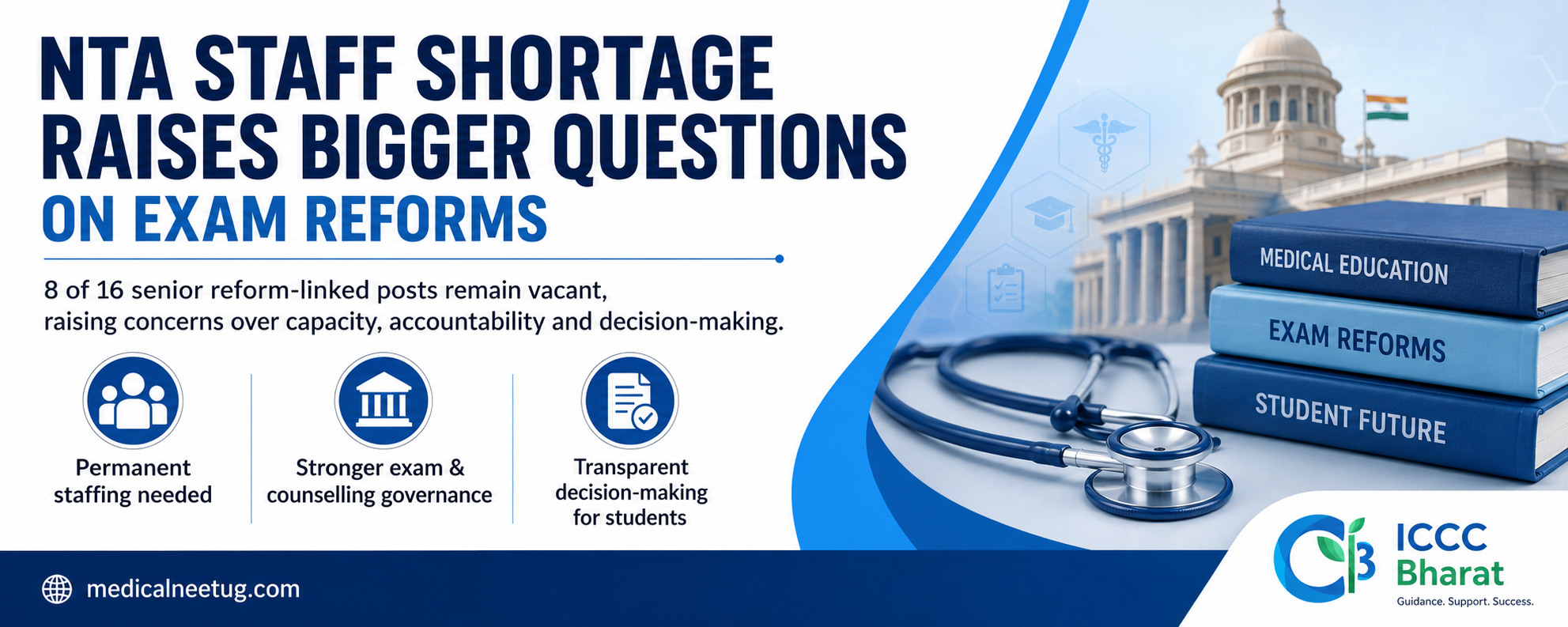
The ongoing NEET paper leak controversy has once again exposed a serious problem inside India’s examination system. Reports suggest that even after reforms were recommended, several senior posts inside the National Testing Agency remain vacant. This raises a very important question: how can an agency responsible for lakhs of students conduct high-stakes examinations without enough permanent, experienced and accountable officers?

But this problem is not limited to NTA alone.

The same weakness can be seen in several important medical education and admission bodies. Whether it is NTA, NBE, NMC, MCC or other counselling-related authorities, the larger problem is the same: shortage of permanent staff, weak institutional structure, lack of accountability, delayed decision-making and absence of experienced professionals in key positions.

The Problem Is Not Only Paper Leak

A paper leak is only the visible part of a deeper crisis. The real issue is structural failure.

When senior posts remain vacant, when important departments depend heavily on contractual or temporary staff, when the same limited group of people handle multiple responsibilities, and when there is no strong decision-making system, mistakes become unavoidable.

Students suffer because:

  • exam schedules become uncertain,
  • counselling gets delayed,
  • seat matrices are uploaded with confusion,
  • grievances are not answered properly,
  • important decisions are postponed,
  • seats remain vacant,
  • and students lose trust in the system.

Medical Counselling Also Needs Reform

Every year, medical counselling faces serious problems. Students and parents struggle with unclear rules, late updates, confusing seat matrices, sudden changes, poor communication and delayed responses.

MCC and state counselling systems must become more transparent and professionally managed. When thousands of MBBS, MD, MS, BDS and other medical seats are at stake, there must be a proper permanent structure, trained manpower and accountable officers.

India cannot afford a system where students keep sending complaints and receive only standard replies without real resolution.

Vacant Seats Are Not Only Because of High Fees

Many officials often say that seats remain vacant only because medical college fees are high. But this is not the full truth.

High fees are one problem, but poor counselling management is also a major reason.

If seat matrices are unclear, if counselling rounds are not planned properly, if decision-makers delay action, if vacant seats are not handled in time, and if student grievances are ignored, then seats will naturally remain vacant.

When thousands of PG seats remain vacant, it is not just a financial issue. It is also an administrative failure.

India Has Enough Talent — But Is It Being Used?

India has experienced doctors, medical education experts, administrators, counsellors, legal experts, data analysts and examination professionals across the country. The question is: why are such people not being brought into the system?

Appointments should not depend on lobbying, influence or repeated internal circulation of the same people. Key positions must be filled based on:

  • track record,
  • experience,
  • honesty,
  • subject knowledge,
  • administrative ability,
  • technology understanding,
  • and commitment to students.

A country of 140 crore people cannot say that it does not have competent professionals to manage national examinations and medical counselling.

Honest Officers Must Be Protected

Another major concern is that honest and capable people often do not want to enter such systems because the structure is weak, political pressure is high and accountability is selective.

If honest officers are discouraged and only convenient people remain in positions, the system will continue to weaken.

India needs a structure where good people are invited, respected, protected and allowed to work independently.

What Reforms Are Needed?

The government must urgently consider major reforms in medical examination and counselling bodies.

There should be permanent senior-level appointments in NTA, NBE, NMC, MCC and related bodies.

There should be independent audit of examination and counselling processes.

Seat matrix publication must be transparent, verified and time-bound.

Counselling software, data handling and grievance redressal must be professional.

Every important decision must have a responsible officer.

Student complaints should not be closed with routine replies.

Vacant seats must be reviewed in real time.

Medical fee approvals and seat matrix permissions must be strictly monitored.

There should be a national-level reform committee with experienced doctors, administrators, legal experts, counselling experts and technology professionals.

Government Must Act Before the System Collapses

The current situation is a warning. Students are losing faith. Parents are frustrated. Courts are repeatedly being approached. Seats are being wasted. Exams are being questioned. Counselling credibility is being damaged.

This is not the time for cosmetic changes. This is the time for hard decisions.

The government must stop treating each controversy as an isolated event. NEET paper leak, vacant PG seats, counselling confusion, fee issues, seat matrix errors and delayed responses are all connected to one bigger problem: weak governance in medical education administration.

Final Opinion

India’s medical education system needs urgent structural reform.

NTA’s staff shortage is only one part of the story. The same problem exists in examination bodies, counselling bodies and regulatory systems. Without permanent staff, competent leadership, transparent appointments and real accountability, students will continue to suffer.

Medical admission is not a small administrative process. It decides the future of lakhs of students and the future of healthcare in India.

The government must act now — not after another scam, not after another court case, not after another batch of seats goes vacant.

India needs strong institutions, honest decision-makers and transparent counselling systems. Without that, no reform will be complete.