Navigating the Maze: Top 9 Mistakes Parents Make During MBBS Counselling

The journey to wearing a white coat doesn’t end when the NEET exam concludes. In fact, for most families, the most stressful phase is just beginning. While your child did the heavy lifting by spending months studying, navigating the complex, bureaucratic maze of MBBS seat allotment falls heavily on the shoulders of parents.

Every year, thousands of brilliant, high-scoring candidates miss out on excellent medical seats simply because of strategic errors made during the choice-filling and registration periods. To help families make informed decisions, ICCC Bharat (Indian Career Counselling Council) has compiled the definitive guide to the top nine most common pitfalls parents must avoid to secure their child’s medical future.

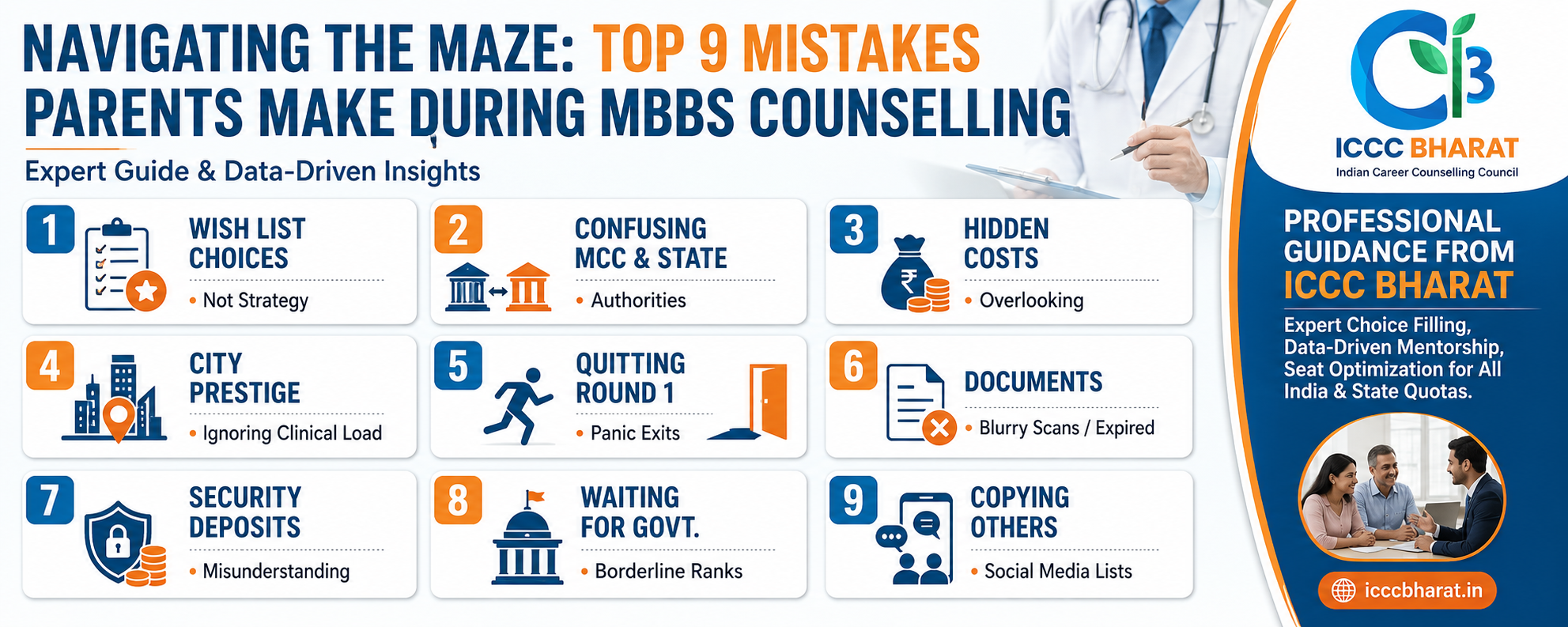
1. Treating Choice Filling Like a “Wish List” Instead of a Strategy

Many parents sit down to fill out college preferences and list only the top 5 or 10 most famous medical colleges (like AIIMS or premier government institutions) without realistically evaluating their child’s actual rank.

  • The Risk: If your child’s rank doesn’t match those ultra-competitive cut-offs, they will receive zero allotments in Round 1, leading to immense panic.
  • The Fix: Create a balanced structure. Fill a robust list of choices ranging from dream colleges to safe, realistic backups based entirely on previous years’ closing ranks.

2. Misunderstanding Multiple Counselling Authorities

Assuming one central website handles all medical seats is a common pitfall. Parents often register on the Medical Counselling Committee (MCC) portal and assume they are covered for everything.

  • The Split: The MCC handles only the 15% All India Quota (AIQ), Central Universities, and Deemed Universities.
  • State Authorities: The remaining 85% of state government seats and private college seats are handled individually by each state’s respective selection committee (e.g., KEA in Karnataka, BCECEB in Bihar). You must register separately on state portals to be eligible for state quota seats.

3. Overlooking Total Course Cost (Hidden Fees)

When evaluating private or deemed medical colleges, parents frequently look only at the annual tuition fee and assume the total cost is just that amount multiplied by five.

  • The Trap: They overlook mandatory hidden costs: hostel fees, mess charges, mandatory university exam fees, caution deposits, and development fees. Always check the official fee structure document on the specific counselling authority’s website to calculate the absolute total cost for the 5.5-year duration.

4. Ignoring Clinical Load in Favor of “City Prestige”

It’s easy to pick a college because it has a beautiful modern campus, is located in a major metropolitan city, or offers a shiny new infrastructure.

Expert Insight: Medicine is learned at the bedside, not just in classrooms. An older government or private hospital with a massive patient load and a bustling Outpatient Department (OPD) will produce a far more competent doctor than a corporate-style college with empty hospital beds.

5. Quitting the Counselling Process After Round 1

If a student doesn’t get a seat—or gets a subpar college—in the initial round, anxious parents often panic and pull out of the process entirely, or rush to look for unapproved, expensive alternatives.

  • The Strategy: The MBBS seat matrix is incredibly dynamic. Thousands of seats open up or get upgraded in Round 2, the Mop-Up Round, and the Stray Vacancy Round as students switch between AIQ and State quotas. Staying patient and strategically participating in later rounds frequently yields much better colleges.

6. Submitting Blurry Scans and Expired Documentation

Document verification is ruthless. Uploading a blurry photo taken from a smartphone, an incorrect file format, or an expired certificate can lead to instant disqualification.

  • The Check: Ensure caste (OBC-NCL, SC, ST), EWS, or domicile certificates are issued within the exact timeline specified in the current year’s counselling brochure. Keep digital folders cleanly organized, and have multiple physical copies of the NEET admit card, scorecard, 10th/12th marksheets, and identity proofs ready.

7. Misunderstanding Security Deposit Refund Rules

MBBS counselling involves substantial security deposits—ranging from ₹10,000 for government colleges to ₹2 Lakhs or more for Deemed Universities. Many parents lose this money because they don’t read the exit rules.

  • The Rule: In many counselling formats, if a seat is allotted to you in Round 2 and you fail to join or report to that college, your security deposit is forfeited. Never fill in a choice for a college your child has absolutely no intention of joining.

8. Waiting Exclusively for a Government Seat on a Borderline Rank

Holding onto hope for a government seat when a child’s score is exactly on the previous year’s cut-off line is emotionally exhausting and tactically dangerous.

  • The Mistake: By the time a parent accepts that a government seat isn’t happening, the best affordable seats in reputed private medical colleges have already been snapped up in the early rounds. Always run a parallel backup plan if your child’s score is on the borderline.

9. Copying Preferences from Friends or Social Media

Every student’s rank, category reservation, financial budget, and geographic preference are entirely unique. Relying on a “master preference list” forwarded on WhatsApp or blindly copying what a neighbor is doing can ruin your child’s specific advantages. Your strategy must be completely tailored to your child’s exact All India Rank (AIR) and category matrix.

🩺 Professional Guidance from ICCC Bharat

Navigating the high-stakes world of medical admissions requires absolute precision. ICCC Bharat (Indian Career Counselling Council) provides expert, data-driven mentorship to help parents and students seamlessly navigate choice filling, document verification, and seat optimization across both All India and State quotas. Protect your child’s hard work with verified, professional counselling strategies.

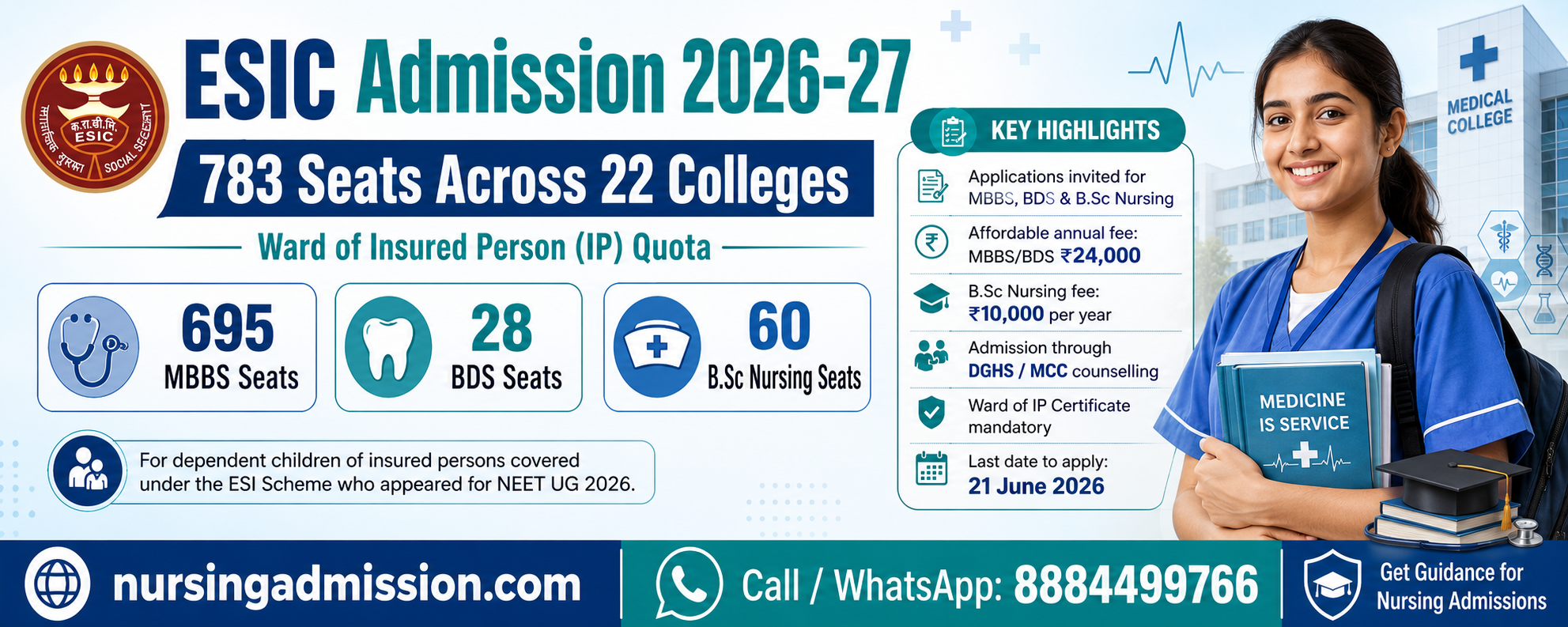
ESIC IP Quota Admission 2026-27: 783 Seats for MBBS, BDS and B.Sc Nursing Across 22 Colleges

The Employees’ State Insurance Corporation, popularly known as ESIC, has invited applications for admission to MBBS, BDS and B.Sc Nursing courses for the academic session 2026-27 under the Ward of Insured Person (IP) quota. This scheme is specially meant for dependent children of workers covered under the Employees’ State Insurance Scheme.

Under this quota, ESIC has provisionally earmarked 783 seats across 22 medical, dental and nursing institutions in India. Out of these, 695 seats are for MBBS, 28 seats are for BDS, and 60 seats are for B.Sc Nursing. These seats are available in ESIC medical colleges and selected government institutions where seats have been reserved for eligible wards of insured persons.

Admission of Ward of Insured Person (IP) in UG (MBBS/BDS/BSc Nursing) courses in ESIC Education Institutions and some Government Medical Colleges under Seats Allocated for Ward of IP for Academic Session 2026–27 – Revised Schedule of Activities. – PDF

📷 size:(773.42 KB) .

Affordable Medical Education for ESIC Beneficiaries

The biggest advantage of the ESIC Ward of IP quota is affordable medical education. Students admitted under this quota can study MBBS or BDS with an annual tuition fee of ₹24,000, while B.Sc Nursing students will have to pay ₹10,000 per year. As per the admission information, no capitation fee or donation is permitted under this scheme.

This makes the ESIC IP quota one of the most valuable opportunities for eligible families, especially for students who want to pursue medical, dental or nursing education at a reasonable cost.

Who Can Apply?

To apply under the ESIC Ward of IP quota, the candidate must be the dependent child of an insured person registered under the ESI Act. The parent should have been an active contributor to the ESI Scheme as on 30 September 2025. The candidate must also have appeared for NEET UG 2026 and should fulfil the eligibility criteria prescribed by the relevant authorities.

A Ward of IP Certificate issued by ESIC is mandatory for admission under this quota. Without this certificate, candidates cannot claim seats under the ESIC IP quota. The application process for the certificate is online through the ESIC portal.

Last Date to Apply

Eligible candidates must apply online for the Ward of IP Certificate before the last date. As per the latest update, the last date to apply for the certificate is 21 June 2026. After receiving the certificate, candidates must separately register on the MCC portal to participate in the centralized counselling process.

Admissions under this quota will be conducted through the centralized counselling process managed by the Directorate General of Health Services (DGHS). Candidates should regularly check the official ESIC and MCC portals for updates related to certificate approval, registration, choice filling and seat allotment.

Why This Opportunity Is Important

For many working families covered under the ESI Scheme, medical education can be financially difficult because of high fees in private institutions. The ESIC Ward of IP quota gives eligible students an opportunity to pursue MBBS, BDS or B.Sc Nursing at subsidised fees.

This scheme not only supports students but also helps insured workers’ families access professional healthcare education. Students who are eligible should not miss this opportunity, especially because the number of seats is limited and the certificate is mandatory before counselling.

Important Points for Students and Parents

Students and parents must ensure that all documents are ready before applying. The insured person’s details, dependent status, proof of age, NEET UG 2026 admit card and other required documents must be uploaded correctly. ESIC has also advised that the insured person’s mobile number should be updated in the ESIC database because OTP verification is required during the application process.

Candidates should remember that obtaining the Ward of IP Certificate is only the first step. After that, MCC registration, choice filling and counselling participation are compulsory for admission.

Conclusion

The ESIC Ward of IP quota admission 2026-27 is a major opportunity for eligible NEET UG candidates. With 783 seats across 22 institutions, including 695 MBBS, 28 BDS and 60 B.Sc Nursing seats, this scheme provides affordable access to professional healthcare education. Eligible students should complete the Ward of IP Certificate application before 21 June 2026 and prepare for MCC counselling without delay.

NTA Staff Shortage Is Only One Symptom: India Needs Urgent Reform in Medical Examination and Counselling Bodies

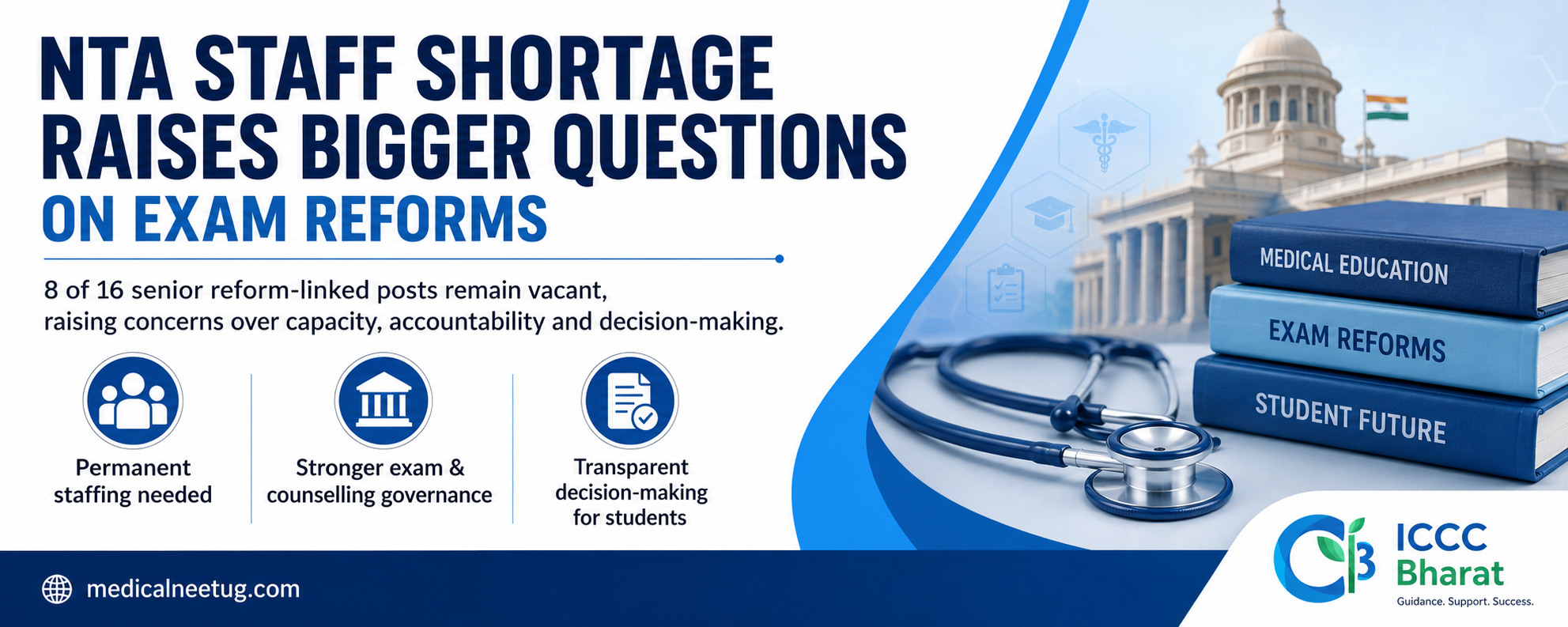
The ongoing NEET paper leak controversy has once again exposed a serious problem inside India’s examination system. Reports suggest that even after reforms were recommended, several senior posts inside the National Testing Agency remain vacant. This raises a very important question: how can an agency responsible for lakhs of students conduct high-stakes examinations without enough permanent, experienced and accountable officers?

But this problem is not limited to NTA alone.

The same weakness can be seen in several important medical education and admission bodies. Whether it is NTA, NBE, NMC, MCC or other counselling-related authorities, the larger problem is the same: shortage of permanent staff, weak institutional structure, lack of accountability, delayed decision-making and absence of experienced professionals in key positions.

The Problem Is Not Only Paper Leak

A paper leak is only the visible part of a deeper crisis. The real issue is structural failure.

When senior posts remain vacant, when important departments depend heavily on contractual or temporary staff, when the same limited group of people handle multiple responsibilities, and when there is no strong decision-making system, mistakes become unavoidable.

Students suffer because:

  • exam schedules become uncertain,
  • counselling gets delayed,
  • seat matrices are uploaded with confusion,
  • grievances are not answered properly,
  • important decisions are postponed,
  • seats remain vacant,
  • and students lose trust in the system.

Medical Counselling Also Needs Reform

Every year, medical counselling faces serious problems. Students and parents struggle with unclear rules, late updates, confusing seat matrices, sudden changes, poor communication and delayed responses.

MCC and state counselling systems must become more transparent and professionally managed. When thousands of MBBS, MD, MS, BDS and other medical seats are at stake, there must be a proper permanent structure, trained manpower and accountable officers.

India cannot afford a system where students keep sending complaints and receive only standard replies without real resolution.

Vacant Seats Are Not Only Because of High Fees

Many officials often say that seats remain vacant only because medical college fees are high. But this is not the full truth.

High fees are one problem, but poor counselling management is also a major reason.

If seat matrices are unclear, if counselling rounds are not planned properly, if decision-makers delay action, if vacant seats are not handled in time, and if student grievances are ignored, then seats will naturally remain vacant.

When thousands of PG seats remain vacant, it is not just a financial issue. It is also an administrative failure.

India Has Enough Talent — But Is It Being Used?

India has experienced doctors, medical education experts, administrators, counsellors, legal experts, data analysts and examination professionals across the country. The question is: why are such people not being brought into the system?

Appointments should not depend on lobbying, influence or repeated internal circulation of the same people. Key positions must be filled based on:

  • track record,
  • experience,
  • honesty,
  • subject knowledge,
  • administrative ability,
  • technology understanding,
  • and commitment to students.

A country of 140 crore people cannot say that it does not have competent professionals to manage national examinations and medical counselling.

Honest Officers Must Be Protected

Another major concern is that honest and capable people often do not want to enter such systems because the structure is weak, political pressure is high and accountability is selective.

If honest officers are discouraged and only convenient people remain in positions, the system will continue to weaken.

India needs a structure where good people are invited, respected, protected and allowed to work independently.

What Reforms Are Needed?

The government must urgently consider major reforms in medical examination and counselling bodies.

There should be permanent senior-level appointments in NTA, NBE, NMC, MCC and related bodies.

There should be independent audit of examination and counselling processes.

Seat matrix publication must be transparent, verified and time-bound.

Counselling software, data handling and grievance redressal must be professional.

Every important decision must have a responsible officer.

Student complaints should not be closed with routine replies.

Vacant seats must be reviewed in real time.

Medical fee approvals and seat matrix permissions must be strictly monitored.

There should be a national-level reform committee with experienced doctors, administrators, legal experts, counselling experts and technology professionals.

Government Must Act Before the System Collapses

The current situation is a warning. Students are losing faith. Parents are frustrated. Courts are repeatedly being approached. Seats are being wasted. Exams are being questioned. Counselling credibility is being damaged.

This is not the time for cosmetic changes. This is the time for hard decisions.

The government must stop treating each controversy as an isolated event. NEET paper leak, vacant PG seats, counselling confusion, fee issues, seat matrix errors and delayed responses are all connected to one bigger problem: weak governance in medical education administration.

Final Opinion

India’s medical education system needs urgent structural reform.

NTA’s staff shortage is only one part of the story. The same problem exists in examination bodies, counselling bodies and regulatory systems. Without permanent staff, competent leadership, transparent appointments and real accountability, students will continue to suffer.

Medical admission is not a small administrative process. It decides the future of lakhs of students and the future of healthcare in India.

The government must act now — not after another scam, not after another court case, not after another batch of seats goes vacant.

India needs strong institutions, honest decision-makers and transparent counselling systems. Without that, no reform will be complete.

NEET-UG Crisis: India Must Stop Lobby-Driven Appointments and Fix Exam Governance Now

The cancellation of NEET-UG 2026 has once again exposed a painful truth: India’s medical entrance system is not suffering only because of paper leaks. It is suffering because of weak governance, poor accountability, delayed reforms, and the appointment of people who may not understand the seriousness of national-level medical admissions.

NTA Director General Abhishek Singh has reportedly said that the NEET-UG process was found to be compromised and that the agency had to take a tough decision in the larger interest of students. He also said the system could not allow “scamsters” or miscreants to operate even in an isolated manner.

This statement must not be treated as routine damage control. It is a warning bell.

NEET-UG is not a small school test. It decides the careers of lakhs of students. Many candidates come from poor and middle-class families. Parents sell land, take loans, leave comfort, and sacrifice years of life for one dream: to see their child become a doctor. When a paper leak, manipulation, or sabotage attempt happens, it is not merely an examination irregularity. It is an attack on merit, public trust, national interest, and the future of hardworking students.

The issue is bigger than NTA alone. The entire chain — NTA, MCC, NMC, Health Ministry, counselling authorities, examination vendors, and policy decision-makers — must be reviewed. The country cannot run such a sensitive system through casual decisions, weak supervision, or lobby-based appointments. India needs capable, experienced, honest, and technically sound people in these institutions.

The Supreme Court had already dealt with the NEET-UG 2024 controversy. At that time, the Court refused to cancel the 2024 exam because there was insufficient material to prove a systemic leak, but it also pushed for reforms and expert review of the examination system. Later, the Centre informed the Supreme Court that it had accepted the expert panel’s recommendations, except the immediate shift to online NEET, citing infrastructure challenges for over 26 lakh students.

That means the warning was already there.

A high-level expert report had also suggested stronger monitoring, periodic appraisal, and mission-mode implementation of reforms for NTA. The report recommended a steering committee to monitor NTA’s performance, ensure compliance within timelines, guide bottlenecks, and submit monthly updates to the Ministry of Education.

Then the hard question is this: If reforms were already discussed, recommended, and accepted, why are students still paying the price?

The Government of India must stop treating this as a one-time crisis. It must clean the system from the top. If capable people are removed and weak or lobby-backed people are appointed, the result will be exactly what the country is seeing today — confusion, cancellation, mistrust, litigation, protests, and lakhs of students left in uncertainty.

The same seriousness is needed in counselling also. MCC and state counselling bodies handle the future of students after the exam. Any delay, wrong seat matrix, unclear rule, poor communication, or careless scheduling can destroy a student’s opportunity. Examination and counselling cannot be run by people who do not understand the ground reality of students, states, categories, quotas, seat matrix, and medical admission complexity.

This is no longer only about conducting NEET. This is about protecting India’s medical education system.

Strong Suggestions to the Government

The Government must immediately bring experienced, independent, and technically qualified people into NTA, MCC, NMC, NBEMS, and all related examination and counselling bodies.

All sensitive appointments must be transparent, merit-based, and free from internal lobbying.

Paper movement, exam-centre selection, digital security, vendor management, and question-paper access must be audited by independent agencies.

The Radhakrishnan committee recommendations and Supreme Court-monitored reform concerns must be implemented with public timelines, not kept only on paper.

The Government must create a national-level exam security protocol because paper leaks and organized manipulation are a direct threat to national credibility.

Students should not suffer again because of administrative failure.

Hard Closing Line

India does not need excuses after every paper leak. India needs clean exams, clean counselling, clean appointments, and clean accountability. NEET-UG is the dream of lakhs of students — it cannot be left in the hands of weak systems, lobbying networks, or incapable decision-makers.