NEET-UG 2026 Leak Probe Widens: Nashik Man May Hold Key to Paper Trail

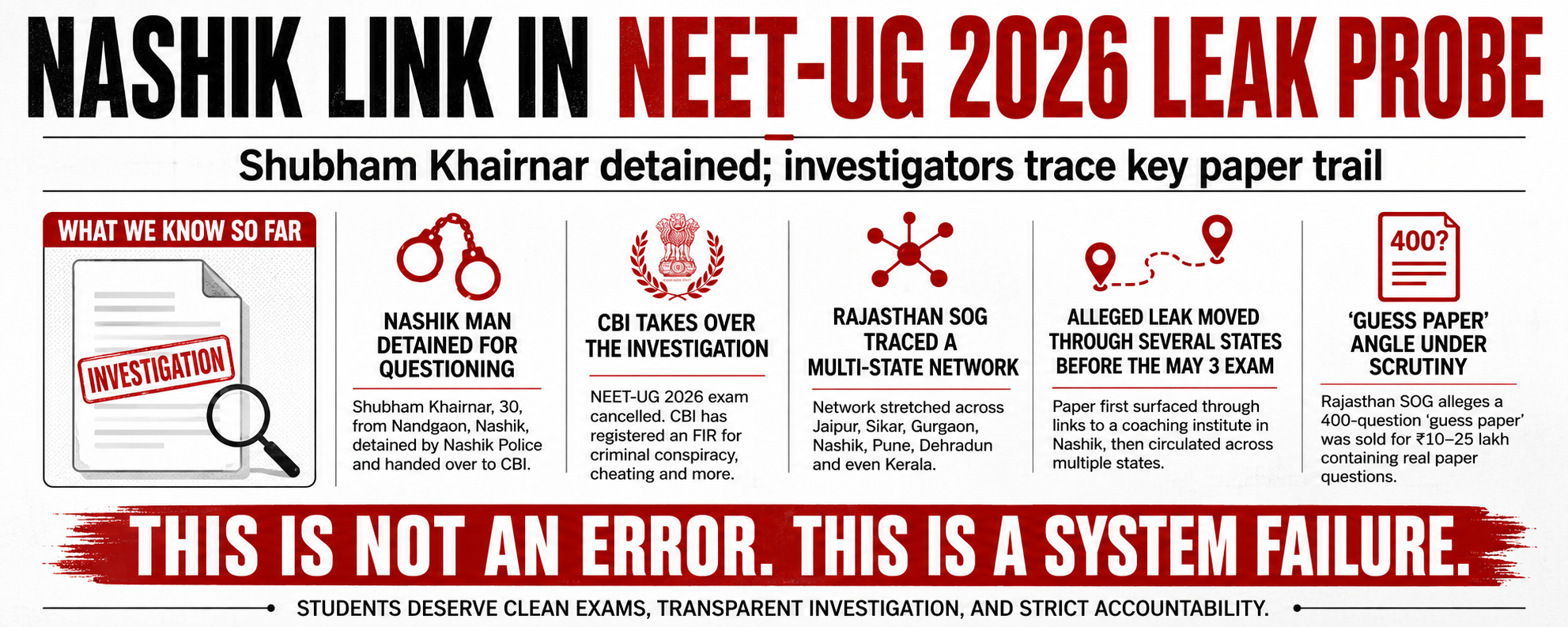
The NEET-UG 2026 paper leak investigation has taken another serious turn after Nashik Police detained 30-year-old Shubham Khairnar, a resident of Nandgaon in Maharashtra’s Nashik district, in connection with the alleged leak case.

According to reports, Khairnar was picked up from the Indiranagar area of Nashik following inputs from Rajasthan Police. The Rajasthan Special Operations Group had been probing the alleged paper leak before the matter was handed over to the Central Bureau of Investigation (CBI) for further investigation.

Investigators reportedly believe that Khairnar may have important information about how the alleged leaked NEET paper travelled through a multi-state network before the May 3 examination. The case is now being treated as a major organised malpractice investigation, not merely an isolated incident.

The probe suggests that the alleged paper may have first surfaced through links connected to a coaching institute in Nashik before being circulated across several states. Reports also indicate that the Rajasthan SOG suspected the leaked paper was disguised as a 400-question “guess paper” and allegedly sold for amounts ranging from ₹10 lakh to ₹25 lakh.

Investigators have claimed that questions from the actual NEET-UG 2026 paper were allegedly hidden inside this document, including Biology and Chemistry questions. If this claim is proven, it will expose a dangerous and well-planned method of cheating the examination system.

The suspected network is believed to have links across Jaipur, Sikar, Gurgaon, Nashik, Pune, Dehradun and Kerala. Police are also reportedly examining possible links to Latur in Maharashtra after allegations that several questions from a private coaching institute’s mock test matched the actual NEET paper.

This case raises serious questions.

How did the alleged paper move across states?
Who created the network?
Who collected money?
Who protected the chain?
Were coaching centres, middlemen or insiders involved?

The answers to these questions are extremely important because NEET is not just an examination — it decides the future of lakhs of medical aspirants.

The cancellation of NEET-UG 2026 has already created huge stress for students and parents. Many candidates come from poor and middle-class families. They spend years preparing, while parents sacrifice income, peace and stability for one medical dream. If paper leaks and organised rackets are allowed to function, genuine students become the biggest victims.

The CBI has reportedly registered an FIR under provisions related to criminal conspiracy, cheating, breach of trust and offences under the Public Examinations (Prevention of Unfair Means) Act. This shows the seriousness of the matter.

Strong Message

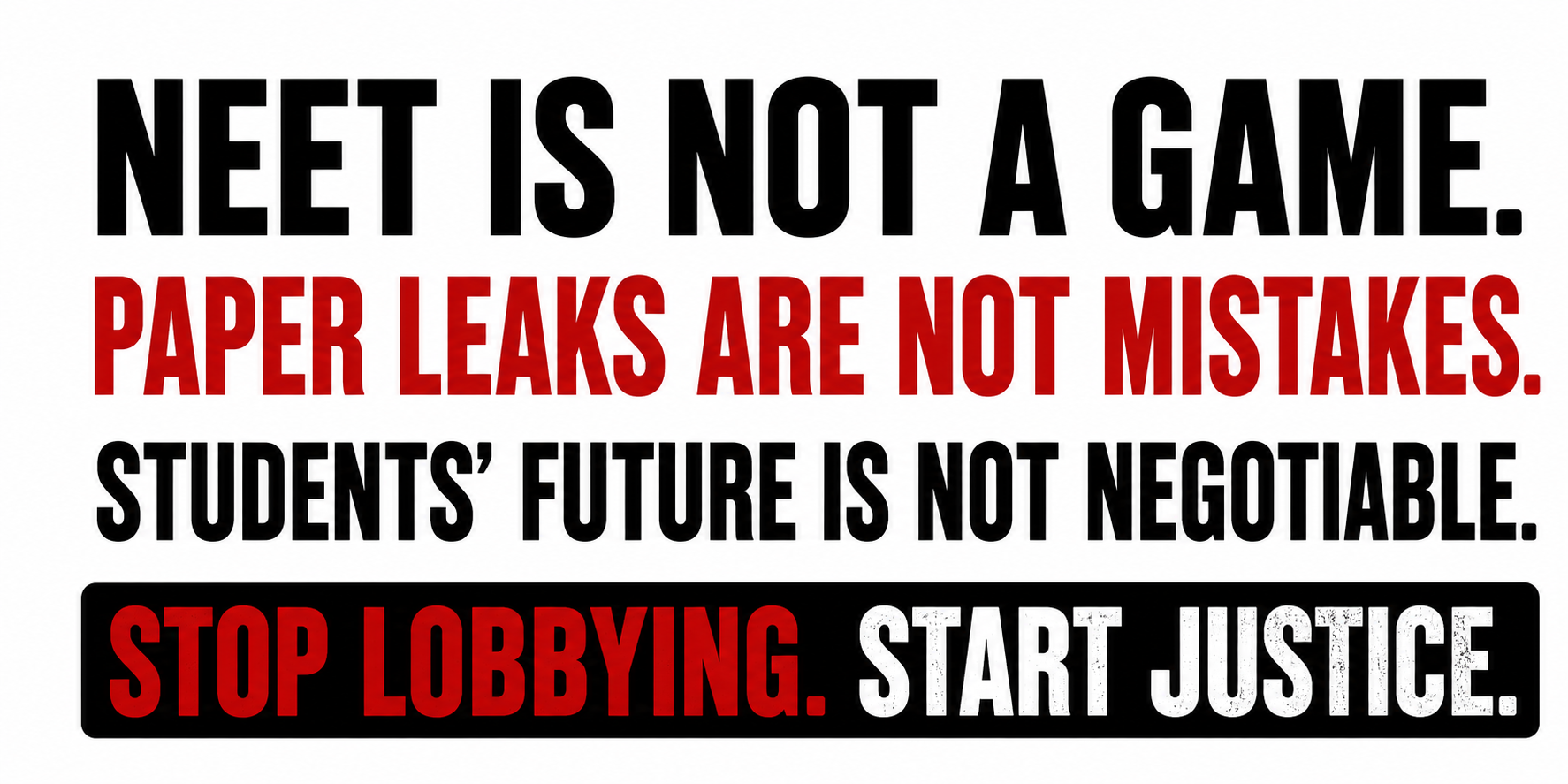
This is not a normal leak case.
This is not a small mistake.
This is not just one person’s crime.

If the allegations are true, this is an organised attack on merit, students’ dreams and India’s medical education system.

What Must Be Done Now

The Government must ensure a deep investigation into the full paper trail.

Every middleman, coaching link, financial handler, digital distributor and mastermind must be identified.

All suspicious coaching networks must be audited.

All candidates who benefited from unfair means must be permanently debarred.

The exam system must be protected with stronger digital security, biometric verification, surveillance and accountability.

Hard Closing Line

NEET cannot become a marketplace where papers are sold, solvers are arranged and students’ futures are traded. India needs clean exams, clean institutions and clean accountability — otherwise genuine students will continue to suffer while exam mafias grow stronger.

NEET-UG Crisis: India Must Stop Lobby-Driven Appointments and Fix Exam Governance Now

The cancellation of NEET-UG 2026 has once again exposed a painful truth: India’s medical entrance system is not suffering only because of paper leaks. It is suffering because of weak governance, poor accountability, delayed reforms, and the appointment of people who may not understand the seriousness of national-level medical admissions.

NTA Director General Abhishek Singh has reportedly said that the NEET-UG process was found to be compromised and that the agency had to take a tough decision in the larger interest of students. He also said the system could not allow “scamsters” or miscreants to operate even in an isolated manner.

This statement must not be treated as routine damage control. It is a warning bell.

NEET-UG is not a small school test. It decides the careers of lakhs of students. Many candidates come from poor and middle-class families. Parents sell land, take loans, leave comfort, and sacrifice years of life for one dream: to see their child become a doctor. When a paper leak, manipulation, or sabotage attempt happens, it is not merely an examination irregularity. It is an attack on merit, public trust, national interest, and the future of hardworking students.

The issue is bigger than NTA alone. The entire chain — NTA, MCC, NMC, Health Ministry, counselling authorities, examination vendors, and policy decision-makers — must be reviewed. The country cannot run such a sensitive system through casual decisions, weak supervision, or lobby-based appointments. India needs capable, experienced, honest, and technically sound people in these institutions.

The Supreme Court had already dealt with the NEET-UG 2024 controversy. At that time, the Court refused to cancel the 2024 exam because there was insufficient material to prove a systemic leak, but it also pushed for reforms and expert review of the examination system. Later, the Centre informed the Supreme Court that it had accepted the expert panel’s recommendations, except the immediate shift to online NEET, citing infrastructure challenges for over 26 lakh students.

That means the warning was already there.

A high-level expert report had also suggested stronger monitoring, periodic appraisal, and mission-mode implementation of reforms for NTA. The report recommended a steering committee to monitor NTA’s performance, ensure compliance within timelines, guide bottlenecks, and submit monthly updates to the Ministry of Education.

Then the hard question is this: If reforms were already discussed, recommended, and accepted, why are students still paying the price?

The Government of India must stop treating this as a one-time crisis. It must clean the system from the top. If capable people are removed and weak or lobby-backed people are appointed, the result will be exactly what the country is seeing today — confusion, cancellation, mistrust, litigation, protests, and lakhs of students left in uncertainty.

The same seriousness is needed in counselling also. MCC and state counselling bodies handle the future of students after the exam. Any delay, wrong seat matrix, unclear rule, poor communication, or careless scheduling can destroy a student’s opportunity. Examination and counselling cannot be run by people who do not understand the ground reality of students, states, categories, quotas, seat matrix, and medical admission complexity.

This is no longer only about conducting NEET. This is about protecting India’s medical education system.

Strong Suggestions to the Government

The Government must immediately bring experienced, independent, and technically qualified people into NTA, MCC, NMC, NBEMS, and all related examination and counselling bodies.

All sensitive appointments must be transparent, merit-based, and free from internal lobbying.

Paper movement, exam-centre selection, digital security, vendor management, and question-paper access must be audited by independent agencies.

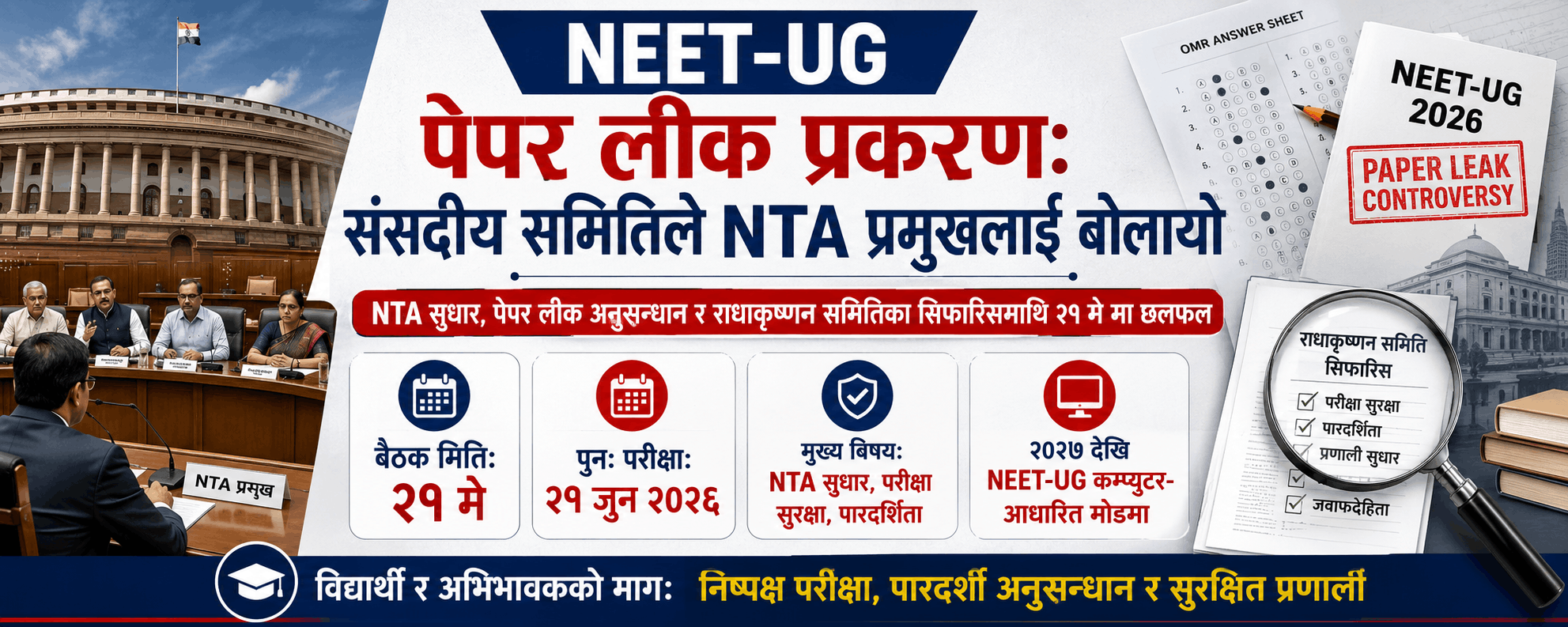
The Radhakrishnan committee recommendations and Supreme Court-monitored reform concerns must be implemented with public timelines, not kept only on paper.

The Government must create a national-level exam security protocol because paper leaks and organized manipulation are a direct threat to national credibility.

Students should not suffer again because of administrative failure.

Hard Closing Line

India does not need excuses after every paper leak. India needs clean exams, clean counselling, clean appointments, and clean accountability. NEET-UG is the dream of lakhs of students — it cannot be left in the hands of weak systems, lobbying networks, or incapable decision-makers.