NEET-UG 2026 पुनः परीक्षा जुन २१ मा: त्रुटिरहित सञ्चालन गर्न निर्देशन

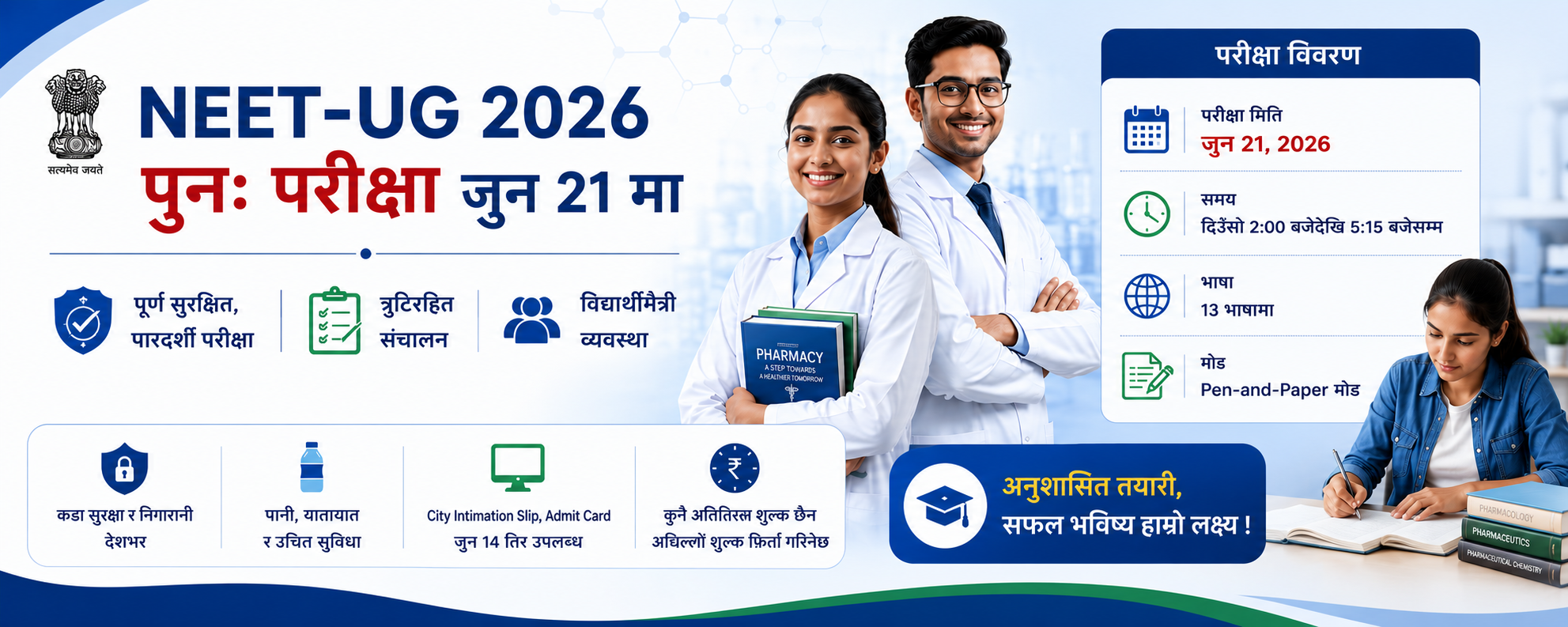
केन्द्रीय शिक्षा मन्त्री धर्मेन्द्र प्रधान ले जुन २१ मा हुने NEET-UG 2026 पुनः परीक्षा सम्बन्धी उच्चस्तरीय समीक्षा बैठकको अध्यक्षता गरेका छन्।

यो बैठक मे ३ मा सञ्चालन गरिएको NEET-UG 2026 परीक्षा प्रश्नपत्र लिक तथा अन्य अनियमितताका आरोपपछि रद्द गरिएपछि आयोजना गरिएको हो। परीक्षा रद्द हुँदा २२ लाखभन्दा बढी विद्यार्थीहरू प्रभावित भएका थिए।

बैठकमा मन्त्रीले पुनः परीक्षा पूर्ण रूपमा सुरक्षित, पारदर्शी र कुनै पनि कमजोरी नरहने गरी सञ्चालन गर्न अधिकारीहरूलाई निर्देशन दिएका छन्। अघिल्लो परीक्षा प्रक्रियामा देखिएका सबै कमजोरीहरू हटाउन विशेष जोड दिइएको छ।

अधिकारीहरूलाई देशभरका जिल्ला प्रशासन प्रमुख (DM) तथा प्रहरी प्रमुख (SP) सँग समन्वय गरेर परीक्षा केन्द्रहरूमा कडा सुरक्षा व्यवस्था, निगरानी र सहज सञ्चालन सुनिश्चित गर्न निर्देशन दिइएको छ।

सुरक्षासँगै विद्यार्थीमैत्री सुविधाहरूमा पनि ध्यान दिन भनिएको छ, जसमा:

• पिउने पानीको व्यवस्था
• यातायात सहयोग
• परीक्षा केन्द्रमा उचित सुविधा

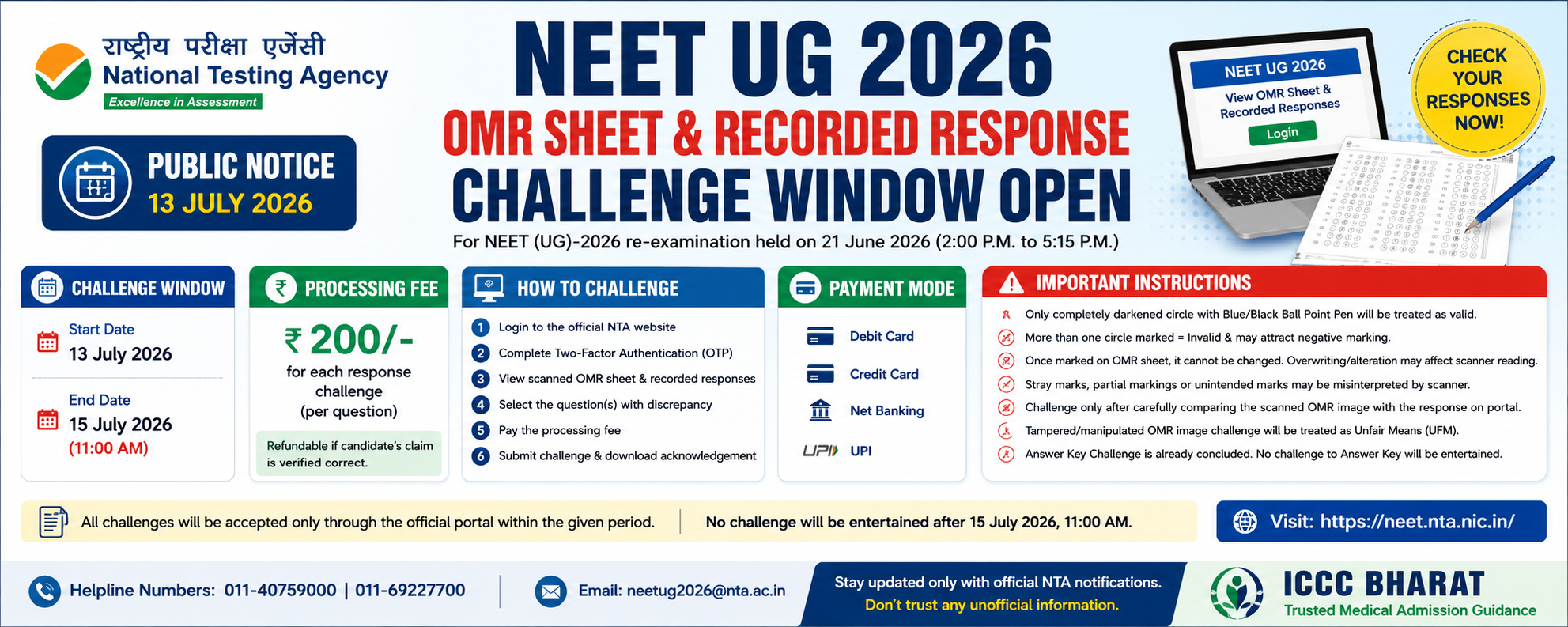
पुनः परीक्षा दिउँसो २:०० बजेदेखि ५:१५ बजेसम्म १३ भाषामा Pen-and-Paper मोड मा सञ्चालन हुनेछ।

विद्यार्थीहरूले मे २१ सम्म आफ्नो हालको ठेगाना र प्राथमिक परीक्षा शहर अपडेट गर्न सक्नेछन्। पुनः परीक्षाका लागि कुनै अतिरिक्त शुल्क लाग्ने छैन, साथै अघिल्लो परीक्षाको शुल्क फिर्ता गरिने जानकारी दिइएको छ।

City Intimation Slip, Admit Card तथा अन्य परीक्षा विवरणहरू NTA को आधिकारिक वेबसाइटमा सम्भावित रूपमा जुन १४ तिर जारी गरिने अपेक्षा गरिएको छ।

विद्यार्थीका लागि महत्त्वपूर्ण सन्देश

आत्तिनु आवश्यक छैन। अहिलेको समय अनुशासित भएर तयारी गर्ने, बुद्धिमानीपूर्वक पुनरावृत्ति गर्ने, NTA का आधिकारिक अपडेटहरू मात्र पछ्याउने र बाँकी समय पूर्ण ध्यानका साथ प्रयोग गर्ने हो। तपाईंको मेहनतले निष्पक्ष र सुरक्षित परीक्षा पाउनुपर्छ।

NEET-UG 2026 Leak Probe Widens: Nashik Man May Hold Key to Paper Trail

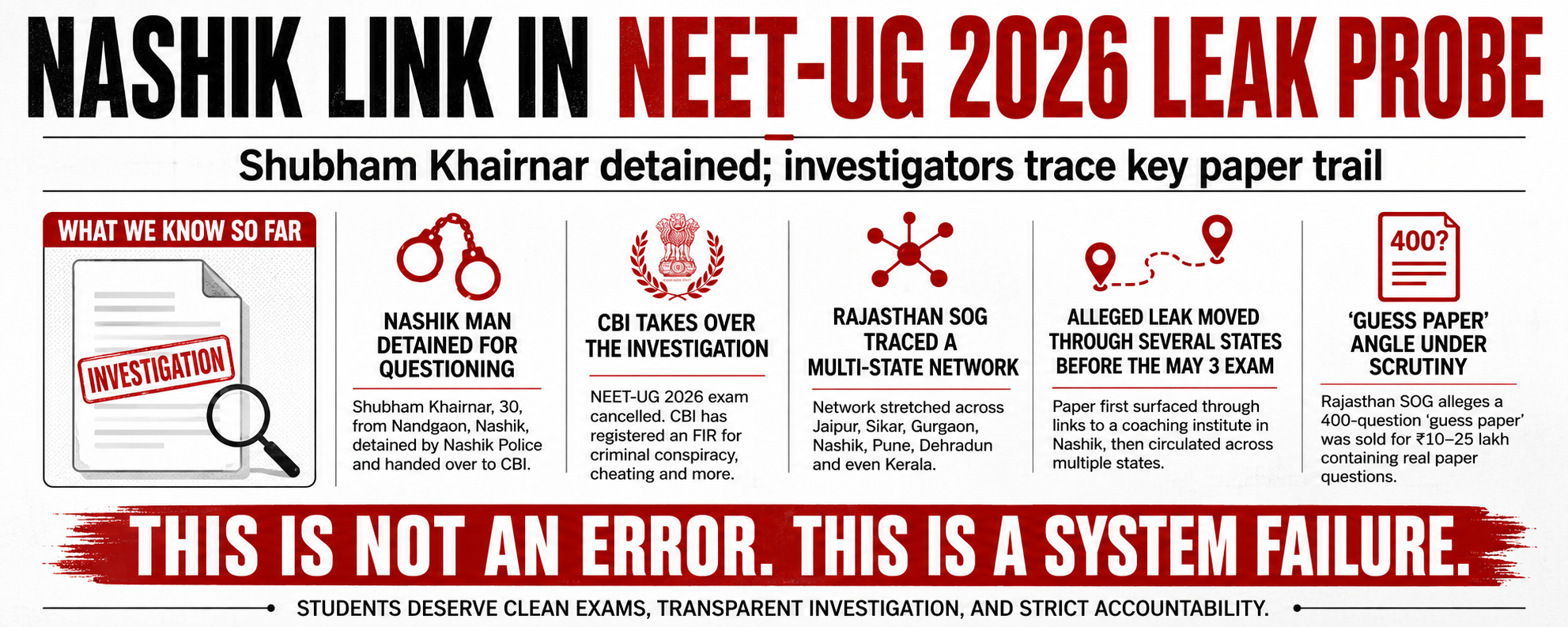
The NEET-UG 2026 paper leak investigation has taken another serious turn after Nashik Police detained 30-year-old Shubham Khairnar, a resident of Nandgaon in Maharashtra’s Nashik district, in connection with the alleged leak case.

According to reports, Khairnar was picked up from the Indiranagar area of Nashik following inputs from Rajasthan Police. The Rajasthan Special Operations Group had been probing the alleged paper leak before the matter was handed over to the Central Bureau of Investigation (CBI) for further investigation.

Investigators reportedly believe that Khairnar may have important information about how the alleged leaked NEET paper travelled through a multi-state network before the May 3 examination. The case is now being treated as a major organised malpractice investigation, not merely an isolated incident.

The probe suggests that the alleged paper may have first surfaced through links connected to a coaching institute in Nashik before being circulated across several states. Reports also indicate that the Rajasthan SOG suspected the leaked paper was disguised as a 400-question “guess paper” and allegedly sold for amounts ranging from ₹10 lakh to ₹25 lakh.

Investigators have claimed that questions from the actual NEET-UG 2026 paper were allegedly hidden inside this document, including Biology and Chemistry questions. If this claim is proven, it will expose a dangerous and well-planned method of cheating the examination system.

The suspected network is believed to have links across Jaipur, Sikar, Gurgaon, Nashik, Pune, Dehradun and Kerala. Police are also reportedly examining possible links to Latur in Maharashtra after allegations that several questions from a private coaching institute’s mock test matched the actual NEET paper.

This case raises serious questions.

How did the alleged paper move across states?
Who created the network?
Who collected money?
Who protected the chain?
Were coaching centres, middlemen or insiders involved?

The answers to these questions are extremely important because NEET is not just an examination — it decides the future of lakhs of medical aspirants.

The cancellation of NEET-UG 2026 has already created huge stress for students and parents. Many candidates come from poor and middle-class families. They spend years preparing, while parents sacrifice income, peace and stability for one medical dream. If paper leaks and organised rackets are allowed to function, genuine students become the biggest victims.

The CBI has reportedly registered an FIR under provisions related to criminal conspiracy, cheating, breach of trust and offences under the Public Examinations (Prevention of Unfair Means) Act. This shows the seriousness of the matter.

Strong Message

This is not a normal leak case.
This is not a small mistake.
This is not just one person’s crime.

If the allegations are true, this is an organised attack on merit, students’ dreams and India’s medical education system.

What Must Be Done Now

The Government must ensure a deep investigation into the full paper trail.

Every middleman, coaching link, financial handler, digital distributor and mastermind must be identified.

All suspicious coaching networks must be audited.

All candidates who benefited from unfair means must be permanently debarred.

The exam system must be protected with stronger digital security, biometric verification, surveillance and accountability.

Hard Closing Line

NEET cannot become a marketplace where papers are sold, solvers are arranged and students’ futures are traded. India needs clean exams, clean institutions and clean accountability — otherwise genuine students will continue to suffer while exam mafias grow stronger.

NEET Solver Gang Busted in Nalanda: This Is Not Cheating, This Is Organised Crime

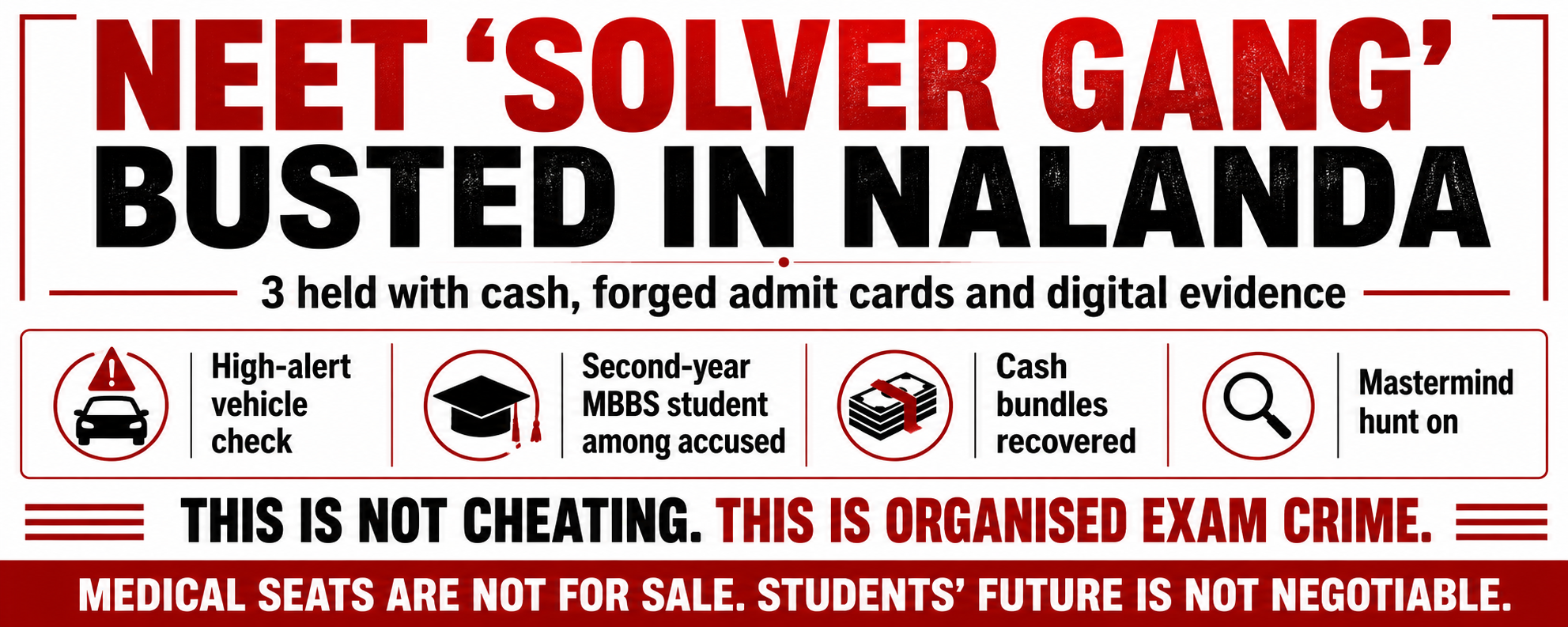
The NEET-UG crisis has taken a more serious turn after Nalanda Police busted an alleged organised “solver gang” ahead of the now-cancelled NEET-UG 2026 examination.

According to reports, three individuals were arrested, including a second-year MBBS student, after police allegedly recovered cash, forged admit cards, and digital evidence from their possession. Rajgir DSP Sunil Kumar Singh said police were on high alert due to the scheduled NEET examination on May 3, 2026, and suspicious vehicles were stopped during checking. Police later found cash bundles, multiple admit cards, financial transaction records, and other material during mobile phone examination.

The arrested persons have been identified in reports as Awadhesh Kumar, Aman Kumar Singh, and Pankaj Kumar. Police said the alleged solvers could not reach the exam centres because of the alert operation, and the investigation is now focused on identifying the mastermind and the wider network behind the racket.

This is not a normal cheating case. This is a direct attack on the dreams of lakhs of students.

A solver gang means proxy candidates are allegedly arranged to write the examination on behalf of real candidates. If such gangs enter a national medical entrance exam, then the damage is not limited to one centre or one district. It destroys trust in the entire system.

NEET decides who will become a doctor. Poor and middle-class parents spend years of savings on coaching, travel, hostel, forms, counselling and preparation. Genuine students study day and night. But if organised gangs, fake admit cards, cash deals and proxy candidates are allowed to operate, then merit becomes meaningless.

This case also raises serious questions for the Government, NTA, exam vendors and security agencies. How are such gangs getting access to candidate details? How are forged admit cards being prepared? Who is connecting solvers with candidates? Who is collecting money? Who is protecting the network?

The answer cannot be only arresting three people. The entire chain must be exposed.

The Nalanda case has also surfaced at a time when NEET-UG 2026 has already been cancelled after paper leak and malpractice concerns. Reports indicate that the investigation has widened across multiple states, with agencies examining larger networks linked to exam malpractice.

Strong Message

NEET is not a playground for criminal gangs.
Medical seats are not for sale.
Students’ dreams are not a business model.
Paper leaks and solver gangs are not mistakes — they are organised attacks on national merit.

What the Government Must Do Now

The Government must order a full investigation into the Nalanda solver gang and its national links.

All accused, middlemen, candidates, financial handlers, digital operators and masterminds must be identified.

NTA must strengthen candidate verification, biometric checks, exam-centre surveillance and admit-card authentication.

Every suspicious transaction linked to solver gangs must be traced.

Counselling and admission must not allow any candidate who used unfair means to enter the medical system.

Hard Closing Line

India cannot produce honest doctors through a dishonest examination system. If solver gangs are not crushed now, the future of genuine NEET aspirants will be sacrificed to money, manipulation and mafia networks.

NEET-UG Crisis: India Must Stop Lobby-Driven Appointments and Fix Exam Governance Now

The cancellation of NEET-UG 2026 has once again exposed a painful truth: India’s medical entrance system is not suffering only because of paper leaks. It is suffering because of weak governance, poor accountability, delayed reforms, and the appointment of people who may not understand the seriousness of national-level medical admissions.

NTA Director General Abhishek Singh has reportedly said that the NEET-UG process was found to be compromised and that the agency had to take a tough decision in the larger interest of students. He also said the system could not allow “scamsters” or miscreants to operate even in an isolated manner.

This statement must not be treated as routine damage control. It is a warning bell.

NEET-UG is not a small school test. It decides the careers of lakhs of students. Many candidates come from poor and middle-class families. Parents sell land, take loans, leave comfort, and sacrifice years of life for one dream: to see their child become a doctor. When a paper leak, manipulation, or sabotage attempt happens, it is not merely an examination irregularity. It is an attack on merit, public trust, national interest, and the future of hardworking students.

The issue is bigger than NTA alone. The entire chain — NTA, MCC, NMC, Health Ministry, counselling authorities, examination vendors, and policy decision-makers — must be reviewed. The country cannot run such a sensitive system through casual decisions, weak supervision, or lobby-based appointments. India needs capable, experienced, honest, and technically sound people in these institutions.

The Supreme Court had already dealt with the NEET-UG 2024 controversy. At that time, the Court refused to cancel the 2024 exam because there was insufficient material to prove a systemic leak, but it also pushed for reforms and expert review of the examination system. Later, the Centre informed the Supreme Court that it had accepted the expert panel’s recommendations, except the immediate shift to online NEET, citing infrastructure challenges for over 26 lakh students.

That means the warning was already there.

A high-level expert report had also suggested stronger monitoring, periodic appraisal, and mission-mode implementation of reforms for NTA. The report recommended a steering committee to monitor NTA’s performance, ensure compliance within timelines, guide bottlenecks, and submit monthly updates to the Ministry of Education.

Then the hard question is this: If reforms were already discussed, recommended, and accepted, why are students still paying the price?

The Government of India must stop treating this as a one-time crisis. It must clean the system from the top. If capable people are removed and weak or lobby-backed people are appointed, the result will be exactly what the country is seeing today — confusion, cancellation, mistrust, litigation, protests, and lakhs of students left in uncertainty.

The same seriousness is needed in counselling also. MCC and state counselling bodies handle the future of students after the exam. Any delay, wrong seat matrix, unclear rule, poor communication, or careless scheduling can destroy a student’s opportunity. Examination and counselling cannot be run by people who do not understand the ground reality of students, states, categories, quotas, seat matrix, and medical admission complexity.

This is no longer only about conducting NEET. This is about protecting India’s medical education system.

Strong Suggestions to the Government

The Government must immediately bring experienced, independent, and technically qualified people into NTA, MCC, NMC, NBEMS, and all related examination and counselling bodies.

All sensitive appointments must be transparent, merit-based, and free from internal lobbying.

Paper movement, exam-centre selection, digital security, vendor management, and question-paper access must be audited by independent agencies.

The Radhakrishnan committee recommendations and Supreme Court-monitored reform concerns must be implemented with public timelines, not kept only on paper.

The Government must create a national-level exam security protocol because paper leaks and organized manipulation are a direct threat to national credibility.

Students should not suffer again because of administrative failure.

Hard Closing Line

India does not need excuses after every paper leak. India needs clean exams, clean counselling, clean appointments, and clean accountability. NEET-UG is the dream of lakhs of students — it cannot be left in the hands of weak systems, lobbying networks, or incapable decision-makers.

The Future of Ayurveda in India: From Ancient Wisdom to Modern Healthcare Revolution

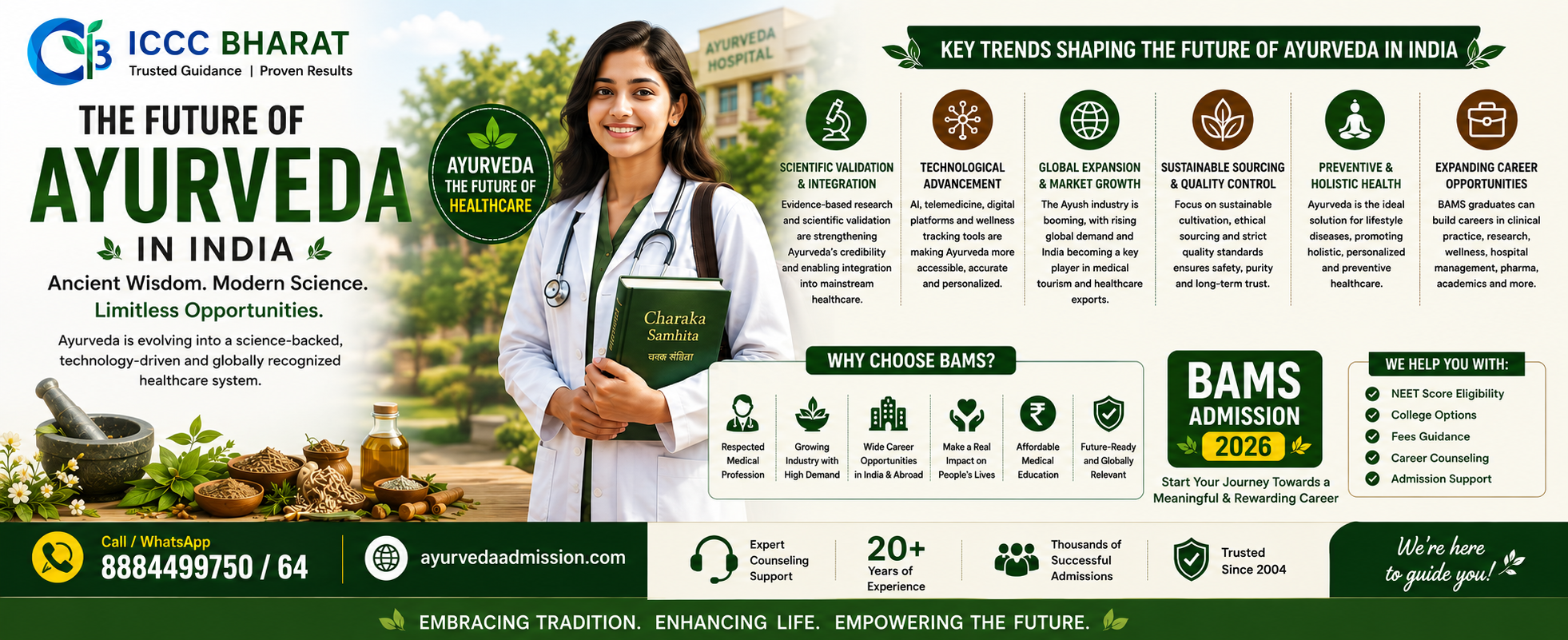
Ayurveda, one of the world’s oldest systems of medicine, is no longer confined to traditional practices and herbal remedies alone. Today, Ayurveda is rapidly transforming into a science-backed, technology-driven, and globally recognized healthcare system. With increasing awareness about holistic wellness, preventive healthcare, and lifestyle management, the future of Ayurveda in India appears more promising than ever before.

India is witnessing a major shift in healthcare preferences. People are increasingly looking beyond symptom-based treatment and focusing on long-term wellness, immunity, mental health, and preventive care. This changing mindset has created a huge demand for Ayurveda and integrative medicine. As a result, the Ayurveda industry is growing at an unprecedented pace and is expected to become one of the strongest pillars of India’s healthcare and wellness economy.

Ayurveda Moving Towards Scientific Validation

One of the biggest transformations in Ayurveda is the growing emphasis on scientific research and evidence-based validation. The Ministry of Ayush and several research institutions are actively promoting clinical studies, standardization, and scientific documentation of Ayurvedic treatments and medicines.

This shift is helping Ayurveda gain credibility among both medical professionals and the public. Modern hospitals and healthcare centers are increasingly integrating Ayurvedic therapies into mainstream healthcare systems, especially in areas such as lifestyle diseases, chronic illnesses, stress management, and rehabilitation.

The future of Ayurveda lies in this balanced integration of traditional wisdom with modern scientific approaches.

Technology and Digital Integration in Ayurveda

Technology is playing a major role in reshaping the Ayurveda sector. Digital healthcare platforms, telemedicine consultations, artificial intelligence (AI), and wellness-tracking applications are making Ayurvedic healthcare more accessible and personalized.

AI-based health analysis, virtual consultations, online wellness coaching, and digital prescription systems are helping Ayurveda reach patients not only across India but around the world. Startups and wellness companies are also investing heavily in Ayurvedic technology platforms, opening new opportunities for innovation and employment.

The combination of Ayurveda and modern technology is expected to create a smarter, data-driven healthcare ecosystem in the coming years.

Global Expansion and Medical Tourism

Ayurveda has become one of India’s strongest soft-power healthcare exports. Countries across Europe, the Middle East, the United States, and Southeast Asia are showing increasing interest in Ayurvedic medicines, therapies, yoga, and Panchakarma treatments.

India is becoming a major destination for wellness tourism and holistic healthcare. International patients are visiting India for detoxification therapies, stress management, chronic disease care, and rejuvenation programs. This global demand is creating significant growth opportunities for Ayurvedic hospitals, wellness resorts, pharmaceutical companies, and trained professionals.

The Indian Ayush market is projected to grow exponentially in the next decade, making Ayurveda one of the fastest-growing healthcare industries in the country.

Focus on Preventive and Holistic Healthcare

Modern healthcare systems are increasingly recognizing the importance of prevention rather than only treatment. Ayurveda’s core philosophy aligns perfectly with this concept. Ayurveda focuses on balancing the body, mind, and lifestyle to prevent diseases before they occur.

With the rise of diabetes, obesity, hypertension, stress disorders, and other lifestyle diseases, Ayurveda is emerging as a valuable solution for long-term wellness and personalized healthcare management.

This preventive approach is expected to make Ayurveda an important component of future public healthcare systems.

Sustainable Sourcing and Quality Control

As demand for Ayurvedic products increases globally, there is also a growing focus on sustainable cultivation of medicinal plants and strict quality control standards. Government bodies and private organizations are working toward improving cultivation practices, supply chain management, and product standardization.

Ensuring safety, purity, and efficacy of Ayurvedic medicines will be crucial for the long-term credibility and expansion of the industry.

Expanding Career Opportunities for BAMS Graduates

The future is also highly promising for students pursuing BAMS (Bachelor of Ayurvedic Medicine and Surgery). Earlier, career opportunities for Ayurveda graduates were limited mainly to private clinics. Today, the scope has expanded significantly.

BAMS graduates now have opportunities in:

  • Clinical practice
  • Panchakarma centers
  • Wellness and spa industries
  • Hospital administration
  • Medical tourism
  • Clinical research
  • Pharmaceutical companies
  • Healthcare startups
  • Public health programs
  • Teaching and academics
  • Integrative hospitals

The growing wellness industry and increasing acceptance of Ayurveda globally are creating stable and rewarding career paths for Ayurvedic professionals.

Challenges Ahead

Despite the rapid growth, Ayurveda still faces certain challenges, including regulatory issues, standardization, scientific validation, and public misconceptions. However, sustained investment in research, innovation, education, and technology is gradually overcoming these barriers.

The future success of Ayurveda will depend on maintaining authenticity while adapting to modern healthcare expectations.

Conclusion

Ayurveda in India is entering a new era. What was once considered purely traditional medicine is now evolving into a scientifically validated, technology-enabled, globally respected healthcare system. Supported by government initiatives, rising public awareness, digital transformation, and international demand, Ayurveda is poised to become a major force in preventive and holistic healthcare.

For students, healthcare professionals, and entrepreneurs, Ayurveda represents not only a cultural heritage but also a powerful future opportunity. As India moves toward integrated healthcare systems, Ayurveda is set to play a vital role in shaping the future of wellness and medicine both nationally and globally.