NEET UG Counselling 2026: MCC Introduces One-Time Reporting and Online Verification

The Ministry of Health and Family Welfare has reviewed the preparations for NEET UG Counselling 2026, with a focus on making the admission process more transparent, technology-enabled and student-friendly. Union Health Minister Shri Jagat Prakash Nadda assessed the readiness of the Medical Counselling Committee, DGHS and other stakeholders for the forthcoming counselling process.

The review covered the counselling schedule, information-technology infrastructure, cybersecurity, grievance redressal, candidate-support measures and coordination with participating medical institutions. Officials were directed to ensure technical stability, prompt resolution of complaints and smooth functioning of the counselling portal.

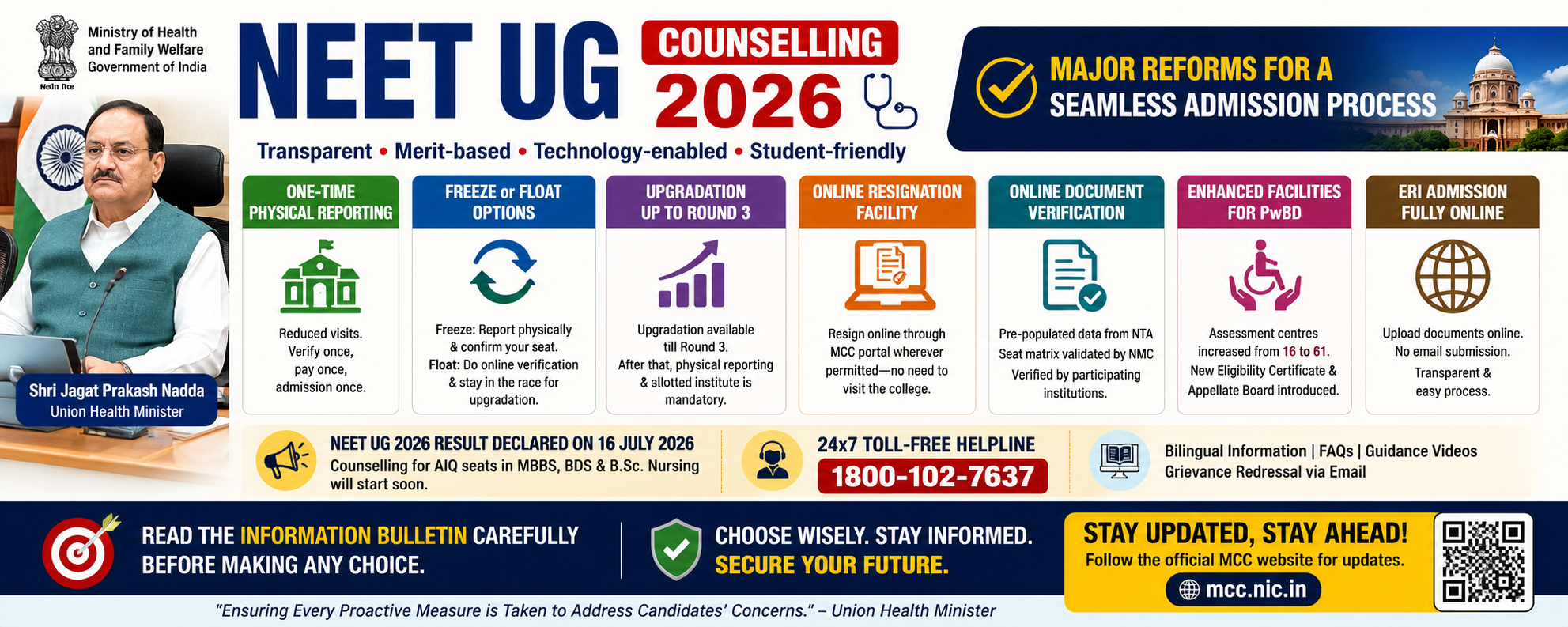
One-Time Physical Reporting

One of the major reforms proposed for NEET UG Counselling 2026 is a one-time physical reporting system. After receiving a seat, candidates will be able to select either the Freeze or Float option online.

Candidates selecting the Freeze option will report physically to the allotted institution to verify original documents, pay the admission fee and complete the admission formalities.

Candidates choosing the Float option for seat upgradation will be allowed to complete document verification online. They will not be required to submit original documents, pay the admission fee or physically visit the allotted institution while participating in subsequent rounds.

The upgradation facility will remain available until the third round. Candidates holding seats after the third round will then report to their respective institutions. The new framework is intended to ensure one-time reporting, one-time original-document verification and one-time fee payment.

Online Seat Resignation Facility

Candidates will also be able to resign from an allotted seat through the MCC counselling portal, wherever resignation is permitted under the applicable rules and timelines. A physical visit to the college may not be required unless specifically mentioned in the Information Bulletin or notified separately by MCC.

Online Document Verification

The counselling process will include pre-populated candidate information received from the National Testing Agency, online document verification, validation of the seat matrix by the National Medical Commission and verification by participating institutions.

These measures are expected to reduce documentation errors, improve transparency and make the admission process more efficient.

New Facilities for PwBD Candidates

The number of designated assessment centres for Persons with Benchmark Disabilities has been increased from 16 to 61 across India.

The certificate issued by designated Medical Boards will now be called an Eligibility Certificate. An Appellate Disability Assessment Board will also be available for eligible candidates who wish to appeal against the initial assessment.

NRI Admission Process to Become Fully Online

The NRI admission process will be completely digitised. NRI candidates will register through the online counselling portal, upload the required documents digitally and undergo online verification by designated officers.

This replaces the earlier practice of submitting NRI documents through email and is intended to make verification more transparent, efficient and time-bound.

Candidate Support and Grievance Redressal

A 24×7 toll-free support centre has been established at 1800-102-7637. MCC will also provide bilingual information material, frequently asked questions and counselling guidance videos.

A dedicated grievance email, mcc2026[at]gov[dot]in, has been introduced for the prompt resolution of candidate queries.

Counselling Expected to Begin Shortly

The NEET UG 2026 results were declared on 16 July 2026. According to the official release, counselling for All India Quota seats in MBBS, BDS and B.Sc. (Hons.) Nursing is expected to commence shortly.

Candidates should carefully read the MCC Information Bulletin, counselling scheme and applicable rules before selecting options related to seat acceptance, upgradation or resignation. They should also regularly check the official MCC counselling portal for the notified schedule and further instructions.
Navigating the Maze: Top 9 Mistakes Parents Make During MBBS Counselling

The journey to wearing a white coat doesn’t end when the NEET exam concludes. In fact, for most families, the most stressful phase is just beginning. While your child did the heavy lifting by spending months studying, navigating the complex, bureaucratic maze of MBBS seat allotment falls heavily on the shoulders of parents.

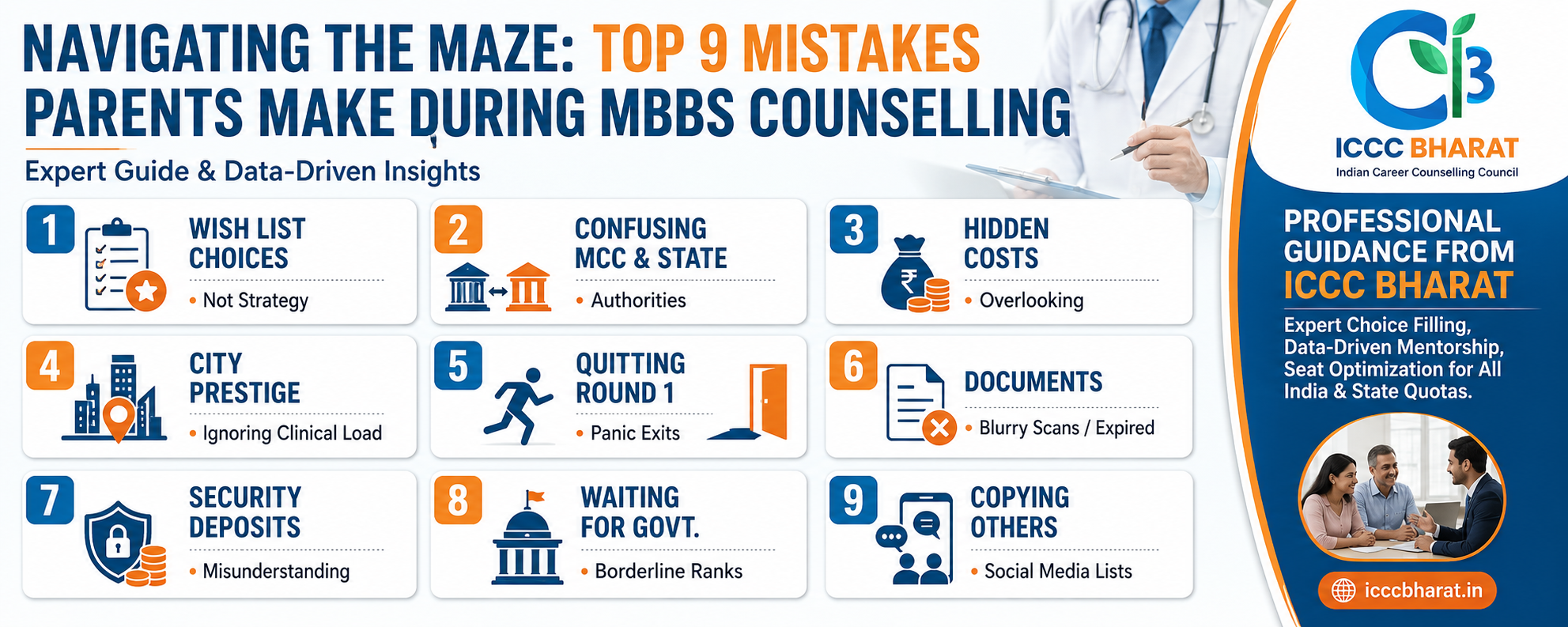
Every year, thousands of brilliant, high-scoring candidates miss out on excellent medical seats simply because of strategic errors made during the choice-filling and registration periods. To help families make informed decisions, ICCC Bharat (Indian Career Counselling Council) has compiled the definitive guide to the top nine most common pitfalls parents must avoid to secure their child’s medical future.

1. Treating Choice Filling Like a “Wish List” Instead of a Strategy

Many parents sit down to fill out college preferences and list only the top 5 or 10 most famous medical colleges (like AIIMS or premier government institutions) without realistically evaluating their child’s actual rank.

  • The Risk: If your child’s rank doesn’t match those ultra-competitive cut-offs, they will receive zero allotments in Round 1, leading to immense panic.
  • The Fix: Create a balanced structure. Fill a robust list of choices ranging from dream colleges to safe, realistic backups based entirely on previous years’ closing ranks.

2. Misunderstanding Multiple Counselling Authorities

Assuming one central website handles all medical seats is a common pitfall. Parents often register on the Medical Counselling Committee (MCC) portal and assume they are covered for everything.

  • The Split: The MCC handles only the 15% All India Quota (AIQ), Central Universities, and Deemed Universities.
  • State Authorities: The remaining 85% of state government seats and private college seats are handled individually by each state’s respective selection committee (e.g., KEA in Karnataka, BCECEB in Bihar). You must register separately on state portals to be eligible for state quota seats.

3. Overlooking Total Course Cost (Hidden Fees)

When evaluating private or deemed medical colleges, parents frequently look only at the annual tuition fee and assume the total cost is just that amount multiplied by five.

  • The Trap: They overlook mandatory hidden costs: hostel fees, mess charges, mandatory university exam fees, caution deposits, and development fees. Always check the official fee structure document on the specific counselling authority’s website to calculate the absolute total cost for the 5.5-year duration.

4. Ignoring Clinical Load in Favor of “City Prestige”

It’s easy to pick a college because it has a beautiful modern campus, is located in a major metropolitan city, or offers a shiny new infrastructure.

Expert Insight: Medicine is learned at the bedside, not just in classrooms. An older government or private hospital with a massive patient load and a bustling Outpatient Department (OPD) will produce a far more competent doctor than a corporate-style college with empty hospital beds.

5. Quitting the Counselling Process After Round 1

If a student doesn’t get a seat—or gets a subpar college—in the initial round, anxious parents often panic and pull out of the process entirely, or rush to look for unapproved, expensive alternatives.

  • The Strategy: The MBBS seat matrix is incredibly dynamic. Thousands of seats open up or get upgraded in Round 2, the Mop-Up Round, and the Stray Vacancy Round as students switch between AIQ and State quotas. Staying patient and strategically participating in later rounds frequently yields much better colleges.

6. Submitting Blurry Scans and Expired Documentation

Document verification is ruthless. Uploading a blurry photo taken from a smartphone, an incorrect file format, or an expired certificate can lead to instant disqualification.

  • The Check: Ensure caste (OBC-NCL, SC, ST), EWS, or domicile certificates are issued within the exact timeline specified in the current year’s counselling brochure. Keep digital folders cleanly organized, and have multiple physical copies of the NEET admit card, scorecard, 10th/12th marksheets, and identity proofs ready.

7. Misunderstanding Security Deposit Refund Rules

MBBS counselling involves substantial security deposits—ranging from ₹10,000 for government colleges to ₹2 Lakhs or more for Deemed Universities. Many parents lose this money because they don’t read the exit rules.

  • The Rule: In many counselling formats, if a seat is allotted to you in Round 2 and you fail to join or report to that college, your security deposit is forfeited. Never fill in a choice for a college your child has absolutely no intention of joining.

8. Waiting Exclusively for a Government Seat on a Borderline Rank

Holding onto hope for a government seat when a child’s score is exactly on the previous year’s cut-off line is emotionally exhausting and tactically dangerous.

  • The Mistake: By the time a parent accepts that a government seat isn’t happening, the best affordable seats in reputed private medical colleges have already been snapped up in the early rounds. Always run a parallel backup plan if your child’s score is on the borderline.

9. Copying Preferences from Friends or Social Media

Every student’s rank, category reservation, financial budget, and geographic preference are entirely unique. Relying on a “master preference list” forwarded on WhatsApp or blindly copying what a neighbor is doing can ruin your child’s specific advantages. Your strategy must be completely tailored to your child’s exact All India Rank (AIR) and category matrix.

🩺 Professional Guidance from ICCC Bharat

Navigating the high-stakes world of medical admissions requires absolute precision. ICCC Bharat (Indian Career Counselling Council) provides expert, data-driven mentorship to help parents and students seamlessly navigate choice filling, document verification, and seat optimization across both All India and State quotas. Protect your child’s hard work with verified, professional counselling strategies.