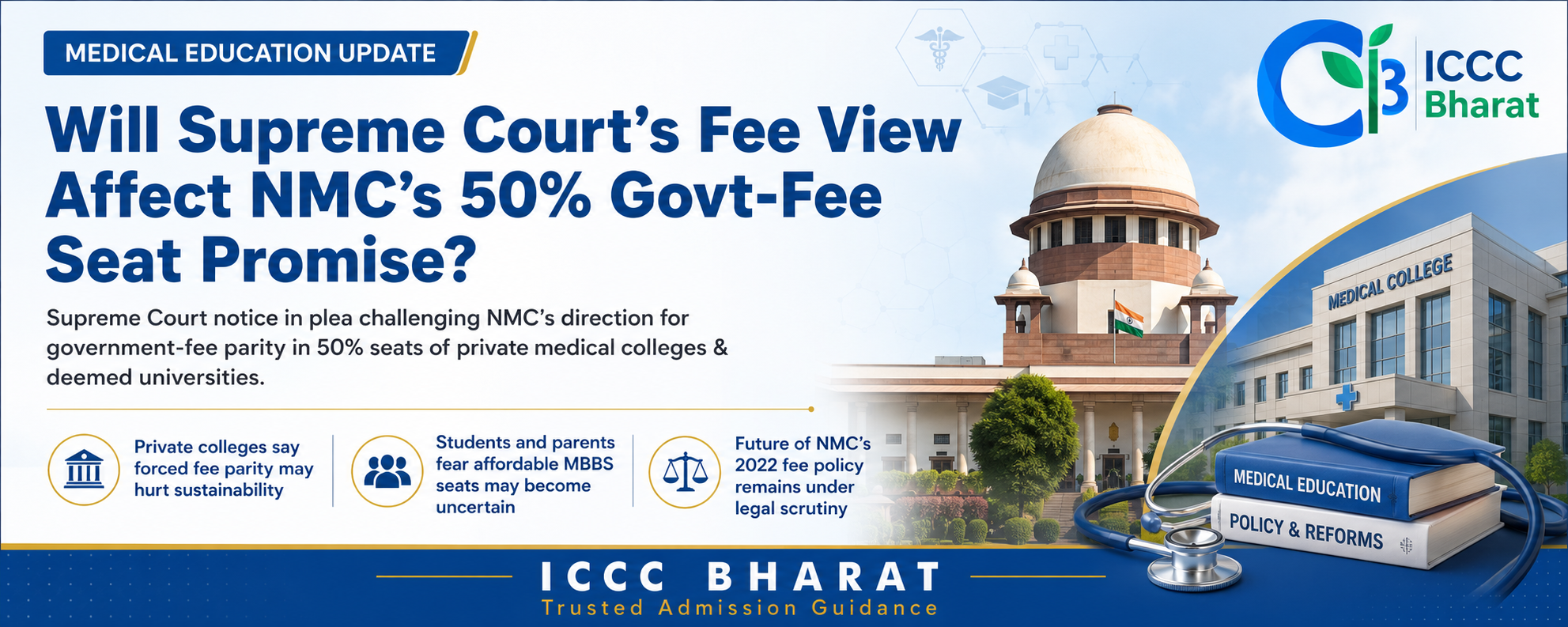
Medical education in India is again facing a major policy and legal question: can private medical colleges and deemed universities be compelled to charge government medical college-level fees for 50% of their seats?
This question has become more serious after the Supreme Court refused to interfere with the fee structure of private medical colleges in Rajasthan in a case filed by an EWS student. The Court observed that self-financing private institutions cannot automatically be forced to charge fees at par with government institutions and that India needs doctors.
At first glance, this may look like an individual student’s case. But its larger impact may be much bigger.
The decision may directly influence the ongoing debate around the National Medical Commission’s 03 February 2022 office memorandum, which recommended that fees for 50% seats in private medical colleges and deemed universities should be at par with government medical colleges of the respective State or Union Territory.
This was one of the biggest promises made to medical aspirants and parents: that 50% seats in private medical colleges would become affordable like government seats.
But after the Supreme Court’s recent observations, the future of this promise has become legally uncertain.
What Was the NMC’s 50% Fee Direction?
The National Medical Commission had issued an office memorandum stating that fees for 50% seats in private medical colleges and deemed universities should be at par with government medical colleges in that State or Union Territory.
The idea behind this direction was simple and student-friendly: private medical education should not remain completely unaffordable, and at least half of the seats should be accessible to students at government-like fee levels.
For lakhs of NEET-UG aspirants, this created hope. Many students and parents believed that even if they could not get a government medical college seat, they may still get a private medical college seat at a reasonable fee.
This was especially important for middle-class families, EWS candidates and students who narrowly miss government seats due to rank competition.
Why the Direction Was Challenged
Private medical colleges and associations challenged the NMC direction, arguing that private self-financing institutions cannot be forced to charge government-level fees without considering infrastructure costs, faculty salaries, hospital expenses, equipment, laboratories, maintenance and regulatory requirements.
Their basic argument is that government colleges are funded and supported by the State, while private colleges are self-financing. Therefore, both cannot be treated identically for fee purposes.
This is where the legal conflict begins.
Students want affordability.
Private colleges want financial sustainability.
The government wants more medical seats.
The courts must balance law, policy, affordability and institutional survival.
Supreme Court Notice in Challenge to NMC Direction
The Supreme Court had earlier issued notice in a petition challenging the validity of the NMC direction requiring government-fee parity for 50% seats in private medical colleges and deemed universities.
This means the validity of the NMC’s 50% fee direction is not a closed issue. It remains a serious legal question.
If the Supreme Court eventually upholds the NMC direction, students may benefit from affordable seats in private medical colleges.
But if the Court strikes it down or limits its implementation, the dream of government-fee seats in 50% private college seats may become difficult or even impossible unless Parliament, State Governments or regulators create a stronger statutory framework.
Latest Supreme Court Observation: A Warning Signal?
The latest Supreme Court order in the Rajasthan EWS fee matter may become important in interpreting the future of private medical college fee regulation.
In that case, the petitioner argued that private medical college fees of around ₹18.90 lakh to ₹25 lakh per year were unaffordable for an EWS candidate, especially when the EWS income limit is ₹8 lakh per year.
The petitioner also relied on the NMC memorandum on government-fee parity for 50% private medical college seats.
However, the Supreme Court refused to interfere. The Bench observed that private institutions cannot simply be equated with government institutions for fee purposes. It also noted that private medical colleges are self-financing institutions and that forcing them to charge only government-level fees may affect their functioning.
This observation may not be a final ruling on the validity of the NMC 50% fee memorandum, but it clearly shows the Court’s concern about forcing private institutions to run at government fee levels.
What About the Prime Minister’s Promise?
The NMC’s 50% fee direction was widely understood by students and parents as a major affordability promise in medical education.
The political message was powerful: 50% seats in private medical colleges would become available at government college fees.
But a policy promise becomes enforceable only when it is supported by a clear legal mechanism.
If the Supreme Court takes the view that private self-financing institutions cannot be compelled through an office memorandum alone, then the promise may face serious implementation difficulty.
This does not mean the promise is impossible forever. But it may mean that a simple NMC office memorandum may not be enough.
A stronger law, clear regulatory power, state adoption, fee committee mechanism and financial balancing model may be required.
The Big Legal Question
The core legal question is this:
Can NMC, through an office memorandum, force private medical colleges and deemed universities to charge government college fees for 50% seats?
Private institutions may argue that such a direction affects their autonomy and financial viability.
Students may argue that medical education is a public good and cannot be left completely to market pricing.
The government may argue that affordable medical education is necessary to create more doctors and reduce inequality.
The Supreme Court will have to balance all these competing interests.
Why the “M&M / Fee Regulation” Debate Matters
The larger line of judicial thinking on private professional institutions has often protected the autonomy of unaided private institutions, while also allowing reasonable regulation to prevent profiteering and capitation fees.
This is the real conflict.
Regulation is allowed.
Profiteering can be controlled.
Capitation fee can be banned.
But can private colleges be forced to charge the same fee as government colleges?
That is the difficult question.
If the Court applies a strict autonomy-based interpretation, the NMC’s 50% government-fee direction may face legal difficulty.
If the Court gives higher weight to public interest, medical affordability and regulatory power under the NMC framework, then the direction may survive, at least with modifications.
Impact on Government Quota Seats in Private Medical Colleges
Many states already have different types of seats in private medical colleges, such as government quota, management quota, institutional quota and NRI quota.
In some states, government quota seats in private colleges are comparatively lower in fee than management seats. But this depends on state laws, fee committees and counselling rules.
The NMC’s 50% fee direction attempted to create a broader national standard.
If the Supreme Court weakens or rejects the NMC direction, then fee regulation may go back largely to state-wise rules and fee fixation committees.
This means students in different states may face different fee structures.
In one state, private government quota seats may remain affordable.
In another state, they may remain very expensive.
This will create inequality in medical education access across India.
What Students Should Understand
Students and parents must understand one important point: a policy announcement and actual enforceable fee benefit are not the same.
Before choosing a private medical college, students must verify:
Whether the state has adopted the NMC 50% fee guideline
Whether the fee committee has approved government-fee parity
Whether the college is legally bound to follow reduced fee
Whether the fee applies to government quota only or 50% total seats
Whether deemed universities are actually implementing it
Whether any court stay or litigation is pending
Whether the counselling brochure clearly mentions the fee
Whether hostel, miscellaneous charges and other costs are separate
Many families assume that 50% seats in private colleges are automatically available at government fees. That assumption can be risky.
The Affordability Crisis Is Real
Even if private colleges have valid arguments about cost, the affordability crisis cannot be ignored.
A student from an EWS family with an annual income limit of ₹8 lakh cannot realistically pay ₹20 lakh per year in tuition fees.
Even many middle-class families cannot afford private MBBS fees without selling assets, taking huge loans or depending on relatives.
This creates a painful contradiction.
India says it needs more doctors.
Students say they want to become doctors.
But the fee structure blocks many deserving candidates.
If affordability is not addressed, medical education will increasingly become accessible only to financially strong families.
Private Colleges Also Have a Point
At the same time, private medical colleges cannot be treated as if they are government-funded institutions.
They have to maintain hospitals, laboratories, faculty, infrastructure, equipment, hostels and regulatory compliance. If fee fixation is unrealistic, institutions may claim they cannot maintain quality or continue operations.
This is why the solution cannot simply be: make all private seats government-fee seats.
A workable model is needed.
The government may have to support private institutions through subsidies, viability gap funding, scholarships, education loan support, or tax and infrastructure incentives if it wants private colleges to offer government-level fees for a large number of seats.
What Could Be a Practical Solution?
A balanced solution may include:
A legally enforceable fee regulation framework
State-wise fee committees with transparent cost audits
Government-fee seats for a defined percentage of private college seats
Scholarship or direct benefit support for EWS and low-income students
Education loan guarantee schemes for medical aspirants
Strict ban on capitation fee and hidden charges
Mandatory publication of total course cost before counselling
Separate protection for government quota seats in private colleges
Uniform disclosure of fees on MCC and state counselling portals
Without these steps, affordability promises may remain only on paper.
ICCC Bharat Interpretation
The Supreme Court’s recent observation should be seen as a warning signal for students, parents and policymakers.
The promise of 50% private medical college seats at government fees may not survive only on the strength of an office memorandum if it is not supported by clear law and state-level implementation.
The Court appears concerned that private self-financing institutions cannot be forced to operate exactly like government colleges. If this reasoning is applied to the NMC 50% fee case, the direction may face serious legal challenge.
However, the need for affordable medical education remains urgent.
The solution is not to abandon students.
The solution is to create a stronger, legally sustainable fee regulation model.
If the government truly wants 50% seats in private medical colleges at government fees, then it must build a proper statutory framework, defend it strongly in court, and support its implementation financially and administratively.
Conclusion
The Supreme Court’s refusal to interfere in the Rajasthan private medical fee case may have a larger impact on the future of NMC’s 50% government-fee direction for private medical colleges and deemed universities.
The legal battle is not just about one student or one state.
It is about the future of affordable MBBS education in India.
If the NMC direction survives, lakhs of students may get hope.
If it fails, the promise of 50% government-fee seats in private medical colleges may become very difficult to implement without a new law or stronger policy mechanism.
India needs doctors. But India also needs a system where deserving students can afford to become doctors.
The future of medical education depends on balancing three things: affordability for students, sustainability for institutions and accountability from regulators.