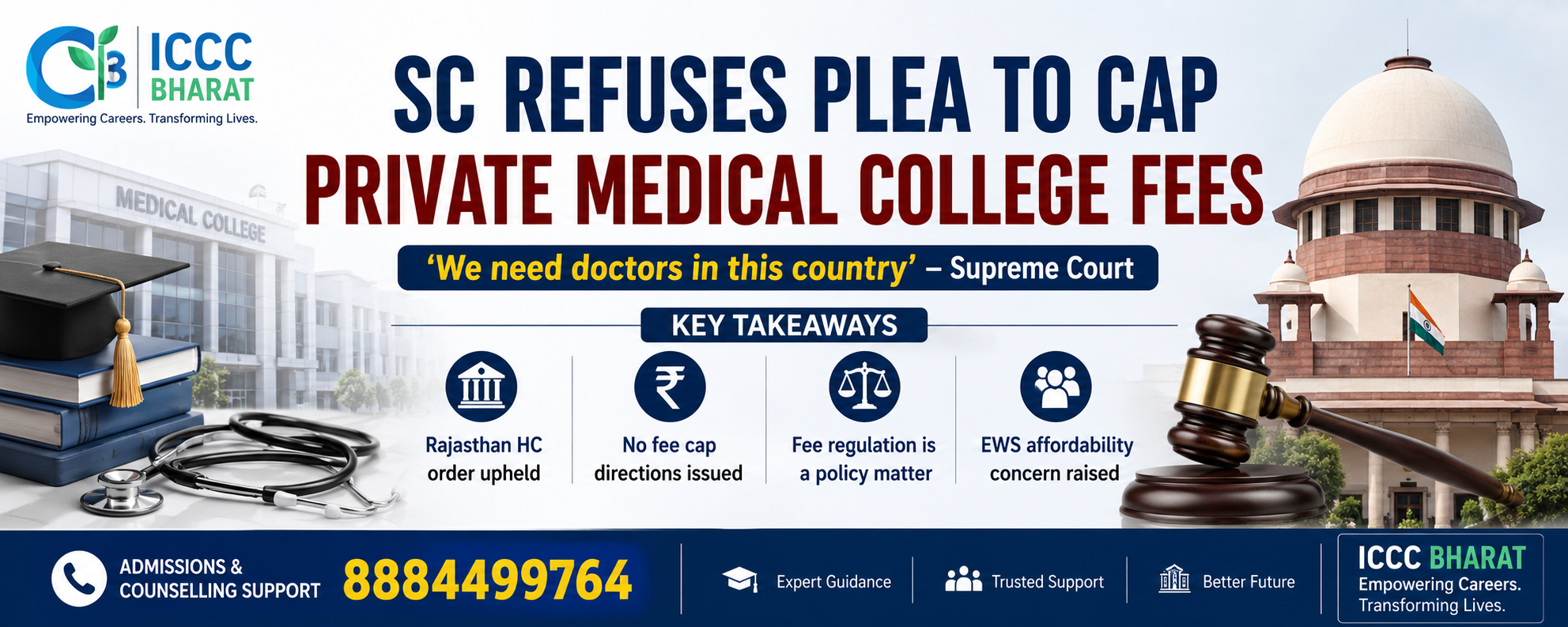
‘We Need Doctors in This Country’: Supreme Court Refuses to Cap Private Medical College Fees

The Supreme Court has dismissed a plea seeking a cap on fees charged by private medical colleges in Rajasthan, observing that India needs more doctors and that fee regulation is primarily a policy matter for competent authorities and regulators.

The case raised an important question that affects thousands of medical aspirants every year: how can economically weaker students pursue MBBS if private medical college fees remain very high, even after securing reservation or participating in counselling?

A Bench of Justices B.V. Nagarathna and Joymalya Bagchi heard a Special Leave Petition challenging an order of the Rajasthan High Court. The petitioner had argued that the annual tuition fees in private medical colleges in Rajasthan were extremely high, reportedly ranging from around ₹18.90 lakh to ₹25 lakh per year. According to the petitioner, such fees make MBBS education unaffordable for candidates belonging to the Economically Weaker Section category.

Supreme Court Refuses to Interfere

The Supreme Court refused to interfere with the Rajasthan High Court’s order and declined to pass any direction to cap the fees of private medical colleges.

The Court observed that medical education requires infrastructure, faculty, clinical facilities, equipment and institutional investment. Because of this, fee fixation cannot be treated as a simple matter of comparison between private and government colleges.

The Court also noted that fee regulation falls within the domain of state authorities and regulatory bodies. Judicial interference, according to the Court, may be justified only when there is clear illegality, arbitrariness or violation of law. In this case, the Court did not find sufficient ground to interfere.

The Court reportedly observed that one individual cannot simply claim that fees in private institutions are excessive and demand that they be brought on par with government institutions.

“We Need Doctors in This Country”

One of the most important remarks made by the Supreme Court was: “We need doctors in this country.”

This statement reflects the larger national requirement for more trained medical professionals. India needs more doctors, specialists and healthcare workers, especially in rural areas, government hospitals and underserved regions.

However, the statement also opens a larger debate. If the country needs more doctors, then the system must also ensure that medical education does not become accessible only to students who can afford high private college fees.

The real challenge is not only about increasing the number of medical seats. It is also about making those seats accessible, affordable and socially meaningful.

Concern of EWS Candidates

The petitioner argued that EWS candidates are given reservation based on an income limit, but when they are allotted private medical college seats with fees running into lakhs every year, the benefit becomes practically difficult to use.

This is a genuine concern raised by many students and parents across India. A student may qualify under EWS, participate in counselling and even receive an allotment, but if the fee is ₹20 lakh or more per year, admission may still remain impossible.

This creates a gap between theoretical reservation and practical affordability.

An EWS certificate may provide eligibility under a category, but it does not automatically solve the financial burden of private medical education. Many families cannot arrange such large amounts even after counselling allotment.

The Bigger Question: Is Reservation Enough Without Affordability?

This case brings forward an important policy question: is reservation meaningful if the allotted seat is financially unaffordable?

For government medical colleges, EWS reservation can provide real access because the fees are comparatively low. But in private medical colleges, even a reserved category candidate may have to pay the same fee as general category candidates.

This creates a situation where economically weaker students may technically get a seat but may be unable to join due to the cost.

Medical education policy must address this gap. Reservation, scholarships, education loans, fee regulation and transparent counselling must work together. Otherwise, many deserving students may remain outside the system.

NMC Fee Regulation Debate

The petitioner also referred to the National Medical Commission’s earlier position that fees for 50% of seats in private medical colleges and deemed universities should be at par with government medical college fees.

This issue has been discussed across the country for several years. Many parents and students expected that such regulation would reduce the burden on middle-class and EWS families.

However, fee regulation in private medical colleges remains a complex issue. States have fee regulatory committees, private colleges argue about infrastructure costs, and students continue to struggle with affordability.

The Supreme Court’s refusal to interfere in this case does not end the public debate. It only clarifies that courts may not directly fix fees unless there is clear illegality or arbitrariness.

Private Medical Colleges and Cost of Medical Education

Private medical colleges play an important role in increasing the number of MBBS seats in India. Many states depend heavily on private institutions to expand medical education capacity.

At the same time, high fees remain one of the biggest barriers for students.

Private medical colleges require hospitals, laboratories, clinical departments, faculty, equipment, patient facilities and regulatory compliance. These costs are real. But the student’s concern is also real. If fees are too high, medical education becomes limited to financially strong families.

This creates a difficult balance between institutional sustainability and student affordability.

Impact on Students and Parents

For many families, MBBS is a lifelong dream. Parents sell assets, take loans and arrange funds from relatives to support medical education. When annual fees cross ₹18 lakh to ₹25 lakh, the total cost of MBBS can become extremely high.

For EWS and middle-class families, this is often beyond reach.

Students who qualify NEET but do not get a government seat are forced to consider private colleges, deemed universities or management quota seats. In such cases, counselling strategy becomes very important because fees vary widely from state to state and college to college.

What Should the Government Do?

The Supreme Court has placed the issue within the domain of policy and regulatory authorities. This means the responsibility now lies with governments, fee regulatory committees and medical education regulators.

There is a need for:

Clear and transparent fee regulation

Public display of college-wise fee structure

Scholarship support for EWS and low-income students

Education loan support with easier terms

Strict control on hidden charges

Transparent counselling information before choice filling

Uniform disclosure of tuition fees, hostel fees, miscellaneous charges and bond conditions

Students should not discover the real financial burden only after allotment.

Need for Transparency in Counselling

One of the biggest problems in medical admission counselling is that students often fill choices without fully understanding the fee structure, bond conditions, hostel charges and refund rules.

Every counselling authority should publish clear college-wise fee details before option entry. Students must know exactly what they are choosing.

For EWS candidates, this is even more important. They should not be allotted seats that are financially impossible for them to accept unless they clearly understand the fee commitment.

ICCC Bharat View

The Supreme Court has made it clear that fee fixation is a policy matter and courts may not interfere unless there is clear illegality. But the concern of students remains serious.

India needs more doctors, but India also needs a fair medical education system where capable students are not blocked only because they cannot afford private college fees.

Medical seats should not become a privilege only for the financially strong. If EWS students are eligible for reservation, the system must also think about how they can practically afford the seat.

The solution is not simply to blame private colleges or courts. The solution must come through strong policy, transparent fee regulation, scholarships, education finance and honest counselling disclosure.

Conclusion

The Supreme Court’s decision in the Rajasthan private medical college fee case has once again brought attention to the affordability crisis in medical education.

The Court refused to cap private medical college fees and observed that India needs doctors. At the same time, the concerns of EWS and middle-class aspirants cannot be ignored.

If medical education remains unaffordable, many deserving students will lose their chance despite qualifying NEET.

The country needs doctors, but it also needs a system where becoming a doctor is not limited only to those who can pay high fees.

Affordable access, transparent counselling and fair regulation are essential for the future of medical education in India.
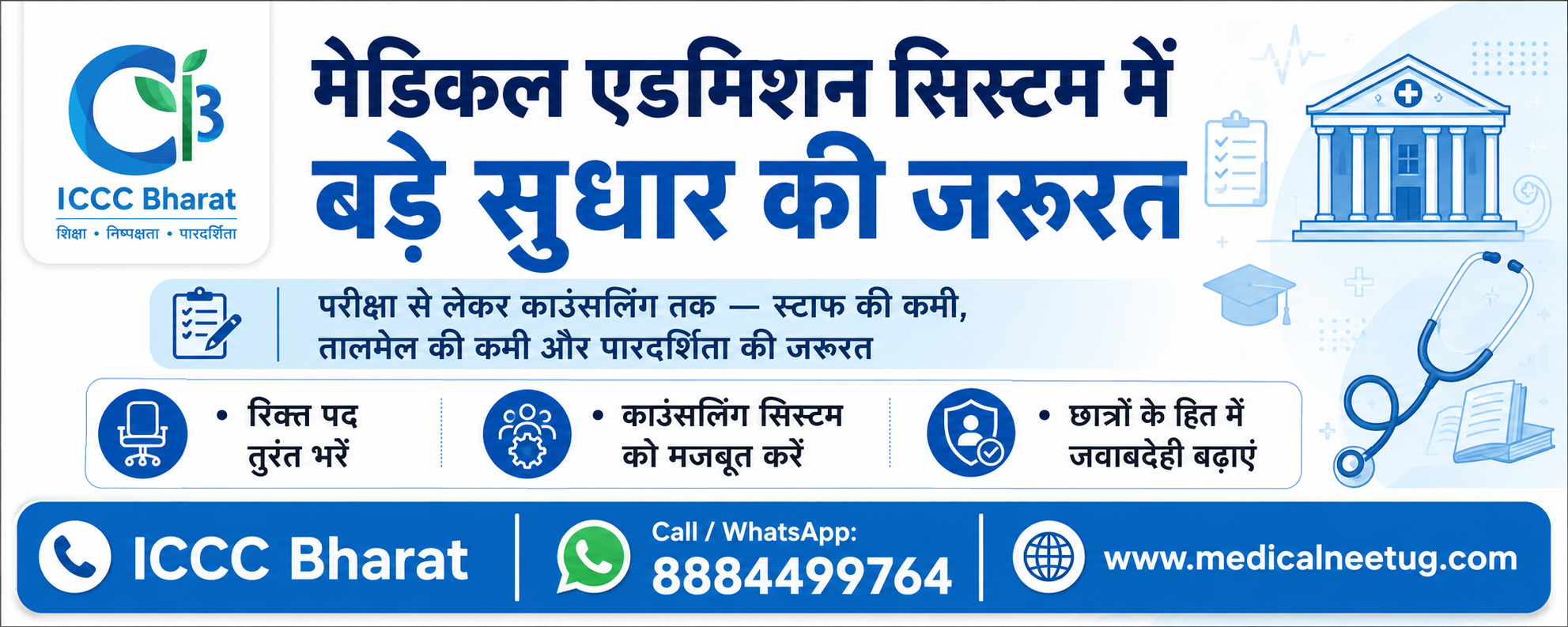
मेडिकल प्रवेश व्यवस्था में सुधार की जरूरत: परीक्षा से काउंसलिंग तक जवाबदेही जरूरी

भारत की मेडिकल प्रवेश व्यवस्था आज एक गंभीर मोड़ पर खड़ी है। NEET परीक्षा से लेकर काउंसलिंग, सीट मैट्रिक्स, allotment, NRI दस्तावेज, पोर्टल व्यवस्था और राज्य स्तरीय प्रवेश प्रक्रिया तक, कई जगहों पर ऐसी समस्याएं बार-बार सामने आती हैं जिनसे छात्रों और अभिभावकों का भरोसा कमजोर होता है।

यह मुद्दा केवल किसी एक संस्था या किसी एक परीक्षा तक सीमित नहीं है। समस्या व्यापक है। परीक्षा कराने वाली एजेंसियों से लेकर काउंसलिंग संचालित करने वाली समितियों और मेडिकल शिक्षा से जुड़े नियामक तंत्र तक, कई स्तरों पर खाली पद, स्टाफ की कमी, अनुभव की कमी और कमजोर समन्वय जैसी चुनौतियां दिखाई देती हैं।

छात्रों का भविष्य प्रशासनिक कमजोरी पर निर्भर नहीं होना चाहिए

मेडिकल प्रवेश कोई सामान्य प्रक्रिया नहीं है। यह लाखों छात्रों के करियर, परिवारों की आर्थिक क्षमता और देश के स्वास्थ्य भविष्य से जुड़ा विषय है।

एक छात्र कई वर्षों तक तैयारी करता है। माता-पिता अपनी बचत लगाते हैं। कुछ छात्र हॉस्टल, कोचिंग, यात्रा और मानसिक दबाव का सामना करते हैं। ऐसे में अगर परीक्षा, result, seat matrix, counselling portal या allotment में बार-बार confusion आता है, तो सबसे ज्यादा नुकसान ईमानदार छात्रों को होता है।

छात्रों का भविष्य किसी विभागीय कमी, कमजोर staffing या coordination failure की वजह से प्रभावित नहीं होना चाहिए।

परीक्षा से काउंसलिंग तक मजबूत मानव संसाधन जरूरी

NTA, NBE, MCC, NMC से जुड़े तंत्र, राज्य काउंसलिंग प्राधिकरण और मेडिकल विश्वविद्यालय — सभी पर आज workload बहुत अधिक बढ़ चुका है। मेडिकल कॉलेजों की संख्या बढ़ी है, deemed universities बढ़ी हैं, private colleges बढ़े हैं, NRI/management/minority/quota rules जटिल हुए हैं और छात्रों की संख्या भी बहुत अधिक हो चुकी है।

ऐसे में पुराने ढांचे और सीमित स्टाफ के भरोसे इतनी बड़ी व्यवस्था चलाना व्यावहारिक नहीं है।

जब संस्थाओं में पर्याप्त trained staff नहीं होते, तो समस्याएं बढ़ती हैं:

सीट मैट्रिक्स में देरी
पोर्टल में तकनीकी भ्रम
NRI दस्तावेजों पर अस्पष्ट जवाब
reservation roster में confusion
allotment पर विवाद
students’ grievances का सही समाधान न होना
राज्य और केंद्र के बीच coordination gap
काउंसलिंग schedule में बार-बार बदलाव

इन समस्याओं को केवल “technical issue” कहकर नहीं टाला जा सकता। यह governance और accountability का मामला है।

दिल्ली में संस्थाएं, लेकिन समन्वय कमजोर

देश की कई केंद्रीय मेडिकल शिक्षा और परीक्षा-संबंधित संस्थाएं दिल्ली से संचालित होती हैं। फिर भी कई बार ऐसा लगता है कि परीक्षा एजेंसी, काउंसलिंग समिति, नियामक निकाय और मंत्रालयों के बीच real-time coordination मजबूत नहीं है।

कभी new college approval देर से आता है।
कभी seat matrix late update होती है।
कभी counselling dates और court matters overlap करते हैं।
कभी states और MCC schedules में practical conflict दिखाई देता है।
कभी students को clear जवाब नहीं मिलता।

जब संस्थाएं एक ही राष्ट्रीय उद्देश्य के लिए काम कर रही हैं, तो उन्हें अलग-अलग island की तरह नहीं चलना चाहिए। एक integrated command system, clear responsibility chart और public communication mechanism जरूरी है।

नियुक्तियां योग्यता और अनुभव के आधार पर होनी चाहिए

भारत में योग्य लोगों की कमी नहीं है। हमारे देश में अनुभवी doctors, administrators, IT experts, legal experts, medical education consultants, policy professionals और sincere officers मौजूद हैं।

फिर सवाल उठता है: महत्वपूर्ण पद लंबे समय तक खाली क्यों रहते हैं?
क्यों कई जगह temporary या outsourced arrangements पर निर्भरता बनी रहती है?
क्यों experienced professionals को structured तरीके से शामिल नहीं किया जाता?

सरकार को यह सुनिश्चित करना चाहिए कि सभी महत्वपूर्ण पद पारदर्शी, merit-based और time-bound process के माध्यम से भरे जाएं।

यह धारणा नहीं बननी चाहिए कि नियुक्तियां केवल lobbying, personal approach या internal convenience के आधार पर होती हैं। ऐसी धारणा भी संस्थाओं की विश्वसनीयता को नुकसान पहुंचाती है।

ईमानदार और अनुभवी लोगों को सिस्टम में जगह मिलनी चाहिए

कई बार सक्षम लोग इसलिए सिस्टम में नहीं आते क्योंकि उन्हें लगता है कि merit से ज्यादा networking काम करती है। कुछ लोग इसलिए दूर रहते हैं क्योंकि वे किसी lobby या pressure system का हिस्सा नहीं बनना चाहते।

अगर देश को सच में शिक्षा और परीक्षा व्यवस्था सुधारनी है, तो ऐसे professionals को सम्मानपूर्वक invite करना होगा, उनकी expertise का उपयोग करना होगा और उन्हें decision-making में वास्तविक भूमिका देनी होगी।

ईमानदार अधिकारियों और knowledgeable professionals को केवल सलाहकार बनाकर नहीं, बल्कि जिम्मेदार भूमिका देकर system strengthen करना होगा।

पेपर लीक केवल एक लक्षण है, बीमारी गहरी है

पेपर लीक या परीक्षा विवाद केवल सतह पर दिखने वाली समस्या है। असली बीमारी गहरी है:

कमजोर protocol
मानव संसाधन की कमी
technology पर अधूरा control
outsourcing पर अत्यधिक निर्भरता
जवाबदेही की कमी
slow grievance redressal
institutions के बीच poor coordination
policy और ground implementation में gap

अगर इन मूल कारणों पर काम नहीं किया गया, तो केवल एक परीक्षा सुधारने से समस्या खत्म नहीं होगी।

राज्य काउंसलिंग में भी सुधार जरूरी

कई state counselling authorities हर साल विवादों में रहती हैं। कहीं seat matrix issue आता है, कहीं category eligibility clarity नहीं होती, कहीं NRI documents को लेकर confusion होता है, कहीं minority quota या roster point पर सवाल उठते हैं।

राज्य काउंसलिंग committees को भी trained manpower, legal cell, IT support, admission experts और grievance desk की जरूरत है।

एक state counselling authority को केवल notice upload करने वाली agency की तरह नहीं, बल्कि student-support system की तरह काम करना चाहिए।

केंद्र सरकार को गंभीरता से सुधार करना होगा

यह विषय केवल किसी agency की आलोचना का नहीं है। यह national interest का मुद्दा है।

भारत विकसित देश बनने की दिशा में आगे बढ़ना चाहता है। लेकिन अगर देश के सबसे मेहनती students — doctors, engineers, researchers और healthcare professionals बनने वाले युवा — कमजोर administrative systems के बीच संघर्ष करेंगे, तो भविष्य की गुणवत्ता प्रभावित होगी।

केंद्र सरकार को चाहिए कि वह medical admission ecosystem का complete administrative audit करे।

इसमें शामिल होना चाहिए:

NTA, NBE, MCC, NMC और state counselling bodies का manpower audit
खाली पदों की सूची और समयबद्ध भर्ती
exam और counselling protocols का review
seat matrix publication की fixed timeline
allotment process की independent audit
NRI/minority/category rules पर uniform clarity
state और central agencies के बीच coordination cell
student grievance redressal portal with tracking number
official reply की accountability
technical failure पर responsibility fixing

कानूनी और संवैधानिक दृष्टि से भी जरूरी

मेडिकल admission system Article 14 और Article 21 से जुड़े fairness, equality और career opportunity के सवालों को प्रभावित करता है। जब छात्र समान परीक्षा और समान काउंसलिंग प्रक्रिया में भाग लेते हैं, तो व्यवस्था पारदर्शी, गैर-भेदभावपूर्ण और जवाबदेह होनी चाहिए।

अगर सीटें खाली रह जाती हैं, seat matrix देर से आती है, rules अस्पष्ट रहते हैं या students को सही समय पर सही information नहीं मिलती, तो यह केवल administrative lapse नहीं बल्कि students’ legitimate expectation का भी सवाल बन जाता है।

इसलिए सुधार केवल policy choice नहीं, बल्कि public duty है।

निष्कर्ष

भारत की मेडिकल प्रवेश व्यवस्था को अब cosmetic सुधार नहीं, बल्कि गहरे structural reform की जरूरत है।

पेपर लीक, सीट मैट्रिक्स विवाद, NRI document confusion, portal issues, counselling delays और allotment controversies — ये सभी संकेत हैं कि सिस्टम पर workload बढ़ चुका है और पुराना ढांचा पर्याप्त नहीं है।

सरकार को तुरंत योग्य लोगों की नियुक्ति, मजबूत staffing, बेहतर technology, legal clarity और institutional coordination पर काम करना चाहिए।

भारत में प्रतिभा की कमी नहीं है। कमी है सही लोगों को सही जिम्मेदारी देने की।

छात्रों ने मेहनत में कमी नहीं की है। अब सिस्टम को ईमानदारी, दक्षता और जवाबदेही दिखानी होगी। देश का भविष्य कमजोर प्रशासनिक ढांचे के भरोसे नहीं छोड़ा जा सकता

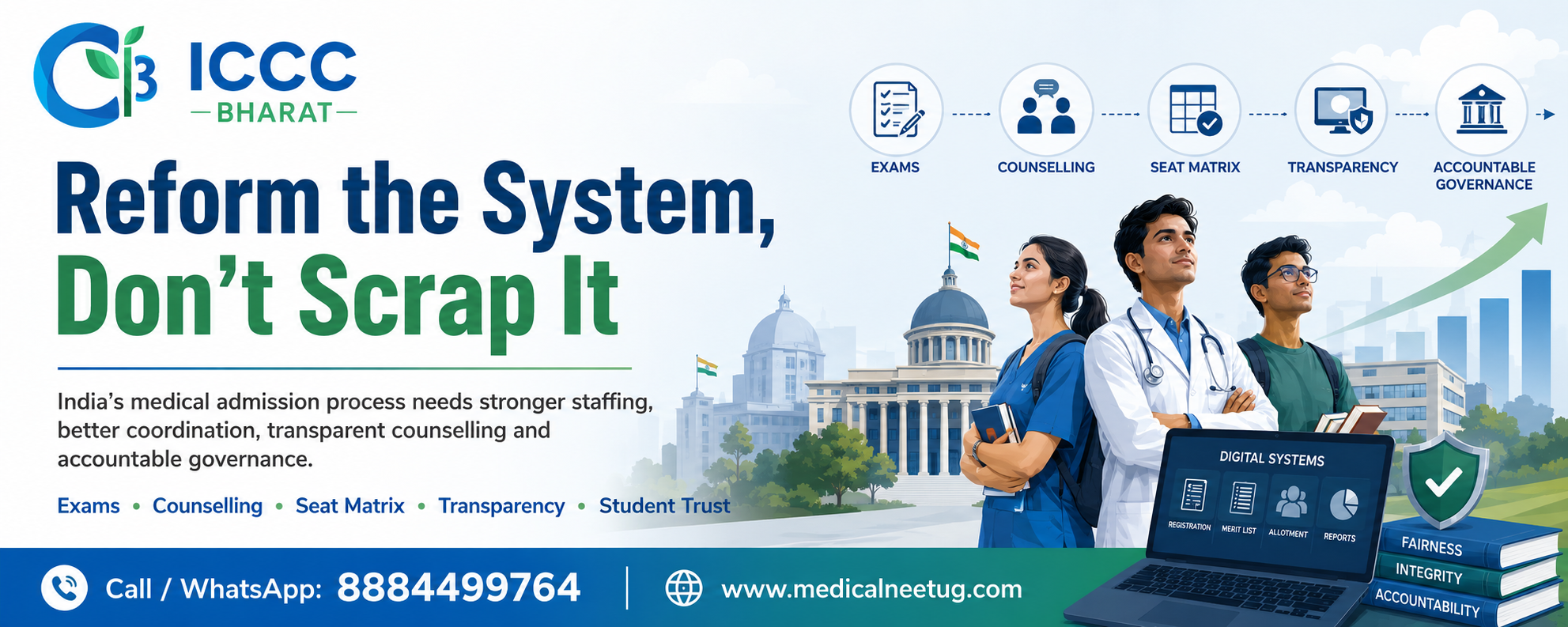
India’s Medical Admission System Needs Urgent Institutional Reform, Not Temporary Fixes

India’s medical admission system is one of the most sensitive and high-pressure education systems in the country. From entrance examinations to counselling, allotment, seat matrix publication, category verification, NRI documentation, roster implementation and final admission, every step affects the future of lakhs of students and families.

The recent controversies around examinations and counselling should not be seen as isolated incidents. They are warning signs of a deeper institutional weakness.

Across the medical admission ecosystem, several bodies are involved — examination agencies, counselling authorities, regulatory institutions, state counselling boards, universities and government departments. But in many places, the system appears to be functioning with staff shortages, vacant senior positions, weak coordination and inadequate technical support.

This is not merely an administrative issue. It is a national concern.

Vacant Posts and Weak Staffing Are Damaging Trust

When an agency handles high-stakes examinations or counselling for lakhs of students, it cannot function properly with insufficient manpower. If key posts remain vacant, if trained staff are missing, or if temporary arrangements are used repeatedly, mistakes become more likely.

Medical admissions require experienced officers who understand reservation rules, minority quota, NRI quota, domicile rules, seat matrix preparation, fee structures, legal orders, court directions and counselling software.

If the people managing the process lack adequate experience or support, students suffer.

Every wrong seat matrix, delayed notification, confusing circular or poor helpline response creates panic among students and parents.

Counselling Authorities Need Strong Permanent Structures

Medical counselling is not a routine clerical process. It decides the careers of future doctors, dentists and healthcare professionals.

Authorities such as national and state counselling bodies must have permanent offices, trained staff, legal experts, technical teams, admission policy experts and grievance redressal officers.

At present, students often face problems such as:

unclear seat matrix updates,
late addition or withdrawal of colleges,
confusion in NRI documentation,
portal errors,
category and roster disputes,
poor communication from helplines,
delayed allotments,
and repeated counselling-related litigation.

These issues show that the system needs better planning and stronger administrative capacity.

Lack of Coordination Creates Confusion

One of the biggest problems is lack of coordination between central and state authorities.

The Ministry of Health and Family Welfare, NMC, MCC, NTA, universities and state counselling authorities must work in a coordinated manner. If one body releases a schedule, another delays approval, and a third changes the seat matrix, students are left confused.

This becomes more serious when new colleges are added late, permissions are delayed, fee structures are unclear, or court orders affect seat availability.

Students should not suffer because institutions are not communicating properly with each other.

Appointments Must Be Transparent and Merit-Based

India has no shortage of capable people. Across the country, there are experienced doctors, administrators, legal experts, education professionals, technologists and admission specialists who understand the system deeply.

The concern is whether such people are being identified and appointed through transparent, merit-based processes.

Important public institutions should not depend on lobbying, personal influence or informal networks. Appointments in examination and counselling bodies must be based on competence, integrity, experience and proven track record.

A country of more than 140 crore people cannot say that it lacks qualified professionals for key education posts.

Paper Leak Is Only One Symptom

The NEET paper leak controversy is a serious matter, but it is only one visible example of a larger problem.

If examination bodies are understaffed, if security systems are weak, if confidential processes are not monitored properly, and if accountability is unclear, then such incidents become possible.

Similarly, if counselling systems lack staff, legal clarity and technical strength, then seat wastage, wrong allotments and repeated disputes will continue.

The issue is not only about one exam or one counselling round. The issue is the credibility of India’s medical education system.

Students and Parents Are Paying the Price

A student preparing for NEET does not only study for one exam. The student carries years of sacrifice, family expectations and emotional pressure.

Parents spend huge amounts on coaching, hostel, travel, documentation and counselling. Many families take loans or use their life savings for medical education.

When the system fails, the student loses confidence. The parent loses trust. The nation loses future healthcare professionals.

No student should lose an opportunity because of poor administration, vacant posts or delayed decision-making.

The Government Must Act Seriously

The central government has a responsibility to strengthen the entire medical admission system. Temporary fixes, committee announcements and last-minute clarifications are not enough.

The government must create a long-term reform plan with clear deadlines and public accountability.

Important steps should include:

filling vacant posts immediately,
appointing experienced and qualified professionals,
creating permanent technical teams,
strengthening counselling infrastructure,
auditing seat matrix preparation,
improving helpline and grievance systems,
ensuring real-time coordination between NMC, MCC, NTA, universities and states,
making all notices clear and legally consistent,
and publishing transparent timelines for every admission stage.

Legal and Administrative Accountability Is Essential

Medical admission processes are frequently affected by court cases because students and parents often feel that their concerns are not resolved at the administrative level.

If grievance systems are strong, many legal disputes can be avoided.

Every authority must maintain proper records, follow published rules, respond to complaints meaningfully and act within legally valid frameworks. Replies should not be mechanical or vague. Students deserve reasoned answers.

Accountability should not begin only after controversy. It must be built into the system from the beginning.

Reform Is Necessary for India’s Future

India wants to become a global leader in education, healthcare and human resources. But that future cannot be built if bright students are handled by weak systems.

Medical admissions decide who will become tomorrow’s doctors, surgeons, dentists, specialists and healthcare leaders. This process must be protected with the highest level of seriousness.

A strong India needs a strong examination system.
A strong healthcare system needs fair medical admissions.
A fair admission system needs competent people, transparent rules and accountable institutions.

Conclusion

The crisis in medical admissions is not just about paper leaks, vacant seats or counselling delays. It is about institutional trust.

India does not need cosmetic reform. It needs deep structural reform.

The government must strengthen examination bodies, counselling authorities and regulatory systems with experienced staff, permanent infrastructure, transparent appointments and technology-driven accountability.

Students are doing their duty by studying hard. Parents are doing their duty by supporting them. Now the system must do its duty by protecting their future.

Medical admissions must be fair, transparent, timely and professionally managed — because the future of India’s healthcare depends on it