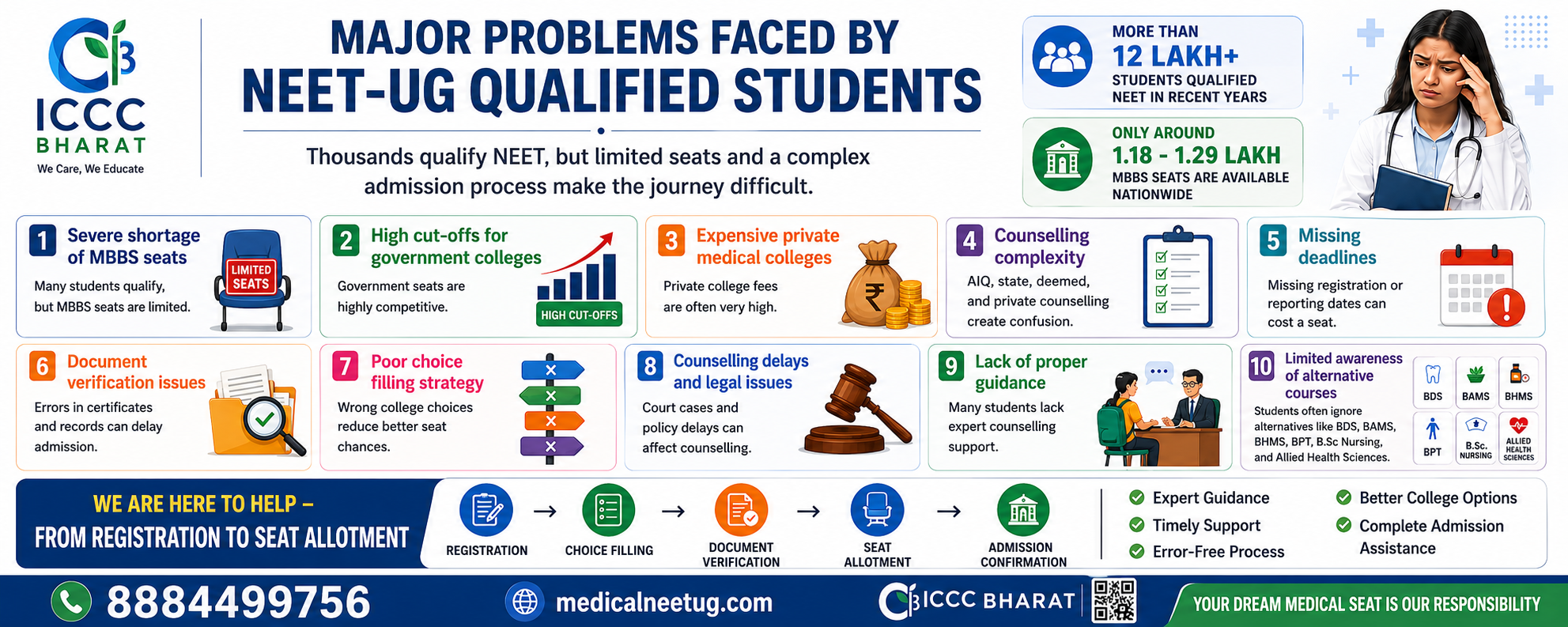
Major Problems Faced by NEET-UG Qualified Students

NEET-UG is one of the most competitive entrance examinations in India. Every year, lakhs of students work hard, qualify NEET, and dream of becoming doctors. However, qualifying NEET is only the first step. The real challenge begins after the result, when students and parents start the admission process.

Many NEET-UG qualified students face confusion, pressure, financial challenges, counselling complexity, and lack of proper guidance. Even after qualifying the exam, getting the right medical seat in the right college is not easy.

1. Severe Shortage of MBBS Seats

One of the biggest problems faced by NEET-UG qualified students is the limited number of MBBS seats. Every year, a large number of students qualify NEET, but the number of available MBBS seats is much lower.

This creates heavy competition for every seat. Students with good scores may also face difficulty in getting admission, especially in preferred colleges or states.

Because of this shortage, many students are forced to explore private colleges, deemed universities, management quota seats, or alternative medical courses.

2. High Cut-Offs for Government Medical Colleges

Government medical colleges are the first choice for most students because of their low fees, good clinical exposure, and strong reputation.

However, the cut-offs for government medical colleges remain very high. Even students with good NEET scores may miss government MBBS seats because of intense competition.

In many states, the closing ranks for government colleges are very competitive. This creates pressure on students and parents during counselling.

3. Expensive Private Medical Colleges

Private medical colleges are an option for students who do not get government seats. However, the fee structure in many private and deemed medical colleges can be very high.

For many families, private MBBS fees become a major financial challenge. Apart from tuition fees, students may also need to consider hostel fees, university charges, security deposits, bond conditions, and other expenses.

Therefore, proper fee analysis is very important before selecting any private medical college.

4. Complex Counselling Process

NEET-UG admission is not based only on marks. Students have to participate in multiple counselling processes depending on their eligibility and preference.

Major counselling routes include:

  • All India Quota counselling
  • State quota counselling
  • Deemed university counselling
  • Private college counselling
  • Management quota counselling
  • NRI quota counselling

Each counselling has different rules, eligibility criteria, documents, deadlines, and fee structures. Many students and parents get confused during this process.

A small mistake in counselling can lead to losing a good seat opportunity.

5. Missing Important Deadlines

NEET counselling has several important stages such as registration, fee payment, document upload, choice filling, choice locking, allotment result, reporting, and admission confirmation.

Some students miss important deadlines due to lack of awareness or confusion. Missing even one deadline can result in losing admission chances.

That is why students must follow official counselling notifications carefully and maintain a proper admission calendar.

6. Document Verification Issues

Document verification is an important part of the admission process. Many students face problems because of incomplete, incorrect, or delayed documents.

Common document-related issues include:

  • Domicile certificate problems
  • Category certificate issues
  • Income certificate errors
  • Minority certificate requirements
  • Identity proof mismatch
  • Academic certificate mistakes
  • NRI document confusion

If documents are not proper, students may face admission delays or even rejection.

7. Poor Choice Filling Strategy

Choice filling is one of the most important steps in NEET counselling. Many students make mistakes while entering college preferences.

Common choice filling mistakes include choosing unrealistic colleges, ignoring state counselling options, not researching fees, not checking bond rules, and not understanding college quality.

A poor choice filling strategy can lead to missing better colleges or getting a seat in an unsuitable college.

Smart choice filling should be based on rank, category, budget, previous cut-offs, college quality, location, fee structure, and future goals.

8. Counselling Delays and Legal Issues

Sometimes, NEET counselling may be affected by court cases, approval delays, seat matrix changes, or policy updates. These delays create uncertainty and stress for students.

Students may have to wait for updated seat matrix details, revised schedules, or new counselling notifications. This makes the admission journey more stressful.

In such situations, students should stay calm and depend only on official updates.

9. Lack of Proper Guidance

Many students, especially from rural areas or first-generation learner families, do not have access to professional counselling support.

Without proper guidance, students may make mistakes in registration, document preparation, counselling selection, choice filling, or reporting.

Proper counselling guidance helps students understand realistic options and avoid costly admission mistakes.

10. Limited Awareness of Alternative Courses

Many students focus only on MBBS. But if they do not get an MBBS seat, they may lose one academic year while preparing again for NEET.

Students should also be aware of other healthcare career options such as:

  • BDS
  • BAMS
  • BHMS
  • BPT
  • B.Sc Nursing
  • Allied Health Sciences

These courses also offer good career opportunities in the healthcare sector. Choosing the right alternative course can save time and create a strong career path.

From Registration to Seat Allotment – Proper Guidance Matters

NEET-UG counselling is a step-by-step process. Students need support from registration to seat allotment and admission confirmation.

Important stages include:

  • Registration
  • Choice filling
  • Document verification
  • Seat allotment
  • Reporting
  • Admission confirmation

With expert guidance, students can avoid errors, understand better college options, complete the process on time, and make informed decisions.

How ICCC Bharat Helps NEET-UG Students

ICCC Bharat supports students and parents throughout the NEET-UG admission journey. From counselling guidance to college selection, students receive assistance based on rank, category, budget, state eligibility, and career goals.

ICCC Bharat helps students with:

  • Expert guidance
  • Timely counselling support
  • Error-free admission process
  • Better college options
  • Complete admission assistance

Conclusion

Qualifying NEET-UG is a great achievement, but getting the right medical seat requires proper planning. Students must understand seat availability, cut-offs, fee structure, counselling rules, documents, and choice filling strategy.

A wrong decision can affect both career and finances. Therefore, students should take informed steps and seek expert guidance when needed.

Your dream medical seat is possible with the right planning, right counselling, and right admission strategy.

ICCC Bharat
Your Dream Medical Seat Is Our Responsibility
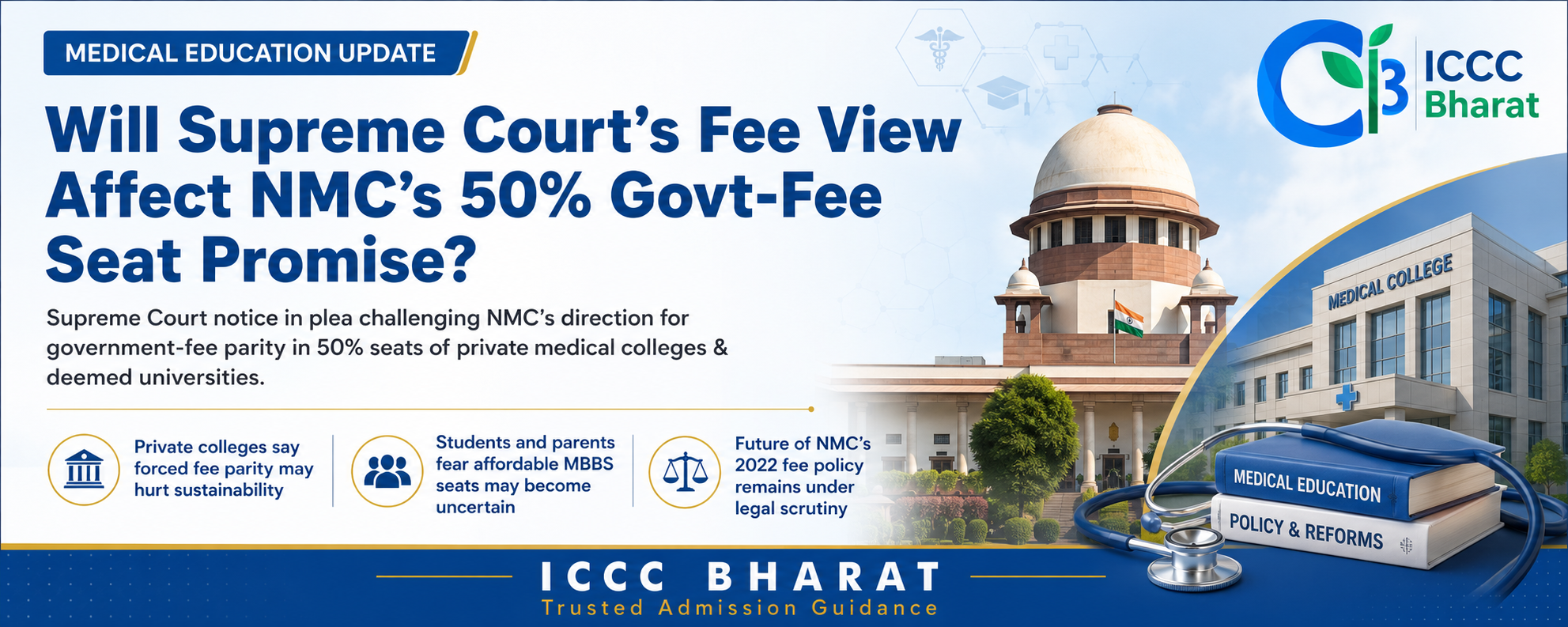
Medical Education Fee Shock: Will Supreme Court’s Private College Fee View Affect the Promise of Government-Fee Seats in 50% Private Medical College Seats?

Medical education in India is again facing a major policy and legal question: can private medical colleges and deemed universities be compelled to charge government medical college-level fees for 50% of their seats?

This question has become more serious after the Supreme Court refused to interfere with the fee structure of private medical colleges in Rajasthan in a case filed by an EWS student. The Court observed that self-financing private institutions cannot automatically be forced to charge fees at par with government institutions and that India needs doctors.

At first glance, this may look like an individual student’s case. But its larger impact may be much bigger.

The decision may directly influence the ongoing debate around the National Medical Commission’s 03 February 2022 office memorandum, which recommended that fees for 50% seats in private medical colleges and deemed universities should be at par with government medical colleges of the respective State or Union Territory.

This was one of the biggest promises made to medical aspirants and parents: that 50% seats in private medical colleges would become affordable like government seats.

But after the Supreme Court’s recent observations, the future of this promise has become legally uncertain.

What Was the NMC’s 50% Fee Direction?

The National Medical Commission had issued an office memorandum stating that fees for 50% seats in private medical colleges and deemed universities should be at par with government medical colleges in that State or Union Territory.

The idea behind this direction was simple and student-friendly: private medical education should not remain completely unaffordable, and at least half of the seats should be accessible to students at government-like fee levels.

For lakhs of NEET-UG aspirants, this created hope. Many students and parents believed that even if they could not get a government medical college seat, they may still get a private medical college seat at a reasonable fee.

This was especially important for middle-class families, EWS candidates and students who narrowly miss government seats due to rank competition.

Why the Direction Was Challenged

Private medical colleges and associations challenged the NMC direction, arguing that private self-financing institutions cannot be forced to charge government-level fees without considering infrastructure costs, faculty salaries, hospital expenses, equipment, laboratories, maintenance and regulatory requirements.

Their basic argument is that government colleges are funded and supported by the State, while private colleges are self-financing. Therefore, both cannot be treated identically for fee purposes.

This is where the legal conflict begins.

Students want affordability.

Private colleges want financial sustainability.

The government wants more medical seats.

The courts must balance law, policy, affordability and institutional survival.

Supreme Court Notice in Challenge to NMC Direction

The Supreme Court had earlier issued notice in a petition challenging the validity of the NMC direction requiring government-fee parity for 50% seats in private medical colleges and deemed universities.

This means the validity of the NMC’s 50% fee direction is not a closed issue. It remains a serious legal question.

If the Supreme Court eventually upholds the NMC direction, students may benefit from affordable seats in private medical colleges.

But if the Court strikes it down or limits its implementation, the dream of government-fee seats in 50% private college seats may become difficult or even impossible unless Parliament, State Governments or regulators create a stronger statutory framework.

Latest Supreme Court Observation: A Warning Signal?

The latest Supreme Court order in the Rajasthan EWS fee matter may become important in interpreting the future of private medical college fee regulation.

In that case, the petitioner argued that private medical college fees of around ₹18.90 lakh to ₹25 lakh per year were unaffordable for an EWS candidate, especially when the EWS income limit is ₹8 lakh per year.

The petitioner also relied on the NMC memorandum on government-fee parity for 50% private medical college seats.

However, the Supreme Court refused to interfere. The Bench observed that private institutions cannot simply be equated with government institutions for fee purposes. It also noted that private medical colleges are self-financing institutions and that forcing them to charge only government-level fees may affect their functioning.

This observation may not be a final ruling on the validity of the NMC 50% fee memorandum, but it clearly shows the Court’s concern about forcing private institutions to run at government fee levels.

What About the Prime Minister’s Promise?

The NMC’s 50% fee direction was widely understood by students and parents as a major affordability promise in medical education.

The political message was powerful: 50% seats in private medical colleges would become available at government college fees.

But a policy promise becomes enforceable only when it is supported by a clear legal mechanism.

If the Supreme Court takes the view that private self-financing institutions cannot be compelled through an office memorandum alone, then the promise may face serious implementation difficulty.

This does not mean the promise is impossible forever. But it may mean that a simple NMC office memorandum may not be enough.

A stronger law, clear regulatory power, state adoption, fee committee mechanism and financial balancing model may be required.

The Big Legal Question

The core legal question is this:

Can NMC, through an office memorandum, force private medical colleges and deemed universities to charge government college fees for 50% seats?

Private institutions may argue that such a direction affects their autonomy and financial viability.

Students may argue that medical education is a public good and cannot be left completely to market pricing.

The government may argue that affordable medical education is necessary to create more doctors and reduce inequality.

The Supreme Court will have to balance all these competing interests.

Why the “M&M / Fee Regulation” Debate Matters

The larger line of judicial thinking on private professional institutions has often protected the autonomy of unaided private institutions, while also allowing reasonable regulation to prevent profiteering and capitation fees.

This is the real conflict.

Regulation is allowed.

Profiteering can be controlled.

Capitation fee can be banned.

But can private colleges be forced to charge the same fee as government colleges?

That is the difficult question.

If the Court applies a strict autonomy-based interpretation, the NMC’s 50% government-fee direction may face legal difficulty.

If the Court gives higher weight to public interest, medical affordability and regulatory power under the NMC framework, then the direction may survive, at least with modifications.

Impact on Government Quota Seats in Private Medical Colleges

Many states already have different types of seats in private medical colleges, such as government quota, management quota, institutional quota and NRI quota.

In some states, government quota seats in private colleges are comparatively lower in fee than management seats. But this depends on state laws, fee committees and counselling rules.

The NMC’s 50% fee direction attempted to create a broader national standard.

If the Supreme Court weakens or rejects the NMC direction, then fee regulation may go back largely to state-wise rules and fee fixation committees.

This means students in different states may face different fee structures.

In one state, private government quota seats may remain affordable.

In another state, they may remain very expensive.

This will create inequality in medical education access across India.

What Students Should Understand

Students and parents must understand one important point: a policy announcement and actual enforceable fee benefit are not the same.

Before choosing a private medical college, students must verify:

Whether the state has adopted the NMC 50% fee guideline

Whether the fee committee has approved government-fee parity

Whether the college is legally bound to follow reduced fee

Whether the fee applies to government quota only or 50% total seats

Whether deemed universities are actually implementing it

Whether any court stay or litigation is pending

Whether the counselling brochure clearly mentions the fee

Whether hostel, miscellaneous charges and other costs are separate

Many families assume that 50% seats in private colleges are automatically available at government fees. That assumption can be risky.

The Affordability Crisis Is Real

Even if private colleges have valid arguments about cost, the affordability crisis cannot be ignored.

A student from an EWS family with an annual income limit of ₹8 lakh cannot realistically pay ₹20 lakh per year in tuition fees.

Even many middle-class families cannot afford private MBBS fees without selling assets, taking huge loans or depending on relatives.

This creates a painful contradiction.

India says it needs more doctors.

Students say they want to become doctors.

But the fee structure blocks many deserving candidates.

If affordability is not addressed, medical education will increasingly become accessible only to financially strong families.

Private Colleges Also Have a Point

At the same time, private medical colleges cannot be treated as if they are government-funded institutions.

They have to maintain hospitals, laboratories, faculty, infrastructure, equipment, hostels and regulatory compliance. If fee fixation is unrealistic, institutions may claim they cannot maintain quality or continue operations.

This is why the solution cannot simply be: make all private seats government-fee seats.

A workable model is needed.

The government may have to support private institutions through subsidies, viability gap funding, scholarships, education loan support, or tax and infrastructure incentives if it wants private colleges to offer government-level fees for a large number of seats.

What Could Be a Practical Solution?

A balanced solution may include:

A legally enforceable fee regulation framework

State-wise fee committees with transparent cost audits

Government-fee seats for a defined percentage of private college seats

Scholarship or direct benefit support for EWS and low-income students

Education loan guarantee schemes for medical aspirants

Strict ban on capitation fee and hidden charges

Mandatory publication of total course cost before counselling

Separate protection for government quota seats in private colleges

Uniform disclosure of fees on MCC and state counselling portals

Without these steps, affordability promises may remain only on paper.

ICCC Bharat Interpretation

The Supreme Court’s recent observation should be seen as a warning signal for students, parents and policymakers.

The promise of 50% private medical college seats at government fees may not survive only on the strength of an office memorandum if it is not supported by clear law and state-level implementation.

The Court appears concerned that private self-financing institutions cannot be forced to operate exactly like government colleges. If this reasoning is applied to the NMC 50% fee case, the direction may face serious legal challenge.

However, the need for affordable medical education remains urgent.

The solution is not to abandon students.

The solution is to create a stronger, legally sustainable fee regulation model.

If the government truly wants 50% seats in private medical colleges at government fees, then it must build a proper statutory framework, defend it strongly in court, and support its implementation financially and administratively.

Conclusion

The Supreme Court’s refusal to interfere in the Rajasthan private medical fee case may have a larger impact on the future of NMC’s 50% government-fee direction for private medical colleges and deemed universities.

The legal battle is not just about one student or one state.

It is about the future of affordable MBBS education in India.

If the NMC direction survives, lakhs of students may get hope.

If it fails, the promise of 50% government-fee seats in private medical colleges may become very difficult to implement without a new law or stronger policy mechanism.

India needs doctors. But India also needs a system where deserving students can afford to become doctors.

The future of medical education depends on balancing three things: affordability for students, sustainability for institutions and accountability from regulators.

‘We Need Doctors in This Country’: Supreme Court Refuses to Cap Private Medical College Fees

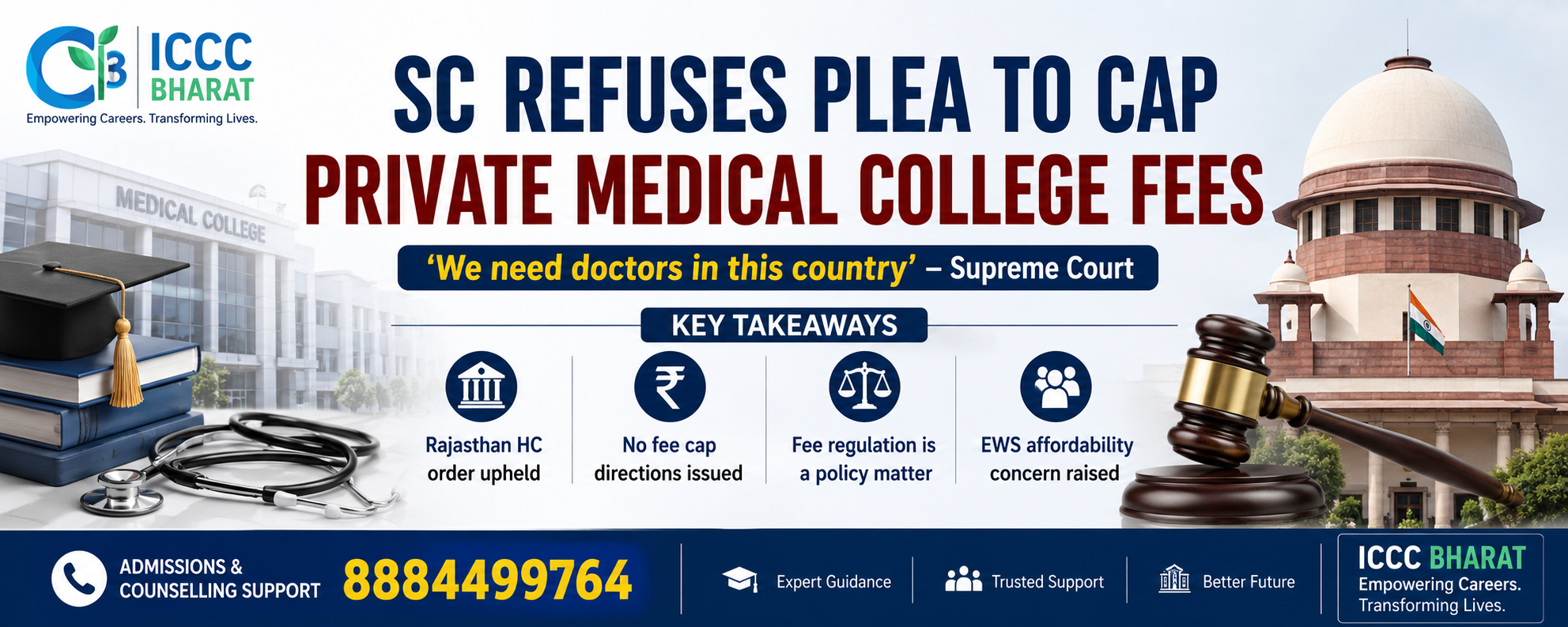
The Supreme Court has dismissed a plea seeking a cap on fees charged by private medical colleges in Rajasthan, observing that India needs more doctors and that fee regulation is primarily a policy matter for competent authorities and regulators.

The case raised an important question that affects thousands of medical aspirants every year: how can economically weaker students pursue MBBS if private medical college fees remain very high, even after securing reservation or participating in counselling?

A Bench of Justices B.V. Nagarathna and Joymalya Bagchi heard a Special Leave Petition challenging an order of the Rajasthan High Court. The petitioner had argued that the annual tuition fees in private medical colleges in Rajasthan were extremely high, reportedly ranging from around ₹18.90 lakh to ₹25 lakh per year. According to the petitioner, such fees make MBBS education unaffordable for candidates belonging to the Economically Weaker Section category.

Supreme Court Refuses to Interfere

The Supreme Court refused to interfere with the Rajasthan High Court’s order and declined to pass any direction to cap the fees of private medical colleges.

The Court observed that medical education requires infrastructure, faculty, clinical facilities, equipment and institutional investment. Because of this, fee fixation cannot be treated as a simple matter of comparison between private and government colleges.

The Court also noted that fee regulation falls within the domain of state authorities and regulatory bodies. Judicial interference, according to the Court, may be justified only when there is clear illegality, arbitrariness or violation of law. In this case, the Court did not find sufficient ground to interfere.

The Court reportedly observed that one individual cannot simply claim that fees in private institutions are excessive and demand that they be brought on par with government institutions.

“We Need Doctors in This Country”

One of the most important remarks made by the Supreme Court was: “We need doctors in this country.”

This statement reflects the larger national requirement for more trained medical professionals. India needs more doctors, specialists and healthcare workers, especially in rural areas, government hospitals and underserved regions.

However, the statement also opens a larger debate. If the country needs more doctors, then the system must also ensure that medical education does not become accessible only to students who can afford high private college fees.

The real challenge is not only about increasing the number of medical seats. It is also about making those seats accessible, affordable and socially meaningful.

Concern of EWS Candidates

The petitioner argued that EWS candidates are given reservation based on an income limit, but when they are allotted private medical college seats with fees running into lakhs every year, the benefit becomes practically difficult to use.

This is a genuine concern raised by many students and parents across India. A student may qualify under EWS, participate in counselling and even receive an allotment, but if the fee is ₹20 lakh or more per year, admission may still remain impossible.

This creates a gap between theoretical reservation and practical affordability.

An EWS certificate may provide eligibility under a category, but it does not automatically solve the financial burden of private medical education. Many families cannot arrange such large amounts even after counselling allotment.

The Bigger Question: Is Reservation Enough Without Affordability?

This case brings forward an important policy question: is reservation meaningful if the allotted seat is financially unaffordable?

For government medical colleges, EWS reservation can provide real access because the fees are comparatively low. But in private medical colleges, even a reserved category candidate may have to pay the same fee as general category candidates.

This creates a situation where economically weaker students may technically get a seat but may be unable to join due to the cost.

Medical education policy must address this gap. Reservation, scholarships, education loans, fee regulation and transparent counselling must work together. Otherwise, many deserving students may remain outside the system.

NMC Fee Regulation Debate

The petitioner also referred to the National Medical Commission’s earlier position that fees for 50% of seats in private medical colleges and deemed universities should be at par with government medical college fees.

This issue has been discussed across the country for several years. Many parents and students expected that such regulation would reduce the burden on middle-class and EWS families.

However, fee regulation in private medical colleges remains a complex issue. States have fee regulatory committees, private colleges argue about infrastructure costs, and students continue to struggle with affordability.

The Supreme Court’s refusal to interfere in this case does not end the public debate. It only clarifies that courts may not directly fix fees unless there is clear illegality or arbitrariness.

Private Medical Colleges and Cost of Medical Education

Private medical colleges play an important role in increasing the number of MBBS seats in India. Many states depend heavily on private institutions to expand medical education capacity.

At the same time, high fees remain one of the biggest barriers for students.

Private medical colleges require hospitals, laboratories, clinical departments, faculty, equipment, patient facilities and regulatory compliance. These costs are real. But the student’s concern is also real. If fees are too high, medical education becomes limited to financially strong families.

This creates a difficult balance between institutional sustainability and student affordability.

Impact on Students and Parents

For many families, MBBS is a lifelong dream. Parents sell assets, take loans and arrange funds from relatives to support medical education. When annual fees cross ₹18 lakh to ₹25 lakh, the total cost of MBBS can become extremely high.

For EWS and middle-class families, this is often beyond reach.

Students who qualify NEET but do not get a government seat are forced to consider private colleges, deemed universities or management quota seats. In such cases, counselling strategy becomes very important because fees vary widely from state to state and college to college.

What Should the Government Do?

The Supreme Court has placed the issue within the domain of policy and regulatory authorities. This means the responsibility now lies with governments, fee regulatory committees and medical education regulators.

There is a need for:

Clear and transparent fee regulation

Public display of college-wise fee structure

Scholarship support for EWS and low-income students

Education loan support with easier terms

Strict control on hidden charges

Transparent counselling information before choice filling

Uniform disclosure of tuition fees, hostel fees, miscellaneous charges and bond conditions

Students should not discover the real financial burden only after allotment.

Need for Transparency in Counselling

One of the biggest problems in medical admission counselling is that students often fill choices without fully understanding the fee structure, bond conditions, hostel charges and refund rules.

Every counselling authority should publish clear college-wise fee details before option entry. Students must know exactly what they are choosing.

For EWS candidates, this is even more important. They should not be allotted seats that are financially impossible for them to accept unless they clearly understand the fee commitment.

ICCC Bharat View

The Supreme Court has made it clear that fee fixation is a policy matter and courts may not interfere unless there is clear illegality. But the concern of students remains serious.

India needs more doctors, but India also needs a fair medical education system where capable students are not blocked only because they cannot afford private college fees.

Medical seats should not become a privilege only for the financially strong. If EWS students are eligible for reservation, the system must also think about how they can practically afford the seat.

The solution is not simply to blame private colleges or courts. The solution must come through strong policy, transparent fee regulation, scholarships, education finance and honest counselling disclosure.

Conclusion

The Supreme Court’s decision in the Rajasthan private medical college fee case has once again brought attention to the affordability crisis in medical education.

The Court refused to cap private medical college fees and observed that India needs doctors. At the same time, the concerns of EWS and middle-class aspirants cannot be ignored.

If medical education remains unaffordable, many deserving students will lose their chance despite qualifying NEET.

The country needs doctors, but it also needs a system where becoming a doctor is not limited only to those who can pay high fees.

Affordable access, transparent counselling and fair regulation are essential for the future of medical education in India.