NEET Solver Gang Busted in Nalanda: This Is Not Cheating, This Is Organised Crime

The NEET-UG crisis has taken a more serious turn after Nalanda Police busted an alleged organised “solver gang” ahead of the now-cancelled NEET-UG 2026 examination.

According to reports, three individuals were arrested, including a second-year MBBS student, after police allegedly recovered cash, forged admit cards, and digital evidence from their possession. Rajgir DSP Sunil Kumar Singh said police were on high alert due to the scheduled NEET examination on May 3, 2026, and suspicious vehicles were stopped during checking. Police later found cash bundles, multiple admit cards, financial transaction records, and other material during mobile phone examination.

The arrested persons have been identified in reports as Awadhesh Kumar, Aman Kumar Singh, and Pankaj Kumar. Police said the alleged solvers could not reach the exam centres because of the alert operation, and the investigation is now focused on identifying the mastermind and the wider network behind the racket.

This is not a normal cheating case. This is a direct attack on the dreams of lakhs of students.

A solver gang means proxy candidates are allegedly arranged to write the examination on behalf of real candidates. If such gangs enter a national medical entrance exam, then the damage is not limited to one centre or one district. It destroys trust in the entire system.

NEET decides who will become a doctor. Poor and middle-class parents spend years of savings on coaching, travel, hostel, forms, counselling and preparation. Genuine students study day and night. But if organised gangs, fake admit cards, cash deals and proxy candidates are allowed to operate, then merit becomes meaningless.

This case also raises serious questions for the Government, NTA, exam vendors and security agencies. How are such gangs getting access to candidate details? How are forged admit cards being prepared? Who is connecting solvers with candidates? Who is collecting money? Who is protecting the network?

The answer cannot be only arresting three people. The entire chain must be exposed.

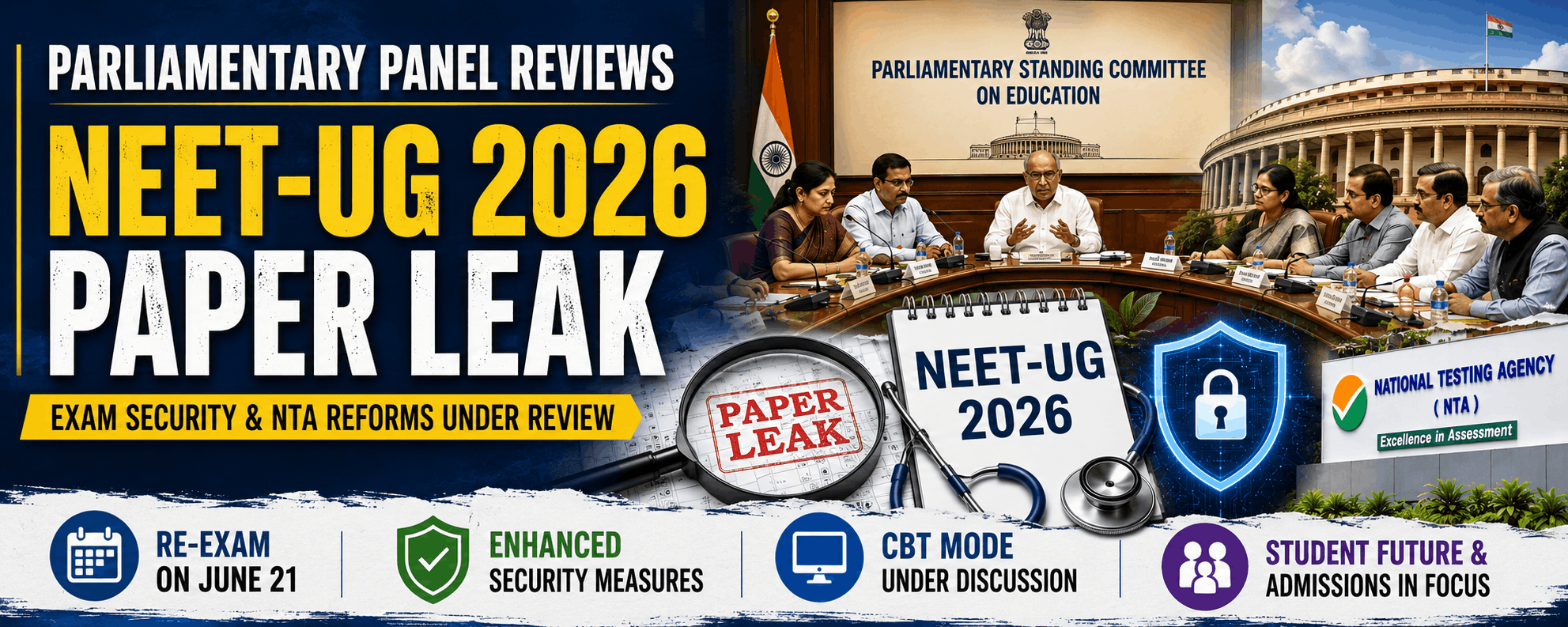
The Nalanda case has also surfaced at a time when NEET-UG 2026 has already been cancelled after paper leak and malpractice concerns. Reports indicate that the investigation has widened across multiple states, with agencies examining larger networks linked to exam malpractice.

Strong Message

NEET is not a playground for criminal gangs.
Medical seats are not for sale.
Students’ dreams are not a business model.
Paper leaks and solver gangs are not mistakes — they are organised attacks on national merit.

What the Government Must Do Now

The Government must order a full investigation into the Nalanda solver gang and its national links.

All accused, middlemen, candidates, financial handlers, digital operators and masterminds must be identified.

NTA must strengthen candidate verification, biometric checks, exam-centre surveillance and admit-card authentication.

Every suspicious transaction linked to solver gangs must be traced.

Counselling and admission must not allow any candidate who used unfair means to enter the medical system.

Hard Closing Line

India cannot produce honest doctors through a dishonest examination system. If solver gangs are not crushed now, the future of genuine NEET aspirants will be sacrificed to money, manipulation and mafia networks.

NEET-UG Crisis: India Must Stop Lobby-Driven Appointments and Fix Exam Governance Now

The cancellation of NEET-UG 2026 has once again exposed a painful truth: India’s medical entrance system is not suffering only because of paper leaks. It is suffering because of weak governance, poor accountability, delayed reforms, and the appointment of people who may not understand the seriousness of national-level medical admissions.

NTA Director General Abhishek Singh has reportedly said that the NEET-UG process was found to be compromised and that the agency had to take a tough decision in the larger interest of students. He also said the system could not allow “scamsters” or miscreants to operate even in an isolated manner.

This statement must not be treated as routine damage control. It is a warning bell.

NEET-UG is not a small school test. It decides the careers of lakhs of students. Many candidates come from poor and middle-class families. Parents sell land, take loans, leave comfort, and sacrifice years of life for one dream: to see their child become a doctor. When a paper leak, manipulation, or sabotage attempt happens, it is not merely an examination irregularity. It is an attack on merit, public trust, national interest, and the future of hardworking students.

The issue is bigger than NTA alone. The entire chain — NTA, MCC, NMC, Health Ministry, counselling authorities, examination vendors, and policy decision-makers — must be reviewed. The country cannot run such a sensitive system through casual decisions, weak supervision, or lobby-based appointments. India needs capable, experienced, honest, and technically sound people in these institutions.

The Supreme Court had already dealt with the NEET-UG 2024 controversy. At that time, the Court refused to cancel the 2024 exam because there was insufficient material to prove a systemic leak, but it also pushed for reforms and expert review of the examination system. Later, the Centre informed the Supreme Court that it had accepted the expert panel’s recommendations, except the immediate shift to online NEET, citing infrastructure challenges for over 26 lakh students.

That means the warning was already there.

A high-level expert report had also suggested stronger monitoring, periodic appraisal, and mission-mode implementation of reforms for NTA. The report recommended a steering committee to monitor NTA’s performance, ensure compliance within timelines, guide bottlenecks, and submit monthly updates to the Ministry of Education.

Then the hard question is this: If reforms were already discussed, recommended, and accepted, why are students still paying the price?

The Government of India must stop treating this as a one-time crisis. It must clean the system from the top. If capable people are removed and weak or lobby-backed people are appointed, the result will be exactly what the country is seeing today — confusion, cancellation, mistrust, litigation, protests, and lakhs of students left in uncertainty.

The same seriousness is needed in counselling also. MCC and state counselling bodies handle the future of students after the exam. Any delay, wrong seat matrix, unclear rule, poor communication, or careless scheduling can destroy a student’s opportunity. Examination and counselling cannot be run by people who do not understand the ground reality of students, states, categories, quotas, seat matrix, and medical admission complexity.

This is no longer only about conducting NEET. This is about protecting India’s medical education system.

Strong Suggestions to the Government

The Government must immediately bring experienced, independent, and technically qualified people into NTA, MCC, NMC, NBEMS, and all related examination and counselling bodies.

All sensitive appointments must be transparent, merit-based, and free from internal lobbying.

Paper movement, exam-centre selection, digital security, vendor management, and question-paper access must be audited by independent agencies.

The Radhakrishnan committee recommendations and Supreme Court-monitored reform concerns must be implemented with public timelines, not kept only on paper.

The Government must create a national-level exam security protocol because paper leaks and organized manipulation are a direct threat to national credibility.

Students should not suffer again because of administrative failure.

Hard Closing Line

India does not need excuses after every paper leak. India needs clean exams, clean counselling, clean appointments, and clean accountability. NEET-UG is the dream of lakhs of students — it cannot be left in the hands of weak systems, lobbying networks, or incapable decision-makers.

NTA DG Admits Sabotage Attempt Behind NEET-UG 2026 Cancellation

The cancellation of NEET-UG 2026 has exposed a serious threat to India’s medical entrance examination system.

NTA Director General Abhishek Singh said that certain individuals are deliberately trying to sabotage the NEET-UG exam process. According to him, the system must be strengthened immediately to identify loopholes and prevent such attacks in future.

He revealed that the issue came to light after a whistleblower message on May 7, claiming that some questions circulated on WhatsApp before the exam matched the actual paper. This triggered further investigation and raised concerns of a possible paper leak.

Singh said the May 3 exam was cancelled only to protect the interests of lakhs of sincere students who had worked hard for the examination. He also admitted that conducting a fresh exam will create huge logistical pressure for NTA, parents, and students.

He further stated that major reforms such as computer-based testing, multi-stage examination, limited attempts, and NTA-owned exam centres require decisions from the Health Ministry and NMC, as NTA only conducts the exam.

The message is clear: NEET-UG needs urgent reform, stronger security, and zero tolerance against exam mafia.

NEET UG 2026 Exam Cancelled After Paper Leak Allegations; Re-Exam Dates to Be Announced

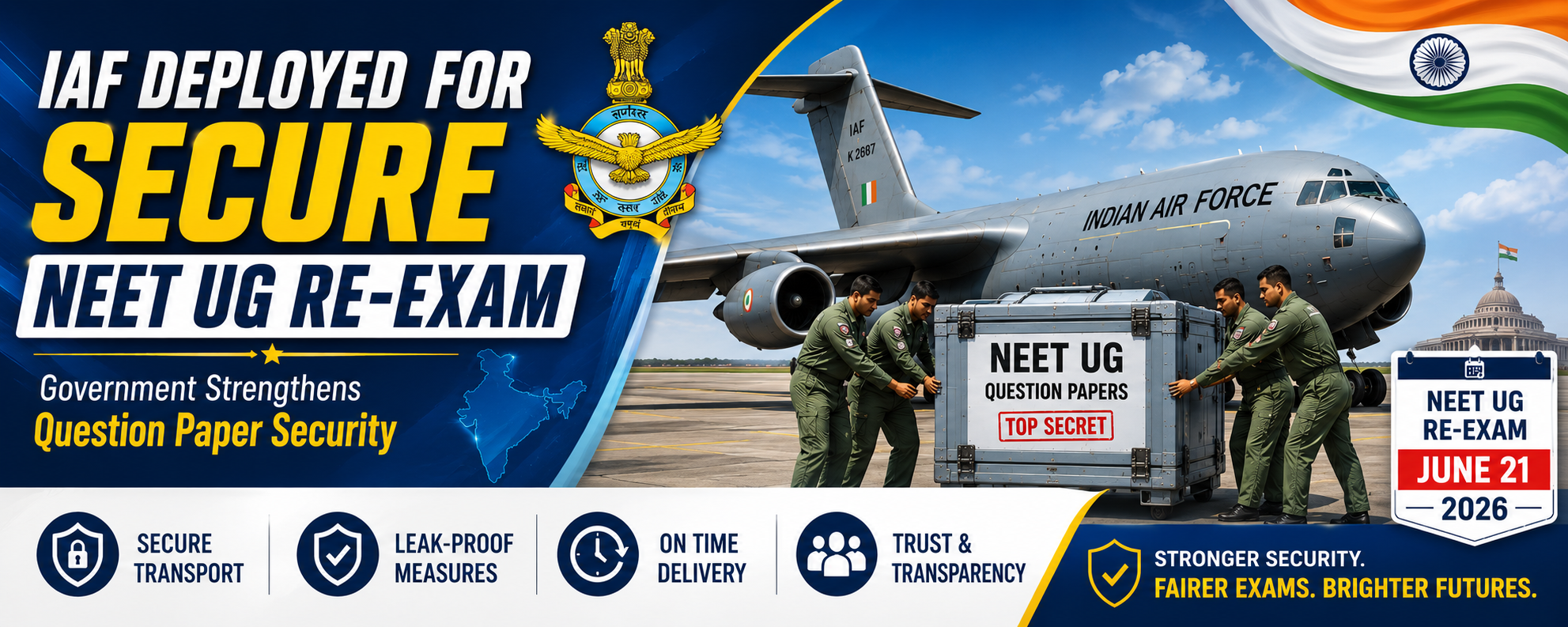
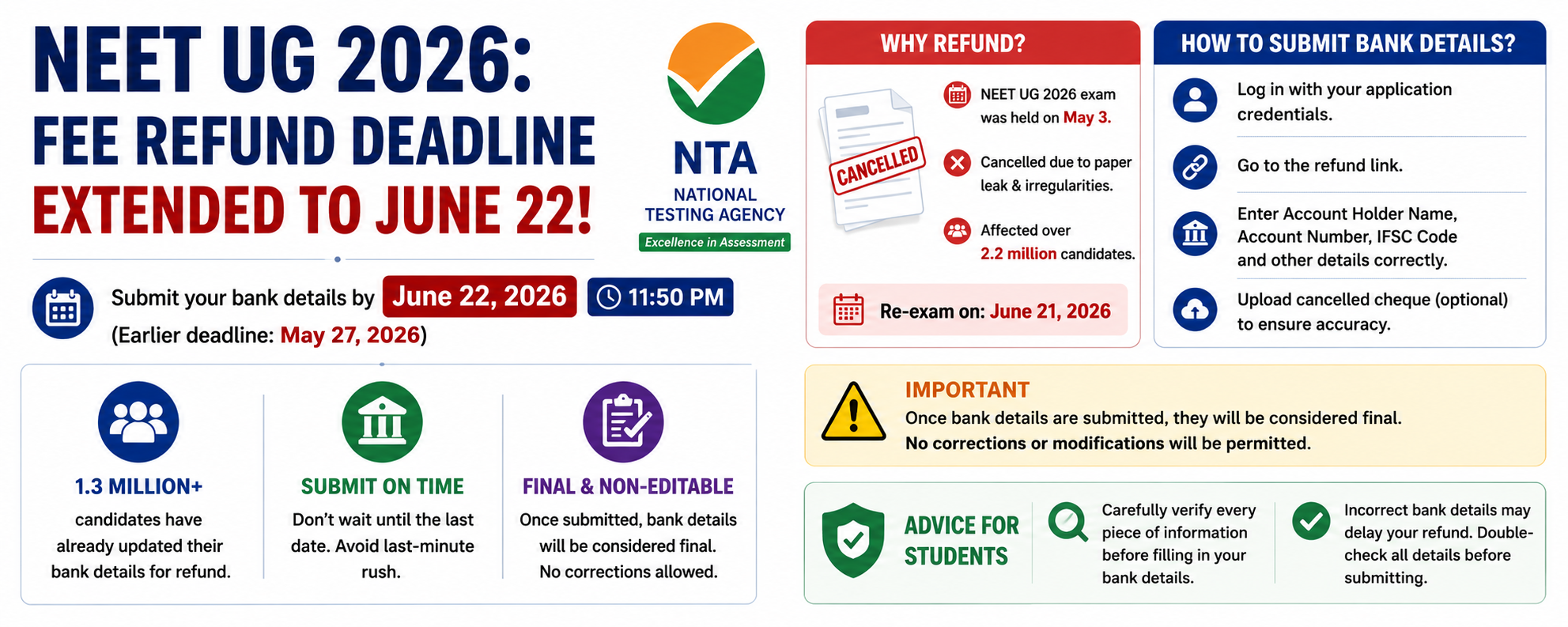
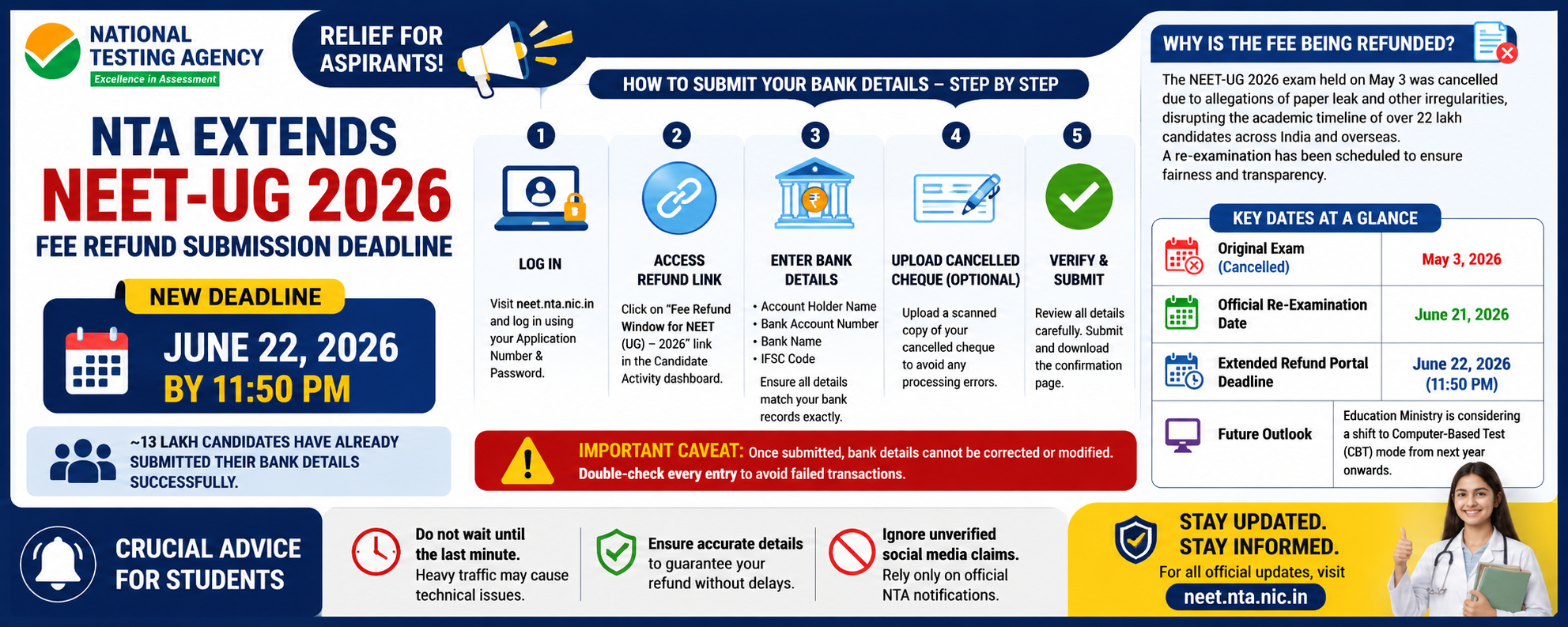
The National Testing Agency has cancelled the NEET UG 2026 examination conducted on May 3, 2026, following allegations of paper leak and examination irregularities. According to the official NEET website, NTA has issued a press release dated 12 May 2026 regarding the decision on the examination.

The decision comes after inputs examined by NTA in coordination with central agencies and findings shared by law enforcement agencies. The matter has also attracted national attention after the Rajasthan Police Special Operations Group began probing suspected irregularities connected to Sikar and other links.

Why Was NEET UG 2026 Cancelled?

As per the notice shared by NTA, the agency stated that the inputs and findings indicated that the examination process could not be allowed to stand. To maintain fairness, transparency, and credibility, NEET UG 2026 held on May 3 has been cancelled, and the exam will be conducted again.

The government has also decided to refer the matter to the Central Bureau of Investigation for a comprehensive inquiry into the allegations.

Rajasthan and Sikar Link Under Probe

The controversy gained momentum after reports emerged from Rajasthan, where the SOG was investigating allegations that a question bank or “guess paper” circulated before the examination had similarities with the actual NEET UG 2026 paper. Sikar has emerged as a major focus in the probe, with multiple individuals reportedly detained for questioning.

Investigators are examining the suspected network, source of circulation, and possible money trail linked to the alleged leak.

What Happens to Students Now?

NTA has clarified that the re-conducted examination dates and the fresh admit card schedule will be announced separately through official channels. Candidates should regularly check:

  • NTA official website
  • NEET official website
  • Official public notices only

Students should avoid relying on social media rumors or unverified messages.

Will Students Need Fresh Registration?

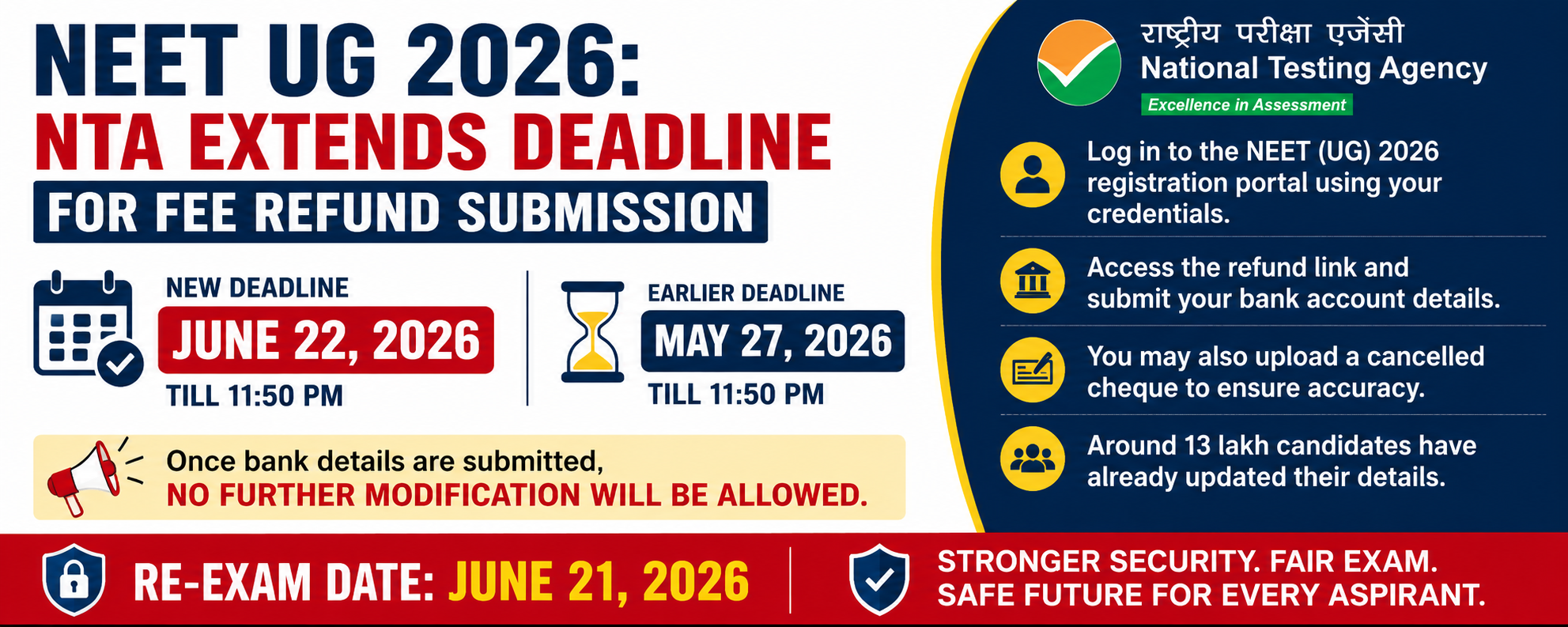
According to the notice, the existing registration data, candidature, and examination centre choices from the May 2026 cycle will be carried forward for the re-conducted examination. No fresh registration will be required.

NTA has also stated that no additional examination fee will be charged, and any fees already paid will be carried forward for the re-exam.

A Difficult but Important Decision

The cancellation has created stress and inconvenience for nearly lakhs of aspirants and their families. However, NTA has stated that the decision was taken in the interest of students and to protect trust in the national examination system.

For students, this is an emotionally difficult moment. Many had already started calculating expected scores, ranks, and counseling possibilities. But now the focus must shift back to preparation, revision, and waiting for official re-exam dates.

Advice for NEET UG 2026 Aspirants

Students should not panic. Instead, they should:

  • Continue revision calmly
  • Preserve all NEET documents
  • Wait for official admit card updates
  • Avoid fake news and forwarded messages
  • Follow only NTA and NEET official websites
  • Use this extra time to strengthen weak topics

Conclusion

The cancellation of NEET UG 2026 is a major development in India’s medical entrance system. With the matter now referred for CBI investigation and re-exam dates expected soon, students must remain alert but calm.

The priority now should be clear: wait for official updates, avoid rumors, and restart focused preparation for the re-conducted NEET UG 2026 examination.

15 Detained in Alleged NEET UG 2026 Paper Leak Case; Sikar Emerges as Key Link in Rajasthan SOG Probe

The alleged NEET UG 2026 paper leak case has taken a serious turn after the Rajasthan Police Special Operations Group detained 15 people in connection with the matter. The investigation is now focusing on the suspected network, possible money trail, and the alleged circulation of questions before the examination.

NEET UG 2026 was conducted by the National Testing Agency on May 3 for admission to undergraduate medical courses including MBBS, BDS, AYUSH, and other medical-related programs across India.

However, allegations of irregularities and possible leakage of questions have created concern among students and parents, leading to a wider probe by the Rajasthan SOG.

Jaipur Man Identified as Alleged Mastermind

According to information emerging from the investigation, the SOG has detained a Jaipur-based person identified as Manish, who is being described as an alleged mastermind in the case.

Investigators are now trying to understand whether the alleged leak was limited to a small group or part of a larger organized network.

The role of middlemen, coaching-linked contacts, and financial transactions is also expected to be examined as part of the investigation.

Sikar Emerges as a Key Link

Sikar, one of Rajasthan’s major coaching hubs, has now emerged as an important point in the investigation.

Investigators suspect that a leaked question bank may have originated from Sikar district. The probe is reportedly examining the role of Rakesh Mandawaria, who runs SK Consultancy on Piprali Road in Sikar.

The agency is likely to investigate whether the alleged question bank was circulated among candidates, coaching-linked groups, or private networks before the examination.

Money Trail Under Investigation

The Rajasthan SOG is also probing the possible money trail connected to the alleged leak.

In such cases, investigators generally examine:

  • digital communication records
  • bank transactions
  • cash movement
  • coaching or consultancy links
  • candidate-level access
  • WhatsApp or Telegram circulation
  • role of middlemen

The detention of multiple people suggests that the investigation may expand further depending on digital and financial evidence.

Students and Parents Worried

The allegations have created anxiety among NEET UG aspirants and parents across India.

For lakhs of students who prepared honestly for the examination, such reports raise serious questions about fairness, transparency, and the credibility of the examination system.

Parents are also concerned because NEET is not just an entrance exam; it directly affects the future of medical aspirants and the financial planning of families.

Need for Transparency

The NEET UG examination is one of the most important entrance tests in India. Any allegation of paper leak or unfair advantage must be investigated quickly and transparently.

Students deserve clarity on:

  • whether the alleged leak was real
  • how many candidates were affected
  • whether the paper circulation happened before the exam
  • whether the exam process was compromised
  • what action will be taken against those involved

A transparent investigation is important to maintain trust in the examination system.

Conclusion

The detention of 15 people by Rajasthan SOG has intensified the alleged NEET UG 2026 paper leak investigation. With Sikar emerging as a key link and a Jaipur-based person identified as the alleged mastermind, the case may widen further in the coming days.

For now, students and parents should avoid panic and wait for official findings from the investigating agencies and concerned authorities.

At the same time, strict action against any proven malpractice is necessary to protect the integrity of NEET and the future of genuine medical aspirants.

Top MBBS Colleges Preferred by NEET Toppers in MCC Counseling 2025: AIIMS & Delhi Colleges Continue to Dominate

Every year, lakhs of students appear for NEET UG with the dream of securing admission into India’s top medical colleges. While cutoff trends and ranks may change every year, one interesting pattern remains almost constant:

The top-ranked students continue to prefer a similar group of elite medical colleges during counseling.

According to the MCC Round-2 counseling analysis for students under AIR 5000, colleges like AIIMS, JIPMER, and Delhi government medical colleges remained among the most preferred choices for NEET toppers in 2025.

These colleges are repeatedly chosen because of:

  • Excellent academic environment
  • High patient inflow and clinical exposure
  • Better PG preparation ecosystem
  • Lower fee structure
  • Strong national reputation
  • Internship and research opportunities

Top 10 Most Preferred MBBS Colleges Under AIR 5000

RankCollege NameStudents Opted / AllottedBest AIRLast AIR Under 5000
1Maulana Azad Medical College (MAMC), Delhi163544968
2AIIMS Jodhpur127554503
3JIPMER Puducherry126504626
4AIIMS New Delhi12514801
5VMMC & Safdarjung Hospital, Delhi121494176
6AIIMS Bhopal1071484747
7AIIMS Bhubaneswar104604690
8AIIMS Rishikesh1012304828
9AIIMS Nagpur981364268
10AIIMS Mangalagiri952864660

Why Students Prefer These Colleges

The demand for these colleges remains high mainly because students consider several important factors before locking their choices during counseling.

1. Strong Clinical Exposure

Top government colleges receive massive patient inflow every day, helping students gain excellent practical experience.

2. Better PG Preparation Environment

Most NEET toppers also think ahead toward NEET PG preparation. Colleges in Delhi and AIIMS campuses provide a highly competitive academic atmosphere.

3. Affordable Fee Structure

Government colleges and AIIMS institutions offer MBBS at significantly lower fees compared to private and deemed universities.

4. Reputation & Brand Value

Institutions like AIIMS Delhi, MAMC, JIPMER, and VMMC have strong national recognition and long-standing academic reputations.


State Preference Also Plays a Major Role

Although top colleges remain similar every year, counseling trends can still change depending on:

  • Number of students qualifying from a particular state
  • State quota availability
  • Domicile preference
  • Reservation category
  • Counseling policies

In many cases, students prefer colleges in their own states because:

  • They are familiar with the language and environment
  • Fees may be lower under state quota
  • Family support becomes easier
  • State reservation benefits apply

For example:

  • Delhi students heavily prefer Delhi colleges
  • Tamil Nadu students often prioritize Tamil Nadu government colleges
  • Maharashtra students prefer BJMC Pune, GMC Mumbai, etc.

This is why counseling trends vary slightly every year even though top colleges remain largely consistent.


AIIMS Continue to Dominate Student Choices

One major observation from 2025 counseling trends is that AIIMS campuses continue to dominate student preferences.

Not only AIIMS Delhi, but newer campuses like:

  • AIIMS Jodhpur
  • AIIMS Bhopal
  • AIIMS Bhubaneswar
  • AIIMS Rishikesh
  • AIIMS Nagpur

have now become top-tier choices among NEET toppers.

Students increasingly prefer these institutions because of:

  • Modern infrastructure
  • National importance status
  • Better academics
  • Research exposure
  • Central government support

Counseling Strategy Still Matters

Even among high-rank students, counseling strategy remains extremely important.

Students carefully analyze:

  • Previous year cutoffs
  • Seat matrix
  • Category rank
  • State quota
  • Upgradation possibilities
  • Bond policies
  • Hostel and living conditions

before locking their final preferences.

A small mistake during counseling can affect:

  • college choice,
  • state allotment,
  • and future opportunities.

Conclusion

The MCC 2025 counseling analysis clearly shows that AIIMS campuses and Delhi government medical colleges continue to remain the most preferred MBBS institutions among NEET toppers.

While cutoff trends and counseling dynamics may change every year, students consistently prioritize:

  • academic quality,
  • clinical exposure,
  • affordability,
  • and PG preparation ecosystem.

At the same time, state-wise student participation and domicile preference also influence counseling trends significantly.

For NEET aspirants, understanding these preference patterns can help in making smarter counseling decisions and realistic college planning during admission rounds.

NEET में कम अंक आने का मतलब MBBS सपना खत्म नहीं! सही काउंसलिंग और सही जानकारी बदल सकती है आपकी जिंदगी

उत्तर प्रदेश, बिहार, राजस्थान, मध्य प्रदेश, हरियाणा और झारखंड जैसे राज्यों में हर साल लाखों छात्र NEET परीक्षा देते हैं। परीक्षा के बाद सबसे ज्यादा तनाव उन्हीं छात्रों में होता है जिनके 150–300 अंक आते हैं।

बहुत से छात्र और माता-पिता यह मान लेते हैं कि:

“अब MBBS नहीं मिलेगा…”

लेकिन सच्चाई इससे बिल्कुल अलग है।

आज के समय में MBBS Admission केवल अंकों से तय नहीं होता।
असल खेल होता है:

  • Rank का,
  • Category का,
  • State Counseling का,
  • Budget Planning का,
  • और सबसे महत्वपूर्ण सही Counseling Strategy का।

केवल अंक नहीं, आपकी Rank तय करती है भविष्य

NEET एक Competitive Exam है।

हर साल:

  • पेपर का स्तर बदलता है,
  • छात्रों की संख्या बदलती है,
  • Cutoff बदलता है,
  • और उसी के अनुसार Rank भी बदलती है।

इसलिए:

“कम अंक” का मतलब हमेशा “खराब Rank” नहीं होता।

कई बार कठिन पेपर में कम अंक पर भी अच्छी Rank मिल जाती है।


हिंदी बेल्ट में Competition सबसे ज्यादा

उत्तर प्रदेश, बिहार और राजस्थान जैसे राज्यों से लाखों छात्र NEET देते हैं।
लेकिन सरकारी MBBS सीटें सीमित हैं।

यही कारण है कि:

  • बहुत से छात्र Private Colleges,
  • Management Quota,
  • Deemed Universities,
  • और दूसरे राज्यों की Counseling

की तरफ जाते हैं।


कई छात्र जानकारी की कमी से सीट खो देते हैं

हर साल हजारों छात्र केवल इसलिए MBBS सीट नहीं ले पाते क्योंकि:

  • उन्हें Counseling Process समझ नहीं आती,
  • सही Choice Filling नहीं कर पाते,
  • State Quota Rules नहीं जानते,
  • या गलत लोगों की सलाह में आ जाते हैं।

बाद में वही छात्र कहते हैं:

“काश सही समय पर सही Guidance मिली होती…”


Central OBC और State OBC का अंतर समझना जरूरी

यह NEET Counseling का सबसे बड़ा Confusion होता है।

बहुत से छात्र:

  • अपने राज्य में OBC होते हैं,
  • लेकिन Central OBC List में नहीं आते।

इसका असर पड़ता है:

  • All India Counseling,
  • Reservation Benefits,
  • और Category Rank

पर।

इसलिए Counseling से पहले:
✅ Category Certificate
✅ State Eligibility
✅ Reservation Rules

को समझना बहुत जरूरी है।


150–300 अंक वालों के लिए आज भी मौके हैं

यदि आपके:

  • 150 अंक,
  • 200 अंक,
  • 250 अंक,
  • या 300 अंक

आए हैं, तो घबराने की जरूरत नहीं है।

आज भी भारत में कई विकल्प उपलब्ध हैं:

  • Private Medical Colleges
  • Budget-Friendly Universities
  • Management Quota Seats
  • दूसरे राज्यों के Counseling Options

कई बार सही Guidance से छात्र कम फीस वाले कॉलेज भी प्राप्त कर लेते हैं।


जल्दी निर्णय लेना जरूरी है

बहुत से अच्छे और कम फीस वाले विकल्प:

  • First Round,
  • और Second Round

में ही भर जाते हैं।

जो छात्र देर करते हैं, उन्हें बाद में:

  • ज्यादा फीस,
  • Donation,
  • या Limited Options

का सामना करना पड़ता है।


सही Counseling ही असली हथियार है

आज के समय में केवल NEET Qualify करना काफी नहीं है।

जरूरी है:
✅ सही College Selection
✅ सही Choice Filling
✅ सही Budget Planning
✅ सही State Analysis
✅ सही Counseling Guidance

क्योंकि:

“आपके अंक आपको Qualified बनाते हैं, लेकिन सही Counseling आपको MBBS सीट दिलाती है।”


निष्कर्ष

यदि आपके कम अंक आए हैं तो निराश मत होइए।

भारत में MBBS Admission System बहुत बड़ा और जटिल है। सही जानकारी और सही रणनीति से आज भी हजारों छात्र MBBS सीट प्राप्त कर रहे हैं।

याद रखिए:

“कई बार ज्यादा अंक वाले छात्र भी सीट खो देते हैं,
और कम अंक वाले छात्र सही Counseling से डॉक्टर बन जाते हैं।”

इसलिए जल्दबाजी में फैसला न लें।
अपनी Rank, Category, Budget और Counseling Options को अच्छे से समझकर आगे बढ़ें।

क्योंकि:

“NEET केवल परीक्षा नहीं है…
यह सही रणनीति और सही मार्गदर्शन का खेल है।”

Karnataka MBBS Linguistic & Religious Minority Quota: Complete Document Guide for KEA NEET UG Counseling

Every year, thousands of students applying through KEA NEET UG Counseling miss excellent MBBS opportunities simply because they do not understand the Linguistic Minority and Religious Minority documentation process properly.

In Karnataka MBBS counseling, minority categories can significantly improve admission opportunities, especially in private medical and dental colleges. However, students must understand:

  • eligibility rules,
  • required annexures,
  • document verification process,
  • and priority systems.

Many students lose seats not because of rank, but because:

“They failed to submit the correct annexure during verification.”


What Is Linguistic Minority in Karnataka MBBS Counseling?

Under KEA counseling, Karnataka provides Linguistic Minority reservation for:

  • Tamil Minority
  • Telugu Minority
  • Kodava Minority
  • Tulu Minority

These categories are applicable only for eligible Karnataka candidates.


Important Eligibility Rules for Linguistic Minority

To claim Linguistic Minority reservation in Karnataka, the student must:

✅ Have studied in Karnataka for 10 years
(from 1st Standard till qualifying examination)

AND

✅ Must have passed:

  • SSLC / 10th
    OR
  • 2nd PUC / 12th

from Karnataka State.

If these conditions are not fulfilled, Linguistic Minority claim may be rejected during verification.


Which Documents Are Required for Linguistic Minority?

Students applying under:

  • Tamil Minority
  • Telugu Minority
  • Kodava Minority
  • Tulu Minority

must submit:

Annexure 5

OR

Annexure 5A

during KEA document verification.

Difference Between Annexure 5 & 5A

AnnexurePurpose
Annexure 5For 10th / SSLC verification
Annexure 5AFor 12th / 2nd PUC verification

These annexures are extremely important for Linguistic Minority verification.

Without these forms:

KEA may reject the minority claim even if the student is otherwise eligible.


Religious Minority in Karnataka MBBS Counseling

Karnataka also provides Religious Minority reservation for:

  • Christian Minority
  • Muslim Minority

These categories apply for:

  • Karnataka Candidates
  • Non-Karnataka Candidates

under specific rules.


Important Rule for Religious Minority Candidates

Although candidates from all states are considered eligible for Religious Minority seats:

Priority is given to Karnataka Religious Minority candidates who studied in Karnataka for 10 years.

This means:

  • Karnataka minority students get first preference,
  • After exhausting Karnataka minority candidates,
  • Remaining seats may be offered to:
    • other Karnataka students,
    • and eligible non-Karnataka minority students.

Which Document Is Required for Religious Minority?

Students applying under:

  • Christian Minority
  • Muslim Minority

must submit:

Annexure 4A

during KEA verification.

This document is mandatory for Religious Minority claims.


RD Number Is Mandatory for Medical & Dental Minority Seats

For Religious Minority categories:

  • an RD Number is also required
    for Medical and Dental admissions.

Students must ensure:
✅ Proper minority certificate
✅ RD Number
✅ Correct annexure submission

before verification.


Special Category: St. John’s Medical College (Roman Catholic Category)

One of the most important minority institutions in Karnataka is:

St. John’s Medical College, Bangalore

This college has:

  • special Roman Catholic categories,
  • separate eligibility conditions,
  • and unique admission procedures.

The categories include:

  • RC-2 to RC-8

and the detailed eligibility conditions are officially published on the KEA website.


Important Point About St. John’s Medical College

For:

  • Category-1 (All India Open Merit)
    AND
  • Category-9 (Karnataka State Open Merit)

of St. John’s Medical College,

No separate minority documents are required.

However, Roman Catholic minority categories follow separate rules and verification systems.


Why Minority Documentation Is Extremely Important

Every year many students:

  • fail to upload correct annexures,
  • submit incomplete minority documents,
  • misunderstand eligibility,
  • or miss verification deadlines.

As a result:

Their minority claim gets rejected,
even if they have good eligibility.

This directly impacts:

  • fee structure,
  • seat availability,
  • and admission chances.

Final Advice for Students & Parents

If you are applying through KEA under:

  • Linguistic Minority
    OR
  • Religious Minority,

make sure you:
✅ Prepare annexures early
✅ Verify RD Number properly
✅ Understand KEA eligibility rules
✅ Keep 10-year study proof ready
✅ Complete document verification carefully

because:

“In Karnataka MBBS Counseling, documentation is as important as your rank.”


Conclusion

Karnataka KEA Counseling provides excellent opportunities through:

  • Tamil Minority
  • Telugu Minority
  • Kodava Minority
  • Tulu Minority
  • Christian Minority
  • Muslim Minority
  • Roman Catholic Categories

But students must understand that:

Correct documentation and annexure submission decide whether your minority claim is accepted or rejected.

Proper planning and early preparation can significantly improve MBBS admission opportunities under Karnataka minority quotas.

NEET UG Counseling Is More Than Marks: How Linguistic Minority, Rank, Category, and Counseling Strategy Decide MBBS Admissions

Every year, nearly 22 to 23 lakh students appear for the NEET UG examination across India. After the examination, many students immediately begin comparing marks and predicting whether they will get an MBBS seat.

However, experienced counselors and admission experts repeatedly explain one important fact:

NEET counseling is not only about marks — it is about how intelligently you use your rank, category, linguistic minority eligibility, domicile, and counseling strategy.

Many students scoring between 150 and 300 marks believe their MBBS dream is over. In reality, India’s counseling system is highly complex and includes several important factors such as:

  • All India Rank
  • State Rank
  • Category Rank
  • Linguistic Minority Quotas
  • Religious Minority Seats
  • Domicile Rules
  • Management Quota
  • NRI Eligibility
  • State-specific counseling systems
  • Fee structures and seat matrix trends

Understanding these factors properly can completely change a student’s admission opportunities.


NEET Marks vs NEET Rank: What Actually Matters?

One of the biggest misconceptions among students is that marks alone decide MBBS admissions.

In reality, NEET is a highly competitive examination where:

  • exam difficulty,
  • candidate performance,
  • normalization trends,
  • and competition levels

all influence the final rank.

A score considered “low” in one year may still generate a competitive rank in another year depending on the difficulty of the examination.

This is why counseling experts always emphasize:

“Your marks do not matter as much as the rank generated from those marks.”


Understanding the Different Types of Ranks

1. All India Rank (AIR)

The All India Rank is generated nationally among all NEET candidates across India.

This rank is important for:

  • MCC counseling
  • All India Quota seats
  • Deemed universities
  • Central institutions

2. State Rank

Every state generates its own merit list and state rank during counseling.

State rank becomes important for:

  • State quota seats
  • Private colleges under state counseling
  • Minority seats
  • Category reservations within the state

In many states, exact category rankings become clear only after students apply for counseling because every NEET-qualified student does not participate in every state counseling process.


Central OBC vs State OBC: A Major Confusion

One of the most misunderstood areas in NEET counseling is the difference between:

  • Central OBC eligibility
  • State OBC eligibility

A student may:

  • qualify as OBC in their home state,
  • but may not fall under the Central OBC-NCL list.

This creates major differences in:

  • All India counseling eligibility
  • Category ranking
  • Reservation benefits

Students must carefully verify whether they belong to:

  • Central OBC-NCL
  • State OBC category
  • EWS
  • SC/ST/PwD category

before participating in counseling.


Linguistic Minority Quotas Can Completely Change Admission Chances

One of the most important but least understood areas in MBBS counseling is the role of linguistic minority quotas.

Many students are unaware that language-based minority eligibility can significantly improve their chances of securing MBBS seats at comparatively lower fee structures.

Telugu Linguistic Minority Example

For example:

  • A Telugu-speaking student studying in Karnataka or Tamil Nadu may become eligible for Telugu linguistic minority seats in certain colleges.

In some situations:

  • Telugu minority students may secure seats with ranks as high as 8 lakh,
  • while local general category students may require much lower ranks for the same seat.

Similarly:

  • Tamil linguistic minorities in Karnataka,
  • Malayalam linguistic minorities in Tamil Nadu,
  • Kannada linguistic minorities in neighboring states,

can all receive advantages depending on the counseling rules and college eligibility criteria.

These factors often become extremely important for students scoring between 150 and 300 marks.


Religious Minority Seats Also Play a Major Role

Apart from linguistic minorities, several colleges across India also operate under religious minority status.

Examples include:

  • Sikh minority colleges
  • Jain minority colleges
  • Muslim minority institutions
  • Hindu minority colleges in Jammu & Kashmir

These colleges may follow separate reservation systems under their respective state counseling processes.

Understanding eligibility for these seats can dramatically improve admission possibilities for students with lower NEET scores.


Students Scoring 150–300 Marks Still Have Opportunities

Students scoring:

  • 150–250 marks
  • 250–300 marks

often panic after NEET results are declared.

However, depending on:

  • category,
  • linguistic minority eligibility,
  • state counseling,
  • budget,
  • fee structure,
  • and counseling strategy,

students may still secure:

  • Private medical college seats
  • Linguistic minority quota seats
  • Religious minority seats
  • Lower-fee university seats
  • Management quota seats
  • Sometimes even without extremely high donation structures

In some situations, students may secure colleges with annual fee structures around ₹20–23 lakhs instead of paying extremely high management quota packages.


Why Counseling Strategy Is More Important Than Ever

Modern NEET counseling is highly data-driven and extremely competitive.

Students must understand:

  • seat matrix trends,
  • round-wise vacancy movement,
  • category conversion rules,
  • linguistic minority advantages,
  • fee structures,
  • state eligibility,
  • mop-up rounds,
  • and stray vacancy rounds.

Many students lose excellent opportunities simply because they:

  • apply late,
  • misunderstand quotas,
  • ignore linguistic minority eligibility,
  • choose wrong colleges,
  • or fail to understand state counseling systems properly.

Importance of Professional Counseling Guidance

A good counseling expert helps students:

  • analyze their rank realistically,
  • understand category benefits,
  • avoid unnecessary donations,
  • identify budget-friendly colleges,
  • utilize minority advantages,
  • and create smarter choice filling strategies.

This becomes especially important for students in the lower score range because even small counseling mistakes can cost:

  • better colleges,
  • lower fee structures,
  • minority advantages,
  • and valuable seat opportunities.

Conclusion

NEET UG counseling in India is no longer a simple marks-based process. It is a highly complex ecosystem involving:

  • ranks,
  • state rules,
  • linguistic minority quotas,
  • religious reservations,
  • counseling dynamics,
  • seat matrix changes,
  • and financial planning.

Students must clearly understand:

“Your NEET marks may qualify you, but your counseling strategy decides your final college.”

For students scoring between 150 and 300 marks, proper counseling and strategic planning can still open doors to MBBS admissions across India through various quota systems and counseling opportunities.

NTA Releases NEET UG 2026 Provisional Answer Key: Important Update for Medical Aspirants

The National Testing Agency (NTA) has officially released the Provisional Answer Keys for the National Eligibility cum Entrance Test (NEET UG) 2026 conducted on 3rd May 2026 across India and abroad.

The public notice, dated 06th May 2026, confirms that the provisional answer keys for all paper series have now been uploaded on the official NEET website.

This is one of the most important stages for NEET aspirants as it allows students to:

  • Verify their responses
  • Estimate expected scores
  • Analyze cutoff possibilities
  • Prepare for counseling strategy

Official Notice Highlights

According to NTA:

  • NEET UG 2026 was conducted successfully on 3rd May 2026.
  • Provisional answer keys for all paper sets are now available online.
  • Candidates will soon be able to challenge the answer keys after the scanned OMR answer sheets are uploaded.
  • The detailed schedule for OMR uploads and answer key challenge submissions will be announced separately.

What Students Should Do Now

1. Check the Official Answer Key

Students should carefully compare their responses with the official provisional answer key to estimate probable marks.

2. Wait for OMR Upload

NTA will soon upload scanned OMR answer sheets. Candidates should verify:

  • Marked responses
  • Question accuracy
  • Possible discrepancies

3. Challenge Incorrect Answers (If Needed)

If students identify any incorrect answer in the provisional key, they can submit objections within the prescribed timeline after OMR upload.

4. Start Counseling Preparation Early

Even before results are officially declared, students should begin:

  • College research
  • State quota analysis
  • Management quota planning
  • Budget evaluation
  • Counseling strategy preparation

Why This Stage is Extremely Important

Many students focus only on marks, but counseling preparation starts immediately after answer key analysis.

Understanding expected rank trends early helps students:

  • Avoid panic
  • Identify realistic college options
  • Plan state counseling participation
  • Explore management quota opportunities
  • Make smarter decisions during choice filling

Official Websites

Students are advised to regularly visit:

for the latest updates regarding:

  • OMR sheet uploads
  • Challenge process
  • Final answer key
  • NEET UG 2026 results
  • Counseling schedules

Final Thoughts

The release of the provisional answer key marks the beginning of the next crucial phase of NEET UG 2026 — result prediction and counseling preparation.

Students should remain calm, analyze their probable scores carefully, and begin preparing a proper counseling strategy instead of waiting until results are announced.

In today’s highly competitive environment, the right counseling strategy can make a major difference in securing the best possible MBBS seat.