4 States Account for 41% of NEET UG 2026 Aspirants: What It Means for Medical Admissions

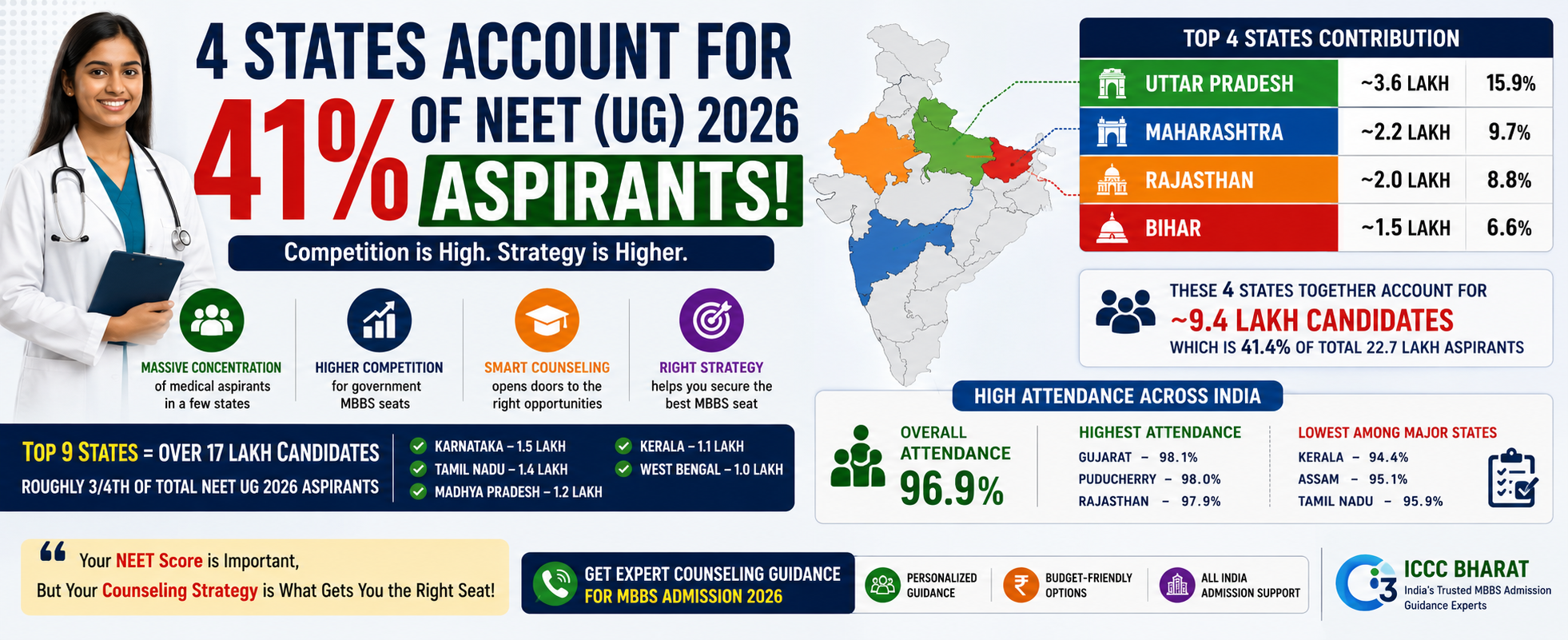
The NEET UG 2026 examination has once again demonstrated how heavily concentrated India’s medical aspirants are in a handful of states. According to state-wise data released by the National Testing Agency (NTA), four states — Uttar Pradesh, Maharashtra, Rajasthan, and Bihar — together accounted for nearly 41% of the total NEET UG 2026 registrations.

Out of approximately 22.7 lakh candidates registered for NEET UG 2026, nearly 9.4 lakh students came from these four states alone. This highlights the increasing pressure on medical admissions and counseling systems, especially in high-population states where competition is extremely intense.

State-Wise NEET UG 2026 Participation

Top Contributing States

  • Uttar Pradesh – Around 3.6 lakh candidates
  • Maharashtra – Around 2.2 lakh candidates
  • Rajasthan – Around 2 lakh candidates
  • Bihar – Around 1.5 lakh candidates

Together, these states dominate the national NEET landscape and significantly influence cutoff trends, counseling competition, and seat allocation dynamics.

Other states with major participation include:

  • Karnataka – 1.5 lakh
  • Tamil Nadu – 1.4 lakh
  • Madhya Pradesh – 1.2 lakh
  • Kerala – 1.1 lakh
  • West Bengal – 1 lakh

The top nine states together contributed more than 17 lakh NEET aspirants, accounting for almost three-fourths of India’s total candidate pool.

What This Means for MBBS Admissions

1. Increased Competition in Government Colleges

States with higher candidate density naturally witness tougher competition for government MBBS seats. Even small mark differences can create large rank variations due to the huge number of aspirants.

2. Higher Pressure on State Quotas

Students from high-volume states face intense competition under state counseling quotas. This pushes many candidates toward:

  • Private medical colleges
  • Deemed universities
  • Management quota seats
  • Other state counseling opportunities

3. Rising Demand for Management Quota Seats

As government seats become harder to secure, students scoring between 150–450 marks increasingly explore management quota options across:

  • Karnataka
  • Telangana
  • Andhra Pradesh
  • Tamil Nadu
  • Maharashtra

The demand for budget-friendly MBBS packages is expected to rise significantly during counseling rounds.

Attendance Trends Remained High

Despite the scale of the examination, NEET UG 2026 recorded an impressive attendance rate of 96.9%.

Highest Attendance States

  • Gujarat – 98.1%
  • Puducherry – 98%
  • Rajasthan – 97.9%

Among larger states:

  • Uttar Pradesh – 97.5%
  • Maharashtra – 97.4%

States with comparatively lower attendance included:

  • Kerala – 94.4%
  • Assam – 95.1%
  • Tamil Nadu – 95.9%

Counseling Strategy Becomes More Important Than Ever

With lakhs of students competing for limited seats, counseling strategy is now equally important as NEET marks.

Students and parents must carefully analyze:

  • State-wise cutoff trends
  • Fee structures
  • Seat matrix changes
  • Round-wise seat availability
  • Management quota opportunities
  • Choice filling strategy

Many students lose good MBBS opportunities not because of low marks, but because of incorrect counseling decisions.

Conclusion

The NEET UG 2026 data clearly shows that medical admission competition in India is becoming increasingly concentrated in a few major states. As aspirant numbers continue to rise, smart counseling, proper planning, and early decision-making will play a major role in securing the best possible MBBS seat.

Students should focus not only on marks and rank, but also on understanding the counseling ecosystem, quota systems, and budget-friendly admission pathways available across India.
The Future of Nursing in India: A Profession Transforming Healthcare

The future of nursing in India is entering a revolutionary phase, driven by technological advancement, global healthcare demand, specialization, and the growing need for quality patient care. Once considered limited to bedside care, nursing today is evolving into one of the most respected, stable, and globally recognized healthcare professions.

India is currently facing a projected shortage of more than 2 million nurses, creating massive opportunities for students pursuing B.Sc. Nursing and related healthcare programs. With increasing healthcare awareness, expansion of hospitals, medical tourism, telemedicine, and an aging population, the demand for skilled nurses is expected to rise dramatically over the next decade.

Rise of Specialized Nursing Careers

Modern healthcare requires highly trained nurses in specialized departments. Areas such as:

  • Critical Care Nursing
  • Oncology Nursing
  • Neonatal & Pediatric Care
  • Emergency & Trauma Care
  • Cardiac Nursing
  • Operation Theatre Technology
  • Community Health Nursing

are witnessing tremendous growth in India and abroad.

The role of Nurse Practitioners and Advanced Practice Nurses is also gaining importance, allowing nurses to take leadership roles in patient management and healthcare delivery.

Technology is Reshaping Nursing

Technology is rapidly transforming the nursing profession. Hospitals and healthcare institutions are increasingly using:

  • Artificial Intelligence (AI)
  • Electronic Health Records (EHRs)
  • Smart Patient Monitoring Systems
  • Telemedicine Platforms
  • Digital Health Applications

This has created a new generation of “informatics nurses” who combine healthcare knowledge with digital technology expertise.

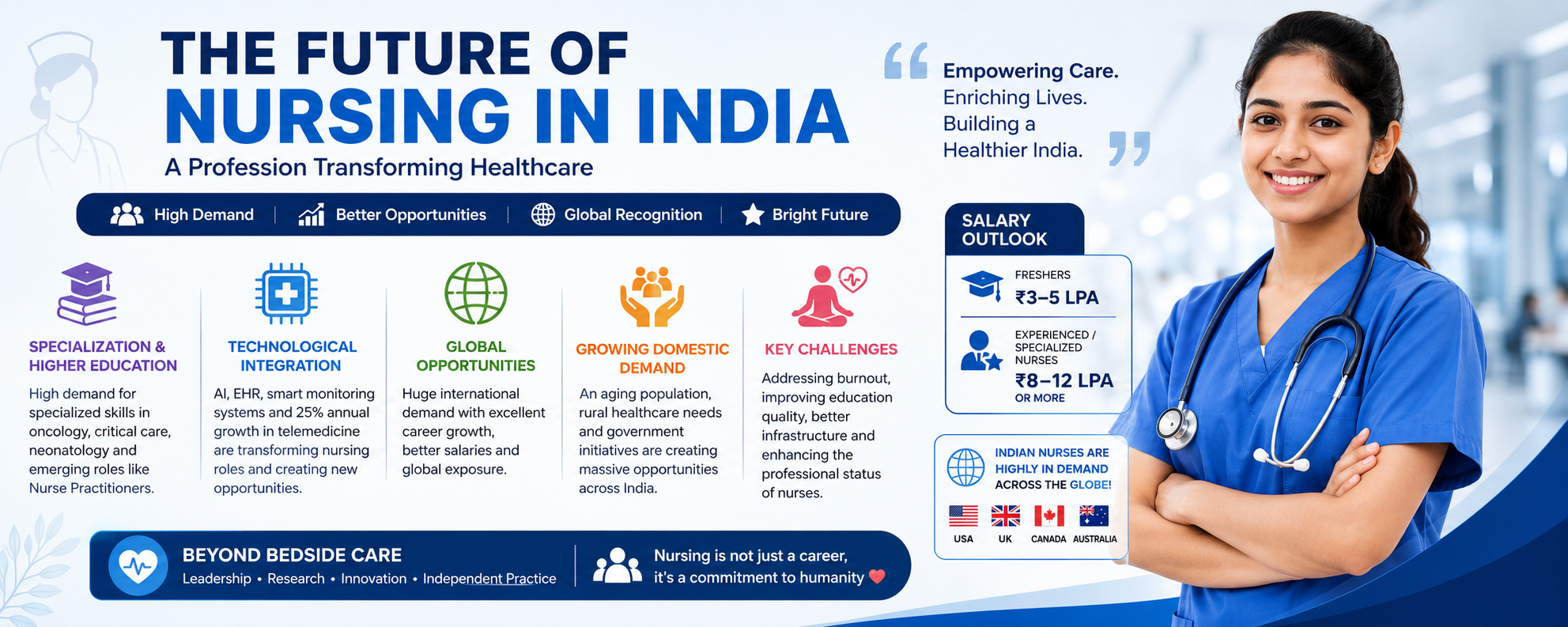
Telemedicine alone is growing at nearly 25% annually, opening new opportunities for nurses to work remotely, assist in virtual consultations, and manage patient care digitally.

Global Demand for Indian Nurses

Indian nurses are highly respected worldwide due to their clinical skills, adaptability, and dedication. Countries such as:

  • USA
  • United Kingdom
  • Canada
  • Australia
  • Germany
  • Gulf Countries

continue to recruit thousands of Indian nurses every year.

With international exposure, nurses can access:

  • Higher salaries
  • Better career growth
  • Advanced education opportunities
  • Permanent residency pathways in many countries

Growing Domestic Opportunities

India’s healthcare sector is expanding rapidly with:

  • Multi-specialty hospitals
  • Corporate healthcare chains
  • Rural healthcare programs
  • Government health missions
  • Rehabilitation centers
  • Elderly care facilities

The aging population has significantly increased the demand for geriatric and community health nurses. Government programs under the National Health Mission are also creating large-scale opportunities in rural and semi-urban healthcare sectors.

Salary & Career Growth

Nursing has become one of the most secure healthcare careers in India.

Average Salary Trends:

  • Freshers: ₹3–5 LPA
  • Experienced/Specialized Nurses: ₹8–12 LPA or more
  • International Placements: Significantly higher packages

Apart from hospitals, nurses today can work in:

  • Research
  • Medical coding
  • Healthcare administration
  • Academics
  • Public health
  • Telehealth services
  • Clinical training institutes

Challenges in the Profession

Despite the bright future, the profession also faces challenges such as:

  • Workforce burnout
  • Long working hours
  • Staff shortages
  • Need for better infrastructure
  • Education quality gaps

Improving working conditions, upgrading nursing education, and strengthening professional recognition will play a major role in shaping the future of the profession.

Conclusion

The nursing profession in India is no longer limited to traditional caregiving roles. It is transforming into a dynamic, technology-driven, leadership-oriented healthcare career with immense global opportunities.

For students looking for a stable, respected, and future-ready profession, nursing offers:
✅ Job security
✅ Global career opportunities
✅ Excellent salary growth
✅ Professional respect
✅ Opportunities in leadership & research

The future of nursing in India is not just promising — it is powerful, progressive, and essential for the future of healthcare itself.