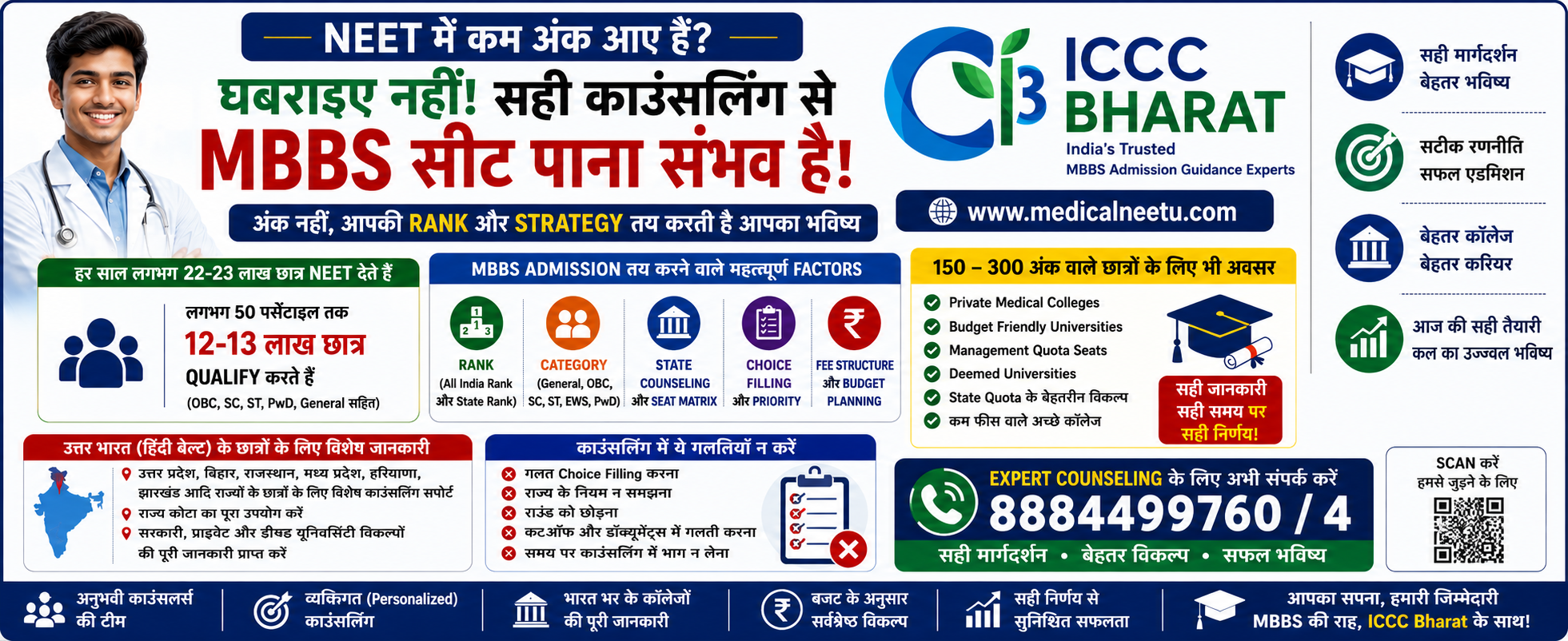
NEET में कम अंक आने का मतलब MBBS सपना खत्म नहीं! सही काउंसलिंग और सही जानकारी बदल सकती है आपकी जिंदगी

उत्तर प्रदेश, बिहार, राजस्थान, मध्य प्रदेश, हरियाणा और झारखंड जैसे राज्यों में हर साल लाखों छात्र NEET परीक्षा देते हैं। परीक्षा के बाद सबसे ज्यादा तनाव उन्हीं छात्रों में होता है जिनके 150–300 अंक आते हैं।

बहुत से छात्र और माता-पिता यह मान लेते हैं कि:

“अब MBBS नहीं मिलेगा…”

लेकिन सच्चाई इससे बिल्कुल अलग है।

आज के समय में MBBS Admission केवल अंकों से तय नहीं होता।
असल खेल होता है:

  • Rank का,
  • Category का,
  • State Counseling का,
  • Budget Planning का,
  • और सबसे महत्वपूर्ण सही Counseling Strategy का।

केवल अंक नहीं, आपकी Rank तय करती है भविष्य

NEET एक Competitive Exam है।

हर साल:

  • पेपर का स्तर बदलता है,
  • छात्रों की संख्या बदलती है,
  • Cutoff बदलता है,
  • और उसी के अनुसार Rank भी बदलती है।

इसलिए:

“कम अंक” का मतलब हमेशा “खराब Rank” नहीं होता।

कई बार कठिन पेपर में कम अंक पर भी अच्छी Rank मिल जाती है।


हिंदी बेल्ट में Competition सबसे ज्यादा

उत्तर प्रदेश, बिहार और राजस्थान जैसे राज्यों से लाखों छात्र NEET देते हैं।
लेकिन सरकारी MBBS सीटें सीमित हैं।

यही कारण है कि:

  • बहुत से छात्र Private Colleges,
  • Management Quota,
  • Deemed Universities,
  • और दूसरे राज्यों की Counseling

की तरफ जाते हैं।


कई छात्र जानकारी की कमी से सीट खो देते हैं

हर साल हजारों छात्र केवल इसलिए MBBS सीट नहीं ले पाते क्योंकि:

  • उन्हें Counseling Process समझ नहीं आती,
  • सही Choice Filling नहीं कर पाते,
  • State Quota Rules नहीं जानते,
  • या गलत लोगों की सलाह में आ जाते हैं।

बाद में वही छात्र कहते हैं:

“काश सही समय पर सही Guidance मिली होती…”


Central OBC और State OBC का अंतर समझना जरूरी

यह NEET Counseling का सबसे बड़ा Confusion होता है।

बहुत से छात्र:

  • अपने राज्य में OBC होते हैं,
  • लेकिन Central OBC List में नहीं आते।

इसका असर पड़ता है:

  • All India Counseling,
  • Reservation Benefits,
  • और Category Rank

पर।

इसलिए Counseling से पहले:
✅ Category Certificate
✅ State Eligibility
✅ Reservation Rules

को समझना बहुत जरूरी है।


150–300 अंक वालों के लिए आज भी मौके हैं

यदि आपके:

  • 150 अंक,
  • 200 अंक,
  • 250 अंक,
  • या 300 अंक

आए हैं, तो घबराने की जरूरत नहीं है।

आज भी भारत में कई विकल्प उपलब्ध हैं:

  • Private Medical Colleges
  • Budget-Friendly Universities
  • Management Quota Seats
  • दूसरे राज्यों के Counseling Options

कई बार सही Guidance से छात्र कम फीस वाले कॉलेज भी प्राप्त कर लेते हैं।


जल्दी निर्णय लेना जरूरी है

बहुत से अच्छे और कम फीस वाले विकल्प:

  • First Round,
  • और Second Round

में ही भर जाते हैं।

जो छात्र देर करते हैं, उन्हें बाद में:

  • ज्यादा फीस,
  • Donation,
  • या Limited Options

का सामना करना पड़ता है।


सही Counseling ही असली हथियार है

आज के समय में केवल NEET Qualify करना काफी नहीं है।

जरूरी है:
✅ सही College Selection
✅ सही Choice Filling
✅ सही Budget Planning
✅ सही State Analysis
✅ सही Counseling Guidance

क्योंकि:

“आपके अंक आपको Qualified बनाते हैं, लेकिन सही Counseling आपको MBBS सीट दिलाती है।”


निष्कर्ष

यदि आपके कम अंक आए हैं तो निराश मत होइए।

भारत में MBBS Admission System बहुत बड़ा और जटिल है। सही जानकारी और सही रणनीति से आज भी हजारों छात्र MBBS सीट प्राप्त कर रहे हैं।

याद रखिए:

“कई बार ज्यादा अंक वाले छात्र भी सीट खो देते हैं,
और कम अंक वाले छात्र सही Counseling से डॉक्टर बन जाते हैं।”

इसलिए जल्दबाजी में फैसला न लें।
अपनी Rank, Category, Budget और Counseling Options को अच्छे से समझकर आगे बढ़ें।

क्योंकि:

“NEET केवल परीक्षा नहीं है…
यह सही रणनीति और सही मार्गदर्शन का खेल है।”

NEET UG Counseling Is More Than Marks: How Linguistic Minority, Rank, Category, and Counseling Strategy Decide MBBS Admissions

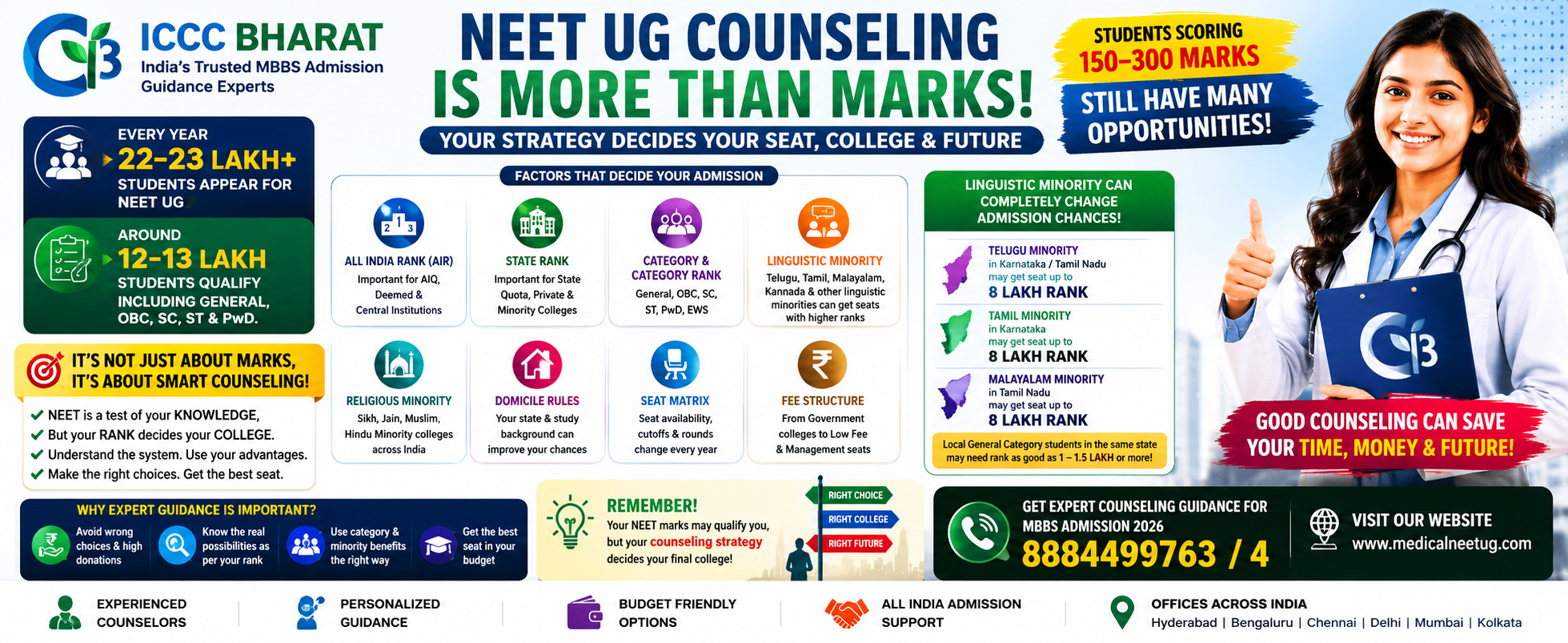
Every year, nearly 22 to 23 lakh students appear for the NEET UG examination across India. After the examination, many students immediately begin comparing marks and predicting whether they will get an MBBS seat.

However, experienced counselors and admission experts repeatedly explain one important fact:

NEET counseling is not only about marks — it is about how intelligently you use your rank, category, linguistic minority eligibility, domicile, and counseling strategy.

Many students scoring between 150 and 300 marks believe their MBBS dream is over. In reality, India’s counseling system is highly complex and includes several important factors such as:

  • All India Rank
  • State Rank
  • Category Rank
  • Linguistic Minority Quotas
  • Religious Minority Seats
  • Domicile Rules
  • Management Quota
  • NRI Eligibility
  • State-specific counseling systems
  • Fee structures and seat matrix trends

Understanding these factors properly can completely change a student’s admission opportunities.


NEET Marks vs NEET Rank: What Actually Matters?

One of the biggest misconceptions among students is that marks alone decide MBBS admissions.

In reality, NEET is a highly competitive examination where:

  • exam difficulty,
  • candidate performance,
  • normalization trends,
  • and competition levels

all influence the final rank.

A score considered “low” in one year may still generate a competitive rank in another year depending on the difficulty of the examination.

This is why counseling experts always emphasize:

“Your marks do not matter as much as the rank generated from those marks.”


Understanding the Different Types of Ranks

1. All India Rank (AIR)

The All India Rank is generated nationally among all NEET candidates across India.

This rank is important for:

  • MCC counseling
  • All India Quota seats
  • Deemed universities
  • Central institutions

2. State Rank

Every state generates its own merit list and state rank during counseling.

State rank becomes important for:

  • State quota seats
  • Private colleges under state counseling
  • Minority seats
  • Category reservations within the state

In many states, exact category rankings become clear only after students apply for counseling because every NEET-qualified student does not participate in every state counseling process.


Central OBC vs State OBC: A Major Confusion

One of the most misunderstood areas in NEET counseling is the difference between:

  • Central OBC eligibility
  • State OBC eligibility

A student may:

  • qualify as OBC in their home state,
  • but may not fall under the Central OBC-NCL list.

This creates major differences in:

  • All India counseling eligibility
  • Category ranking
  • Reservation benefits

Students must carefully verify whether they belong to:

  • Central OBC-NCL
  • State OBC category
  • EWS
  • SC/ST/PwD category

before participating in counseling.


Linguistic Minority Quotas Can Completely Change Admission Chances

One of the most important but least understood areas in MBBS counseling is the role of linguistic minority quotas.

Many students are unaware that language-based minority eligibility can significantly improve their chances of securing MBBS seats at comparatively lower fee structures.

Telugu Linguistic Minority Example

For example:

  • A Telugu-speaking student studying in Karnataka or Tamil Nadu may become eligible for Telugu linguistic minority seats in certain colleges.

In some situations:

  • Telugu minority students may secure seats with ranks as high as 8 lakh,
  • while local general category students may require much lower ranks for the same seat.

Similarly:

  • Tamil linguistic minorities in Karnataka,
  • Malayalam linguistic minorities in Tamil Nadu,
  • Kannada linguistic minorities in neighboring states,

can all receive advantages depending on the counseling rules and college eligibility criteria.

These factors often become extremely important for students scoring between 150 and 300 marks.


Religious Minority Seats Also Play a Major Role

Apart from linguistic minorities, several colleges across India also operate under religious minority status.

Examples include:

  • Sikh minority colleges
  • Jain minority colleges
  • Muslim minority institutions
  • Hindu minority colleges in Jammu & Kashmir

These colleges may follow separate reservation systems under their respective state counseling processes.

Understanding eligibility for these seats can dramatically improve admission possibilities for students with lower NEET scores.


Students Scoring 150–300 Marks Still Have Opportunities

Students scoring:

  • 150–250 marks
  • 250–300 marks

often panic after NEET results are declared.

However, depending on:

  • category,
  • linguistic minority eligibility,
  • state counseling,
  • budget,
  • fee structure,
  • and counseling strategy,

students may still secure:

  • Private medical college seats
  • Linguistic minority quota seats
  • Religious minority seats
  • Lower-fee university seats
  • Management quota seats
  • Sometimes even without extremely high donation structures

In some situations, students may secure colleges with annual fee structures around ₹20–23 lakhs instead of paying extremely high management quota packages.


Why Counseling Strategy Is More Important Than Ever

Modern NEET counseling is highly data-driven and extremely competitive.

Students must understand:

  • seat matrix trends,
  • round-wise vacancy movement,
  • category conversion rules,
  • linguistic minority advantages,
  • fee structures,
  • state eligibility,
  • mop-up rounds,
  • and stray vacancy rounds.

Many students lose excellent opportunities simply because they:

  • apply late,
  • misunderstand quotas,
  • ignore linguistic minority eligibility,
  • choose wrong colleges,
  • or fail to understand state counseling systems properly.

Importance of Professional Counseling Guidance

A good counseling expert helps students:

  • analyze their rank realistically,
  • understand category benefits,
  • avoid unnecessary donations,
  • identify budget-friendly colleges,
  • utilize minority advantages,
  • and create smarter choice filling strategies.

This becomes especially important for students in the lower score range because even small counseling mistakes can cost:

  • better colleges,
  • lower fee structures,
  • minority advantages,
  • and valuable seat opportunities.

Conclusion

NEET UG counseling in India is no longer a simple marks-based process. It is a highly complex ecosystem involving:

  • ranks,
  • state rules,
  • linguistic minority quotas,
  • religious reservations,
  • counseling dynamics,
  • seat matrix changes,
  • and financial planning.

Students must clearly understand:

“Your NEET marks may qualify you, but your counseling strategy decides your final college.”

For students scoring between 150 and 300 marks, proper counseling and strategic planning can still open doors to MBBS admissions across India through various quota systems and counseling opportunities.
4 States Account for 41% of NEET UG 2026 Aspirants: What It Means for Medical Admissions

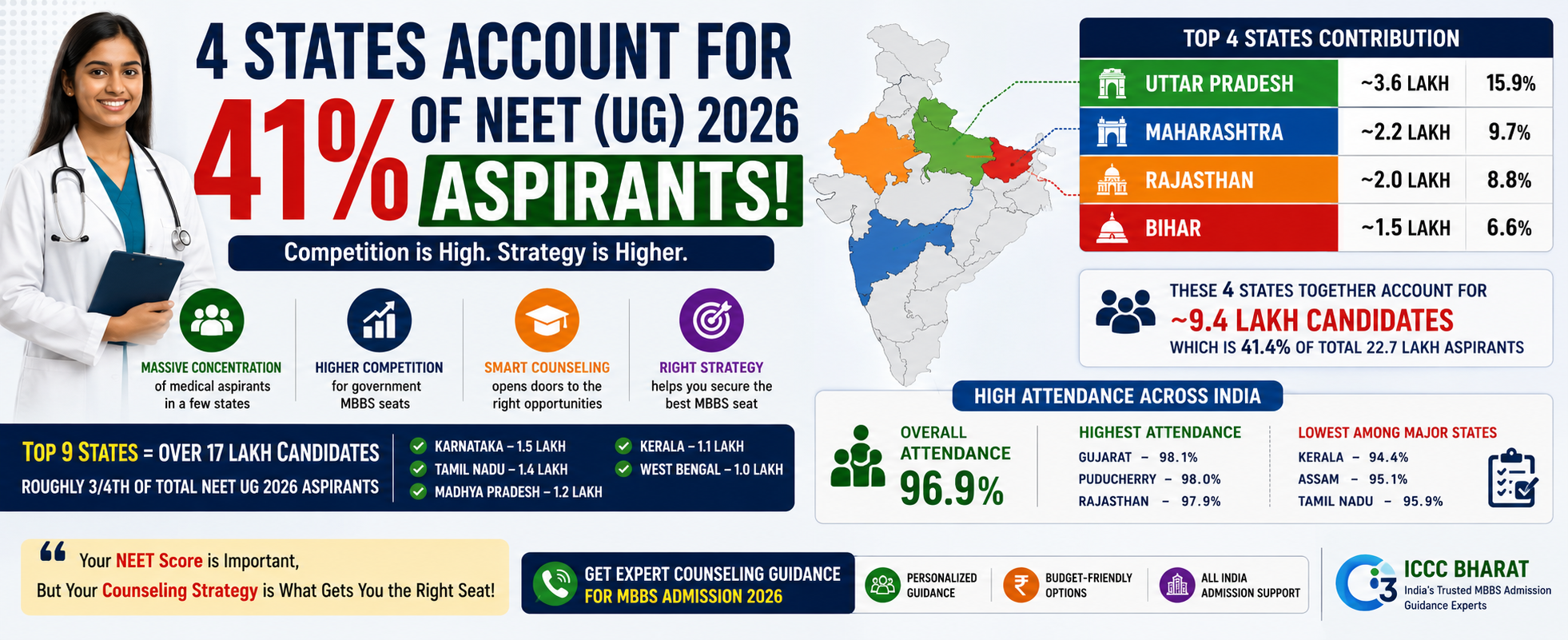
The NEET UG 2026 examination has once again demonstrated how heavily concentrated India’s medical aspirants are in a handful of states. According to state-wise data released by the National Testing Agency (NTA), four states — Uttar Pradesh, Maharashtra, Rajasthan, and Bihar — together accounted for nearly 41% of the total NEET UG 2026 registrations.

Out of approximately 22.7 lakh candidates registered for NEET UG 2026, nearly 9.4 lakh students came from these four states alone. This highlights the increasing pressure on medical admissions and counseling systems, especially in high-population states where competition is extremely intense.

State-Wise NEET UG 2026 Participation

Top Contributing States

  • Uttar Pradesh – Around 3.6 lakh candidates
  • Maharashtra – Around 2.2 lakh candidates
  • Rajasthan – Around 2 lakh candidates
  • Bihar – Around 1.5 lakh candidates

Together, these states dominate the national NEET landscape and significantly influence cutoff trends, counseling competition, and seat allocation dynamics.

Other states with major participation include:

  • Karnataka – 1.5 lakh
  • Tamil Nadu – 1.4 lakh
  • Madhya Pradesh – 1.2 lakh
  • Kerala – 1.1 lakh
  • West Bengal – 1 lakh

The top nine states together contributed more than 17 lakh NEET aspirants, accounting for almost three-fourths of India’s total candidate pool.

What This Means for MBBS Admissions

1. Increased Competition in Government Colleges

States with higher candidate density naturally witness tougher competition for government MBBS seats. Even small mark differences can create large rank variations due to the huge number of aspirants.

2. Higher Pressure on State Quotas

Students from high-volume states face intense competition under state counseling quotas. This pushes many candidates toward:

  • Private medical colleges
  • Deemed universities
  • Management quota seats
  • Other state counseling opportunities

3. Rising Demand for Management Quota Seats

As government seats become harder to secure, students scoring between 150–450 marks increasingly explore management quota options across:

  • Karnataka
  • Telangana
  • Andhra Pradesh
  • Tamil Nadu
  • Maharashtra

The demand for budget-friendly MBBS packages is expected to rise significantly during counseling rounds.

Attendance Trends Remained High

Despite the scale of the examination, NEET UG 2026 recorded an impressive attendance rate of 96.9%.

Highest Attendance States

  • Gujarat – 98.1%
  • Puducherry – 98%
  • Rajasthan – 97.9%

Among larger states:

  • Uttar Pradesh – 97.5%
  • Maharashtra – 97.4%

States with comparatively lower attendance included:

  • Kerala – 94.4%
  • Assam – 95.1%
  • Tamil Nadu – 95.9%

Counseling Strategy Becomes More Important Than Ever

With lakhs of students competing for limited seats, counseling strategy is now equally important as NEET marks.

Students and parents must carefully analyze:

  • State-wise cutoff trends
  • Fee structures
  • Seat matrix changes
  • Round-wise seat availability
  • Management quota opportunities
  • Choice filling strategy

Many students lose good MBBS opportunities not because of low marks, but because of incorrect counseling decisions.

Conclusion

The NEET UG 2026 data clearly shows that medical admission competition in India is becoming increasingly concentrated in a few major states. As aspirant numbers continue to rise, smart counseling, proper planning, and early decision-making will play a major role in securing the best possible MBBS seat.

Students should focus not only on marks and rank, but also on understanding the counseling ecosystem, quota systems, and budget-friendly admission pathways available across India.