India’s medical admission process is easily one of the most high-stakes, emotionally charged, and sensitive education systems in the country. From the intense battle of the NEET examination to the multi-stage maze of counselling—encompassing seat matrix publication, choice filling, allotment, NRI verification, fee payment, and final joining—every single step directly alters the destiny of hundreds of thousands of students and their families.
When an administrative framework handles thousands of life-defining seats and holds hundreds of crores in refundable security deposits, it cannot afford to operate in the shadows. It must be a beacon of absolute transparency, technical competence, and unshakeable accountability.
Yet today, a growing chorus of serious concerns raised by aspirants, frustrated parents, and medical education experts suggests otherwise. The systemic glitches, communication gaps, and administrative obscurities plaguing the Medical Counselling Committee (MCC) can no longer be brushed aside as routine bureaucratic complaints. They are critical warning signs of a system on the verge of a structural breakdown.
A National-Level Weight on a Fragmented Spine
The MCC is not a minor administrative desk hidden away in a ministry corridor; it is a massive national admission engine. Operating under the Directorate General of Health Services (DGHS) and the Ministry of Health and Family Welfare (MoHFW), the MCC is directly responsible for allocating All India Quota (AIQ) seats, deemed university seats, Central Universities, and premier institutional seats across MBBS, BDS, MD, MS, and super-speciality courses.
Because the future of India’s healthcare ecosystem rests on this very pipeline, the system demands an infrastructure that is physically, technically, and administratively flawless. Unfortunately, the current setup feels fragmented, heavily outsourced, and structurally opaque.
The Question of Financial Custody and the HLL Connection
To participate in medical counselling, particularly for high-fee categories like Deemed Universities, families are required to deposit substantial amounts of money as refundable security fees. These deposits frequently run into lakhs of rupees per candidate. Naturally, where public money is involved, absolute financial clarity is a mandate, not a choice.
However, a closer look at the MCC’s official support structure reveals deep-seated questions about accountability:
- The Domain Disconnect: The official financial and refund-related grievance emails listed on the MCC contact page utilize the domain
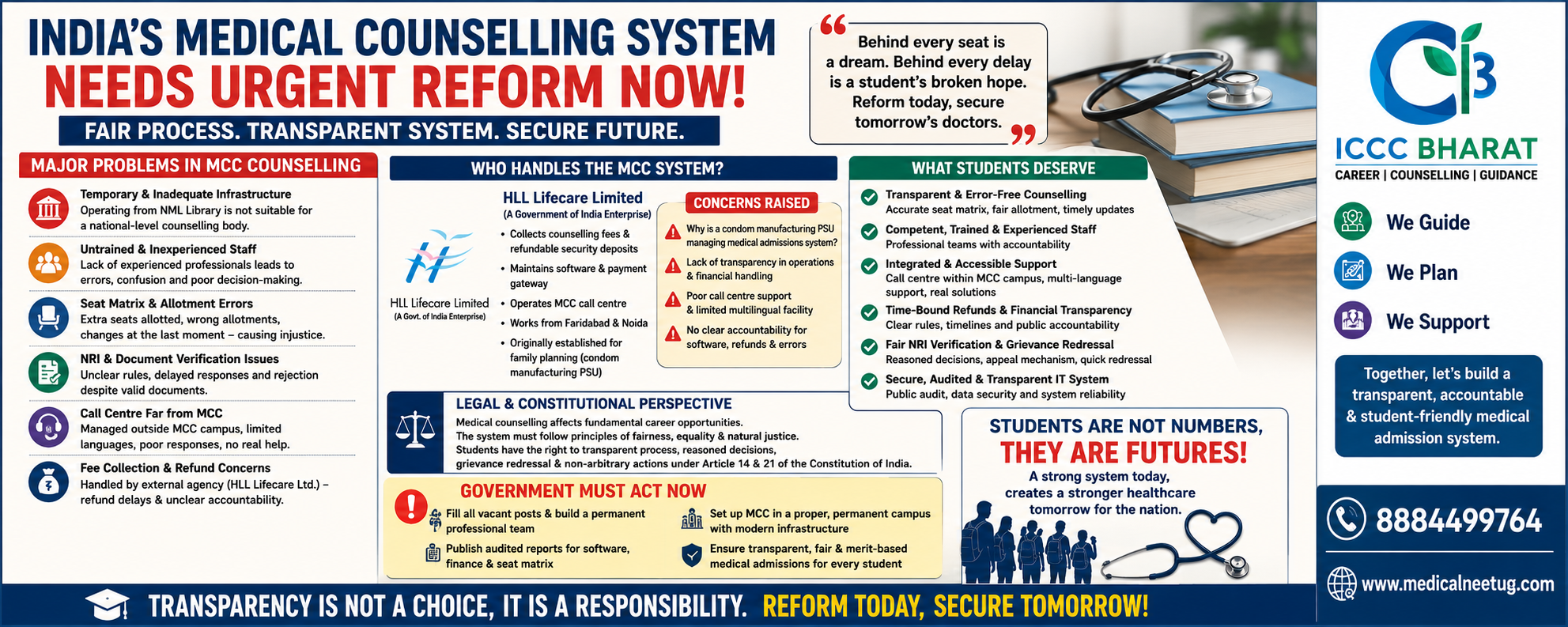
lifecarehll.com—belonging to HLL Lifecare Limited. - The Corporate Profile: HLL Lifecare is a Government of India Central Public Sector Enterprise (CPSE). While it has evolved into a diversified healthcare services provider, its historical core lies in the manufacturing of affordable contraceptives and family planning products.
While HLL’s involvement may be entirely legal and sanctioned by the Ministry, the public and the student community have a legitimate right to demand clarity on the following fronts:
🛑 Critical Questions on Financial Accountability
- Who exactly holds custody of the thousands of crores collected as student deposits?
- What is the independent audit mechanism governing the interest earned on these massive short-term funds?
- Who bears legal liability when refunds are delayed for months, causing immense financial distress to middle-class families?
- What are the performance metrics and penalty clauses governing the outsourced call centres handling student panics?
The Urgent Need for a Public Tech Audit
Medical counselling has transitioned almost entirely online, making the underlying software algorithm the ultimate arbiter of a student’s merit. Public bidding records show that HLL has historically floated tenders for installing servers and software packages specifically for the “Medical Counselling Support Cell.”
If a public sector enterprise is managing or procuring the technology backbone of a high-stakes national admission portal, the entire software suite must be subjected to a rigorous, independent public audit. We are not just talking about an interface that loads quickly; a national medical portal requires a bulletproof digital architecture.
| Essential Tech Safeguard | Current Threat / Vulnerability |
| Allotment Algorithm Audit | Risk of logical loops or faulty code prioritizing lower ranks over higher merit. |
| Seat Matrix Validation | Glitches showing incorrect, duplicate, or unapproved seats mid-round. |
| Cybersecurity Certification | Vulnerability to data leaks, server crashes during peak hours, and unauthorized access. |
| Data Privacy Compliance | Exposure of sensitive candidate information, leading to predatory targeting by private agents. |
Students should not be forced to gamble their careers on an unverified algorithm, nor should they be left stranded by generic, automated email auto-responders when their entire life’s savings are on the line.
De-escalating the Language Barrier
India’s medical aspirants are deeply diverse, hailing from every corner of the nation—from the southern tips of Tamil Nadu and Kerala to the eastern frontiers of West Bengal and the Northeast. Yet, the national helpdesk remains notoriously uniform and unhelpful.
A helpdesk cannot function effectively if call-handlers merely read off standard scripts in a limited set of languages. When a student is dealing with complex, time-sensitive issues like cross-state category eligibility, complex fee structures, or intricate NRI document rules, they need to speak with trained counselling officers, not entry-level customer care representatives. The helpdesk must be converted into a highly professional, multi-lingual, and legally accountable support system.
Seat Matrix Errors and Arbitrary NRI Verifications
Perhaps the most damaging failures in recent history involve errors in the seat matrix and arbitrary rejections during Non-Resident Indian (NRI) document verification.
A single incorrect seat listing or duplicate allotment can trigger nationwide panic, spark endless litigation, stall the entire admission calendar, and unjustly rob a deserving candidate of a year of their life. Seat matrix preparation is highly complex legal work involving the National Medical Commission (NMC), state authorities, and Supreme Court mandates. It requires a strict, legally binding verification protocol before any choice-filling round opens.
Similarly, the NRI quota verification process has become a legal minefield. Candidates submit expensive, embassy-attested documents only to face abrupt rejections without detailed explanations. Under the principles of natural justice, every single rejection must be backed by a reasoned order:
[Specific Document Deficiency] ➔ [Statutory Rule Relied Upon] ➔ [Timeframe window for Correction/Appeal]
A one-line status update or absolute silence from an administrative body is an outright violation of a student’s legitimate expectations of fairness.
The Path Forward: A Statutory National Authority
The current ad-hoc, fragmented arrangement between the Ministry of Health, the DGHS, and outsourced public enterprises like HLL Lifecare is no longer sustainable. To protect fundamental career opportunities and uphold the constitutional right to equality and non-arbitrariness, the Central Government must act before this fragile ecosystem collapses into a larger crisis.
The ultimate solution lies in transitioning away from temporary committees and establishing a Permanent Statutory Medical Counselling Authority directly accountable to Parliament.
Architecture of a Modern Counselling Authority
- Permanent Office Infrastructure: Moving away from fragmented, multi-agency temporary setups.
- Specialized Internal Cells: Dedicated, permanent wings for IT Security, Legal Compliance, Finance & Independent Audit, and Student Grievances.
- Live Transparency Dashboards: Real-time public tracking of seat matrix changes, withdrawal histories, allotment logic, and refund disbursements.
- Expert Oversight: A governing board that includes independent legal minds, cybersecurity experts, public administration veterans, and student welfare advocates.
Conclusion: A Matter of National Trust
This critique is not an attack on any single department or public sector organization; it is an urgent defense of India’s future doctors.
The young minds who will tomorrow man our ICUs, perform complex surgeries, and safeguard public health cannot have their careers hang by the fraying threads of unverified software algorithms, delayed refunds, language barriers, and opaque administrative decisions.
Medical counselling is not a mere clerical exercise in seat allotment. It is a sacred national trust. It is time for the government to step in, conduct an independent structural audit, and deliver a medical admission system that is transparent, legally sound, and profoundly accountable. Our future doctors deserve nothing less.