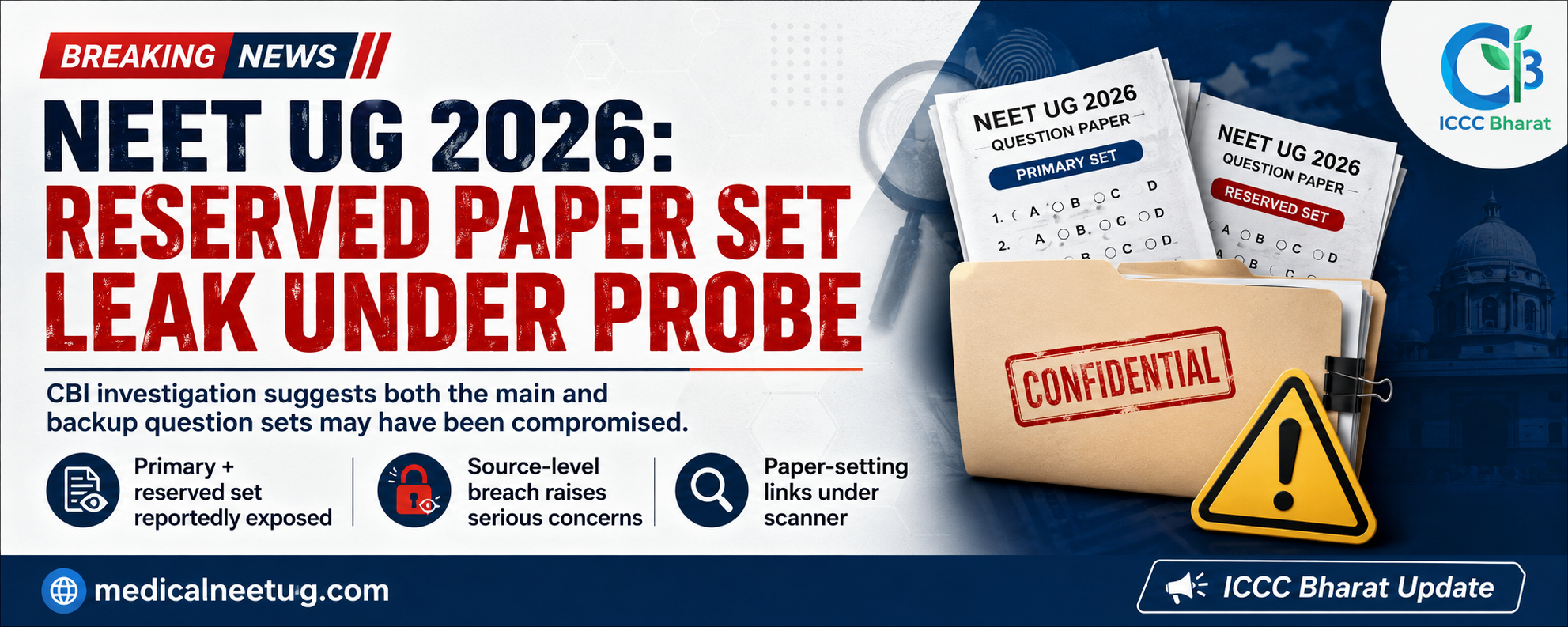
NEET UG 2026 Reserved Paper Set Leak: How the Backup Question Paper Was Allegedly Compromised

The NEET UG 2026 paper leak investigation has moved into a more alarming phase after reports suggested that even the reserved question paper set may have been compromised. This development has raised serious questions about the depth of the breach, the security of the paper-setting process, and the internal safeguards of the National Testing Agency.

A reserved paper set is supposed to function as an emergency backup. It is a separate question paper prepared alongside the main paper and kept confidential for use only if the primary paper is compromised, lost, damaged, or affected by logistical failure.

However, if both the main and reserved sets are compromised, the issue is no longer just a distribution-level lapse. It becomes a source-level breach — meaning the leak may have happened before printing, transport, or exam-centre handling.

What Is a Reserved Paper Set?

A reserved paper set is a secondary version of the examination paper. It is normally created as a contingency mechanism.

Its purpose is to protect the examination process in case:

  • the main paper is leaked,
  • question papers are lost during transit,
  • printing or packaging errors occur,
  • exam-centre logistics fail,
  • or any emergency affects the original paper.

In a secure system, the reserved set should remain untouched unless officially activated.

But in the NEET UG 2026 probe, reports claim that the breach may have affected both the primary and backup question pools because the alleged leak originated from the paper-setting stage itself.

Why This Is a Serious Development

If only the printed question paper is leaked during transport or at an exam centre, authorities can sometimes activate the reserved set and continue the examination.

But if the reserved set is also leaked, the system loses its emergency shield.

This means:

  • the backup mechanism fails,
  • the examination integrity collapses,
  • the re-exam becomes unavoidable,
  • and the credibility of the paper-setting process comes under scrutiny.

This is why the alleged leak of the reserved set is more serious than an ordinary paper leak.

How Was the Paper Allegedly Leaked?

According to reports, the Central Bureau of Investigation is examining whether the leak originated from inside the paper-setting committee linked to NTA.

The investigation reportedly points to two separate sets of leaked material — one handwritten and one typed. These question sets allegedly moved through a chain of insiders, recruiters, middlemen, and candidates before the May 3 examination.

The CBI has arrested retired chemistry professor P. V. Kulkarni, who was reportedly associated with the NTA panel involved in setting the question paper. Reports also state that Pune-based teacher Manisha Gurunath Mandhare, allegedly linked to the Biology paper-setting process, has been arrested in the case.

Alleged Role of Paper-Setting Experts

Reports suggest that the CBI is now closely examining people connected with the question paper preparation chain, including subject experts and paper setters. The agency has reportedly sought details from NTA about those who had access to the question paper before it was sealed.

The arrest of people allegedly linked to the paper-setting process makes this case particularly sensitive. If the allegation is proved, it would indicate that the leak did not happen only at the transportation or examination-centre stage, but much earlier — during the creation and handling of the question pool.

Main Paper vs Reserved Paper: What Happens If Both Are Leaked?

Normally, if the main paper is compromised, authorities may use the reserved set. But when both papers are suspected to be compromised, the examination cannot proceed safely.

In such a scenario, the possible consequences are:

  • cancellation of the examination,
  • fresh paper preparation,
  • re-examination,
  • investigation into insiders,
  • audit of the entire paper-setting chain,
  • review of paper security protocols,
  • and possible reform of the examination model.

This is exactly why the NEET UG 2026 controversy has become a national-level issue.

CBI Probe Expands

The CBI investigation has reportedly expanded to examine whether the alleged leak was part of a larger conspiracy involving insiders, coaching links, candidates, and middlemen. Reports have said that the entire paper-setting group may now be under scrutiny, and more arrests may follow depending on evidence.

The probe is also looking into:

  • digital evidence,
  • WhatsApp and Telegram circulation,
  • handwritten notes,
  • printed copies,
  • financial transactions,
  • coaching-centre links,
  • and possible internal access routes.

Why the Reserved Set Leak Matters for Exam Reforms

The alleged compromise of a reserved paper set exposes a major weakness in the examination architecture. A backup paper is useful only when its secrecy is stronger than the main paper.

If the same access chain can expose both the main and reserved sets, the system needs structural reform.

This may increase pressure for:

  • digital question paper locking,
  • stricter access control,
  • independent audit trails,
  • stronger background verification of experts,
  • reduced human access to full question papers,
  • encrypted transmission,
  • and computer-based testing.

The Bigger Question: Was This a Systemic Failure?

This case is no longer only about who circulated the paper. The bigger question is whether the system had adequate safeguards to prevent insiders from accessing, copying, dictating, or transmitting confidential questions.

If the paper-setting committee itself becomes vulnerable, the entire exam chain becomes fragile.

For a national examination like NEET UG, where more than 20 lakh students compete for medical seats, even a small breach can damage public confidence. A source-level leak can destroy the credibility of the entire examination.

Conclusion

The alleged leak of the NEET UG 2026 reserved question paper set is a deeply serious development. A reserved paper is supposed to be the final safeguard of the examination system. If that too was compromised, it indicates a breach at the most sensitive level of exam preparation.

The CBI investigation will now be crucial in determining how the questions moved out, who had access, whether insiders were involved, and how far the leaked material travelled.

For students and parents, the most important advice remains clear: avoid rumours, follow official updates, and focus on the re-examination. For the examination system, however, this case may become a turning point for major reforms in security, accountability, and transparency.
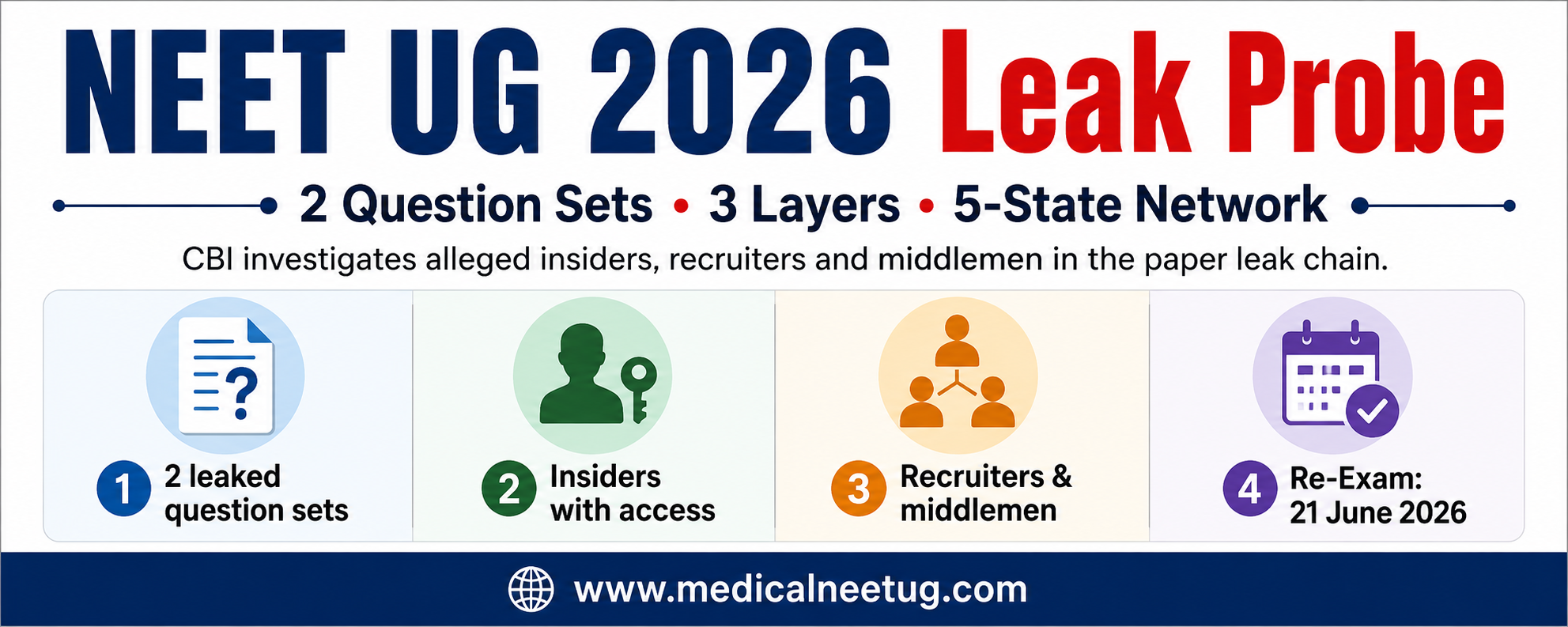
How NEET UG 2026 Paper Was Allegedly Leaked: Two Question Sets, Three Layers and a Five-State Network

The NEET UG 2026 paper leak investigation has taken a wider and more serious turn. The Central Bureau of Investigation is now probing not only middlemen and coaching links but also alleged insiders connected with the National Testing Agency’s paper-setting process.

The case has already led to multiple arrests across different states and has forced more than 22 lakh medical aspirants to prepare again for the re-examination scheduled on 21 June 2026.

According to the investigation details emerging so far, the alleged leak operation may have worked through a structured network involving insiders, recruiters and middlemen.


Two Sets of Questions Allegedly Leaked

Investigators are examining claims that two separate sets of question material were leaked before the NEET UG 2026 examination.

One set was reportedly handwritten, while another was later converted into digital form and circulated as a PDF.

CBI is probing whether the leaked material included questions from:

  • Botany
  • Zoology
  • Chemistry

The agency has reportedly alleged that many of these questions matched the actual NEET UG 2026 question paper held on 3 May 2026.


Alleged Role of NTA-Linked Experts

The CBI has arrested Manisha Gurunath Mandhare, a senior botany teacher from Pune, and P. V. Kulkarni, a retired chemistry professor from Latur.

Both were reportedly associated with the NEET UG 2026 paper-setting process as subject experts.

According to investigators, Mandhare allegedly had access to Botany and Zoology questions, while Kulkarni is accused of leaking Chemistry-related material.

The agency is now examining whether their access to confidential question papers was misused before the exam.


How the Leak Allegedly Started

As per the investigation, the alleged leak may have started from special coaching sessions conducted before the examination.

At Mandhare’s residence in Pune, selected students were allegedly asked to:

  • write down important questions,
  • mark answers in textbooks,
  • and note down Biology-related content.

Investigators claim that several of these questions later matched the actual NEET UG 2026 Biology paper.

In another part of the probe, Kulkarni is accused of allegedly leaking Chemistry questions.


From Coaching Notes to PDF

The leaked material allegedly moved from handwritten notes to digital circulation.

Investigators believe that questions discussed during the Pune coaching sessions were later compiled into a PDF containing around 500 to 600 questions.

This PDF was allegedly circulated through:

  • WhatsApp groups,
  • Telegram channels,
  • and private student networks.

This digital movement made the investigation more complex because the material could be forwarded rapidly across multiple locations.


The Gurugram and Rajasthan Link

The CBI is also probing the role of middlemen who allegedly distributed and sold the leaked material.

According to reports, the leaked question set allegedly moved from Nashik-based accused Shubham Khairnar to Gurugram-based Yash Yadav.

Yash Yadav allegedly sold the paper set to Mangilal Biwal, also identified as Mangilal Khatik, for around ₹10 lakh.

Investigators claim the deal was based on the condition that at least 150 questions should match the actual NEET paper.

Later, printed copies were allegedly distributed among relatives, students and other connected persons.


Beauty Parlour Owner Under Scanner

Another major name in the investigation is Pune-based Manisha Waghmare, who reportedly ran a beauty parlour.

CBI has identified her as an important link in the alleged network.

She is accused of connecting selected students with insiders and helping mobilise candidates for special coaching sessions.

Investigators are also checking financial transactions linked to her and other accused persons.


Three-Layer Network Under Investigation

The alleged operation appears to have worked through three main layers:

1. Insiders

People who allegedly had access to confidential questions before the exam.

2. Recruiters

Individuals who allegedly identified students willing to pay for access to question material.

3. Middlemen

People who allegedly circulated, printed, forwarded or sold the leaked material.

This structure suggests that the alleged paper leak was not a random incident but may have involved an organised network.


Arrests Across Multiple States

So far, several people have reportedly been arrested from different states.

The names under investigation include:

  • Manisha Gurunath Mandhare from Pune
  • P. V. Kulkarni from Latur
  • Manisha Waghmare from Pune
  • Dhananjay Lokhanda from Ahilyanagar
  • Shubham Khairnar from Nashik
  • Mangilal Biwal / Khatik from Jaipur
  • Vikas Biwal from Jaipur
  • Dinesh Biwal from Jaipur
  • Yash Yadav from Gurugram

The arrests show that the alleged network may have spread across Maharashtra, Rajasthan, Haryana and other states.


Entire Paper-Setting Chain Under Scrutiny

The CBI is now reportedly examining the broader question paper preparation process.

This includes:

  • subject experts,
  • paper setters,
  • NTA-linked officials,
  • coaching contacts,
  • digital communication,
  • printing or copying points,
  • financial transactions,
  • and possible previous exam links.

Officials are also probing whether the accused had any role in earlier examination-related leaks.


Why This Case Is Serious

This case is extremely serious because the alleged breach appears to involve the question-setting stage itself.

Usually, paper leak cases are suspected at later stages such as printing, transportation or exam centre distribution. But if the leak happened at the paper-setting level, it raises deeper concerns about exam security and confidentiality.

For students, this is not only about one exam. It is about trust in the national medical entrance system.


Impact on Students

More than 22 lakh students who appeared for NEET UG 2026 are now preparing for a re-exam.

The cancellation has caused:

  • mental stress,
  • extra preparation pressure,
  • travel planning issues,
  • uncertainty among parents,
  • and loss of confidence in the system.

However, authorities have stated that the re-exam is necessary to protect genuine students and restore fairness.


Conclusion

The NEET UG 2026 paper leak case has now become one of the most serious examination controversies in recent years.

The investigation suggests a possible network involving alleged insiders, recruiters, middlemen and digital circulation channels. With multiple arrests and the paper-setting process under scrutiny, the CBI probe is expected to uncover how far the leak spread and who was responsible.

Students and parents should avoid rumours, follow only official updates and focus on preparation for the re-examination on 21 June 2026.