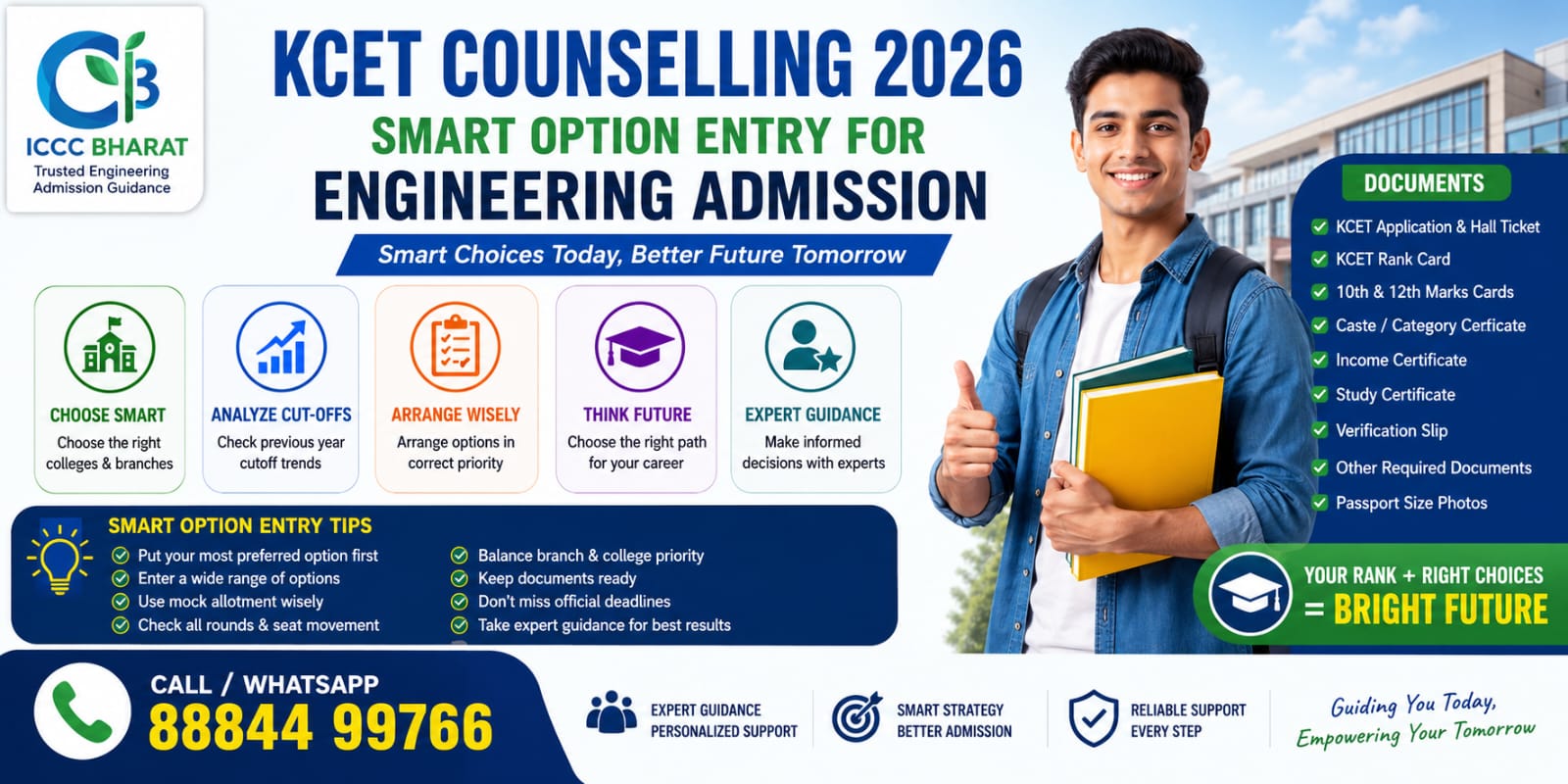
KCET counselling is one of the most important stages for students seeking engineering admission in Karnataka. After the KCET results, many students and parents feel confused about college selection, branch preference, cutoff trends, and option entry order. A small mistake in option entry can affect the final seat allotment, so students must make careful and smart decisions.
What Is KCET Option Entry?
KCET option entry is the process where students select their preferred colleges and branches through the KEA counselling portal. Based on the student’s rank, category, reservation, seat availability, and option order, KEA allots seats in different counselling rounds.
For KCET 2026, candidates must follow official KEA instructions, complete document verification, download the verification slip, and enter college-course options within the given deadline. Students are advised to regularly check the KEA official website for updates.
Why Smart Option Entry Is Important
Many students think option entry is only about selecting top colleges. But in reality, option entry is a strategy. The order of choices plays a major role in seat allotment.
A smart option entry can help students:
- Improve admission chances
- Avoid losing better college options
- Balance branch preference and college reputation
- Use cutoff trends properly
- Stay prepared for multiple rounds
- Make practical choices based on rank
1.Do Not Choose Colleges Randomly
Students should not enter options only by copying a friend’s list or following social media suggestions. Every student has a different rank, category, location preference, budget, and career goal.
Before entering options, students should prepare a proper list of colleges based on:
- Previous year cutoffs
- Branch preference
- Placement records
- College location
- Academic reputation
- Infrastructure
- Internship opportunities
- Fees and affordability
2.Give First Preference to Your Dream Options
Even if your rank is slightly higher than the previous year cutoff, do not remove your dream college or branch completely. Cutoffs can change every year depending on competition, seat matrix, category, and student choices.
For example, if you are aiming for CSE, ECE, AI & ML, Data Science, Mechanical, Civil, or Electrical branches in a reputed college, keep those options in the correct order based on your priority.
The simple rule is:
Put your most preferred option first, not the most “safe” option first.
3.Understand College vs Branch Priority
One of the biggest doubts during KCET counselling is:
Should I choose a top college with a different branch or CSE in another college?
The answer depends on the student’s long-term goal. If the student is very clear about software, coding, AI, data science, or IT career, then branch preference becomes very important. But if the student values college brand, campus exposure, peer group, and placement network, then college reputation may also matter.
Students should compare:
- Interest in the branch
- Placement scope
- Higher education plans
- Career flexibility
- College brand value
- Industry demand
There is no single answer for every student. The best choice is the one that matches the student’s future career plan.
4.Check Previous Year Cutoff Trends
Previous year cutoff is one of the most useful tools during KCET option entry. It helps students understand which colleges and branches may be possible for their rank.
But students should remember that cutoff is only an indication, not a guarantee. Cutoffs may change due to:
- Number of students participating
- Seat availability
- Category-wise competition
- Branch demand
- New courses or seat changes
- Round-wise seat movement
Students should check Round 1, Round 2, extended round, and final cutoff trends before finalizing options.
5.Do Not Enter Very Few Options
Many students enter only a small number of options, thinking they will get only their preferred college. This is risky.
If the cutoff does not match, the student may miss out on good alternatives. It is better to enter a wide range of options, including dream colleges, moderate chances, and safe options.
A balanced option list should include:
- Dream options
- Possible options
- Safe options
- Backup branches
- Backup colleges
6.Arrange Options in Correct Priority Order
The order of options is very important. KEA allotment is based on rank and preference order. Students should not place a less preferred college above a better option just because it looks safer.
For example:
If a student wants ECE in College A more than CSE in College B, then ECE in College A should be placed above CSE in College B.
Your option list should reflect your real preference.
7.Be Careful After Mock Allotment
Mock allotment helps students understand their possible seat based on entered options. After mock allotment, students usually get a chance to modify, add, delete, or rearrange options.
Students should use this stage carefully. If the mock result is not satisfactory, they should review the cutoff, add more options, and correct the priority order.
Mock allotment is not final allotment, but it is a very important warning signal.
8.Keep Documents Ready
Before counselling and admission, students should keep all important documents ready. Commonly required documents may include:
- KCET application form
- KCET hall ticket
- KCET rank card
- SSLC / 10th marks card
- 2nd PUC / 12th marks card
- Study certificate
- Caste / category certificate if applicable
- Income certificate if applicable
- Kannada medium / rural / special category documents if applicable
- Verification slip
- Passport-size photos
Students must always follow the official KEA document instructions.
9.Do Not Ignore Good Emerging Branches
Many students focus only on CSE and ignore other strong branches. In 2026, branches like ECE, AI & ML, Data Science, Information Science, Cyber Security, Electrical, Mechanical, and core engineering branches also have good career scope when chosen from the right college.
Students should not select a branch only because of trend. They should understand the subjects, career opportunities, and future industry demand.
10.Take Expert Guidance Before Final Locking
KCET option entry can be confusing because students must compare ranks, cutoffs, colleges, branches, categories, and future career scope. Expert counselling can help students avoid common mistakes and create a smart option entry strategy.
A proper counselling plan can help students understand:
- Which colleges are possible
- Which branches are realistic
- Which options are risky
- Which colleges should be kept as backup
- How to arrange the option list
- How to respond after mock allotment and final allotment
Common Mistakes Students Should Avoid
- Entering options without cutoff analysis
- Keeping safe options above dream options
- Selecting only famous colleges without checking branch scope
- Ignoring lower rounds and seat movement
- Entering too few choices
- Depending only on friends or social media
- Not checking fees and location
- Missing official KEA deadlines
Final Advice for KCET 2026 Students
KCET counselling is not just about rank. It is about making the right decision at the right time. Students should carefully study college options, branch scope, cutoff trends, and career goals before submitting option entry.
Smart option entry can improve your admission chances and help you choose a better path for your engineering future.
For expert KCET counselling and engineering admission guidance, contact:
ICCC Bharat
Trusted Engineering Admission Guidance
Call / WhatsApp: 88844 99766