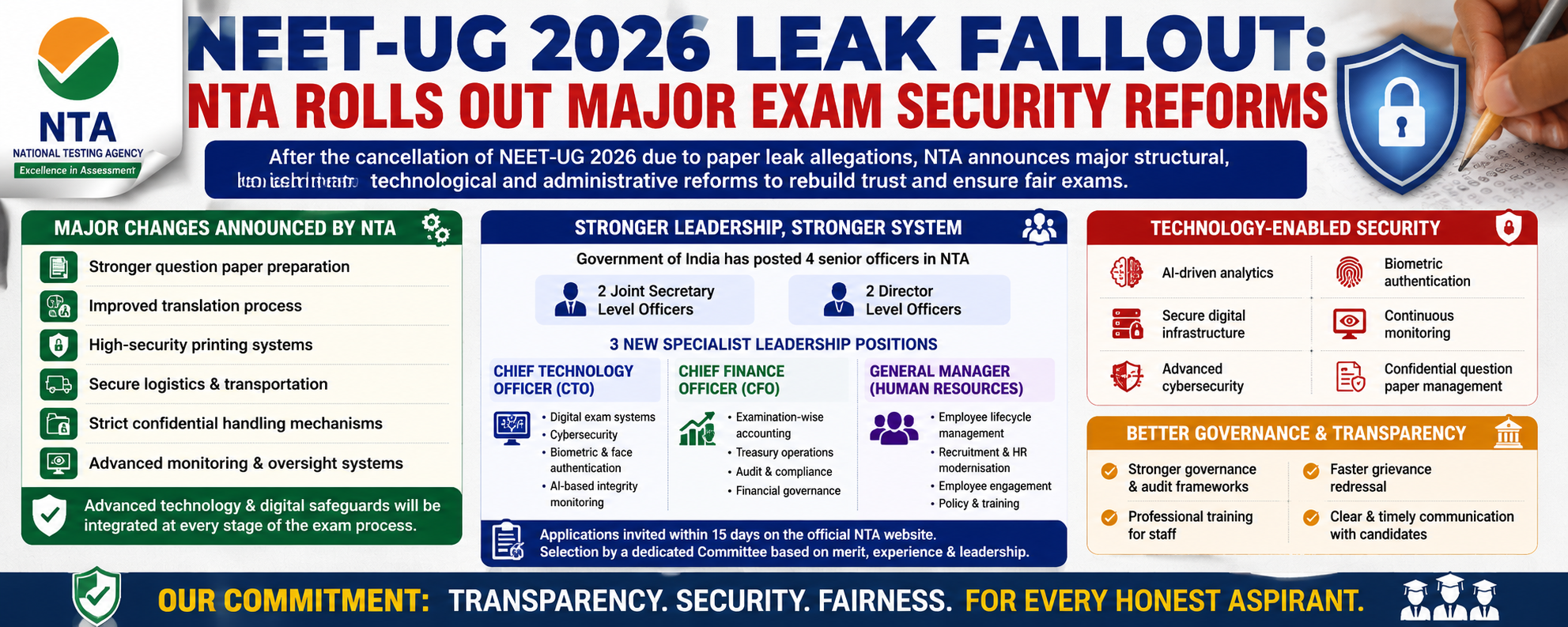
After the cancellation of NEET-UG 2026 due to the paper leak controversy, the National Testing Agency has announced a series of major reforms to strengthen India’s national-level examination system. The move comes after serious concerns were raised by students, parents and education experts regarding the safety, transparency and credibility of the examination process.
NEET-UG 2026 was conducted on May 3 but was later cancelled following allegations of question paper leaks and irregularities across multiple states. More than 22 lakh students were affected by the decision, creating anxiety and uncertainty among medical aspirants across the country.
To prevent such incidents in future, the Government of India formed a high-level expert committee to review the examination system and suggest stronger safeguards. Based on the recommendations, NTA has now started implementing structural, technological and administrative changes.
Major Areas of Reform
According to the NTA statement, the reforms will focus on strengthening key stages of the examination process, including question paper preparation, translation, printing, transportation, confidential handling, monitoring and oversight.
The agency has said that advanced technology and digital safeguards will be added at different levels to reduce the risk of paper leaks, tampering and unauthorised access.
Senior Officers Posted in NTA
As part of the reform process, four senior officers have been posted to the NTA to improve leadership and administrative capacity. These include two Joint Secretary-level officers and two Director-level officers.
Following the Radhakrishnan Committee recommendations, the Joint Secretary-level officers will function as Additional Director Generals in the agency. Their administrative experience is expected to improve coordination, accountability and operational efficiency.
New Specialist Positions
NTA has also invited applications for three important specialist posts:
Chief Technology Officer, Chief Finance Officer and General Manager for Human Resources.
The Chief Technology Officer will handle digital examination systems, candidate portals, cybersecurity, confidential question paper management, biometric verification, face authentication and AI-based integrity monitoring.
The Chief Finance Officer will supervise examination-wise accounts, audit systems, treasury operations and financial governance.
The General Manager for Human Resources will manage regular, deputation-based and contractual staff, along with recruitment, employee policy, training and workforce modernisation.
Technology-Enabled Security
The reforms will also bring stronger use of technology in national examinations. NTA is expected to use AI-driven analytics, biometric authentication, secure digital infrastructure, continuous monitoring and improved cybersecurity systems.
These steps are aimed at making the examination process more secure, traceable and accountable.
Better Governance and Candidate Communication
NTA has also promised stronger governance, better audit mechanisms, professional training of staff, faster grievance redressal and improved communication with candidates.
This is important because students often face confusion due to delayed notices, unclear updates and misinformation during high-pressure examination periods.
Why These Reforms Matter
The NEET-UG 2026 paper leak controversy has shown that India’s examination system needs deep reform, not temporary fixes. For students, NEET is not just an exam. It represents years of preparation, family sacrifice and the dream of becoming a doctor.
A secure and transparent exam system is necessary to protect honest students and restore public trust.
Conclusion
The NTA reforms announced after the NEET-UG 2026 paper leak are a major step towards rebuilding confidence in national-level examinations. However, the real test will be in implementation.
Students and parents will now closely watch whether these reforms lead to stronger security, better transparency, faster communication and fair conduct of future examinations.
The message is clear: national exams must be protected with strong systems, responsible leadership and zero tolerance for malpractice