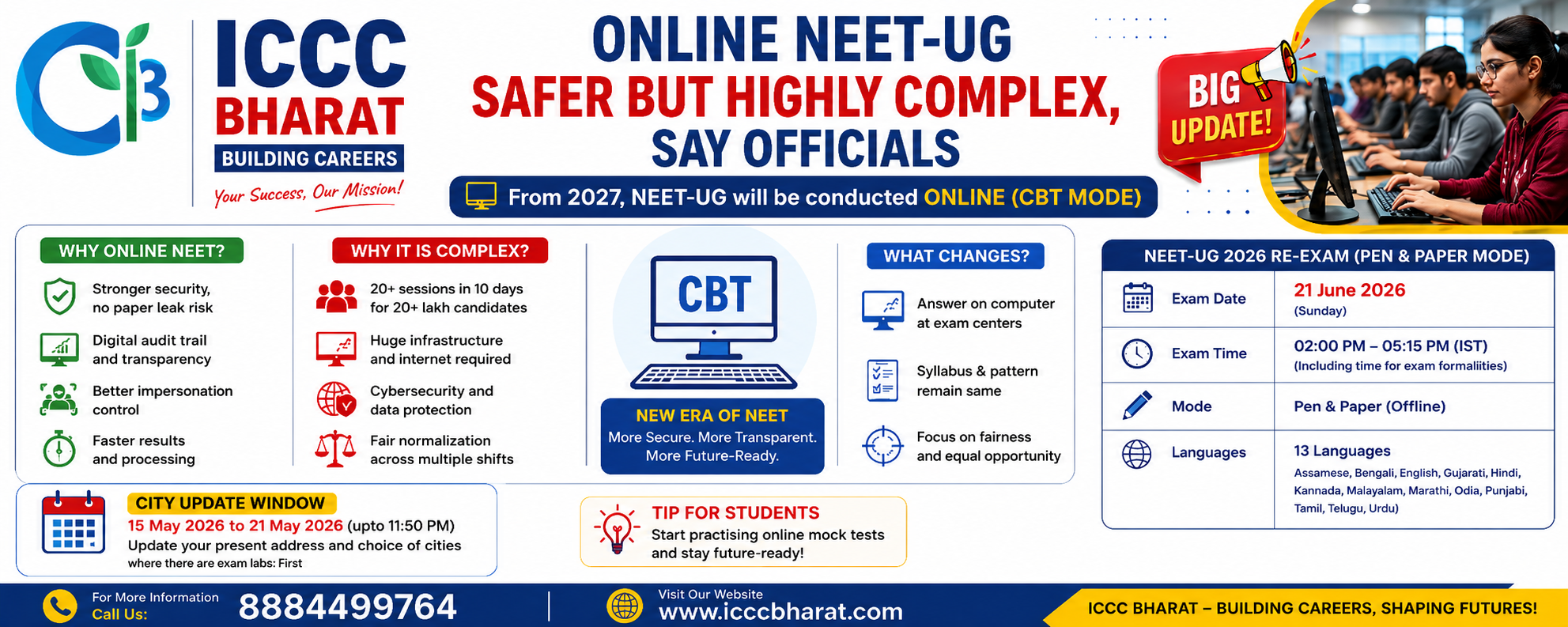
The proposed shift of NEET-UG to online mode from 2027 has started a major discussion among students, parents, education experts, and officials. After the cancellation of NEET-UG 2026 due to paper leak allegations, the move toward a Computer-Based Test model is being seen as a major reform to improve exam security.
However, officials have also cautioned that conducting India’s largest medical entrance examination online will not be easy. NEET-UG involves more than 20 lakh candidates, and shifting such a large exam from pen-and-paper mode to CBT mode requires massive planning, infrastructure, cybersecurity arrangements, and fairness safeguards.
Why Online NEET-UG Is Being Considered
The major reason behind the proposed shift is exam security. In the traditional pen-and-paper system, question papers must be printed, transported, stored, and distributed physically. This creates several risks in the chain of custody.
In CBT mode, candidates answer directly on computer terminals at designated exam centres. This reduces the risk of physical paper leakage and creates a stronger digital audit trail.
Expected Benefits of Online NEET-UG
| Benefit | Explanation |
|---|---|
| Better Exam Security | Reduces physical movement of question papers |
| Digital Audit Trail | Every action can be recorded and tracked |
| Faster Result Processing | CBT can help speed up evaluation and result declaration |
| Better Impersonation Control | Biometric and digital monitoring can be strengthened |
| Less Paper Handling Risk | No printed question paper distribution like offline mode |
Why It Is Highly Complex
Although CBT mode is safer, conducting NEET-UG online is far more difficult than smaller entrance exams because of the huge candidate volume.
Officials have indicated that the exam may require around 20 sessions spread across 10 days to accommodate the large number of candidates. This brings new challenges in fairness, scheduling, and normalization.
Major Challenges in Online NEET-UG
| Challenge | Why It Matters |
|---|---|
| Huge Candidate Pool | NEET has more than 20 lakh candidates |
| Computer Infrastructure | Large number of functional computers needed across India |
| Internet and Power Backup | Rural and semi-urban centres need reliable systems |
| Multiple Shifts | Different shifts require strong normalization |
| Cybersecurity | Online systems must be protected from hacking or data leaks |
| Digital Divide | Rural and economically weaker students may face disadvantage |
| Exam Calendar Pressure | Multi-day exam may affect admission timelines |
Rural Students and Digital Divide Concern
One major concern is whether students from rural areas and economically weaker backgrounds will be equally comfortable with online exams. Many students prepare through books and offline coaching environments and may not have regular access to computers.
If NEET moves online, students may need early training in computer-based mock tests so that lack of digital exposure does not affect performance.
Will Syllabus and Pattern Change?
Initially, the syllabus and overall question pattern are expected to remain the same. The major change will be in the mode of answering.
Instead of marking answers on OMR sheets, students will select answers on a computer screen, similar to other exams like JEE and CUET.
Normalization Will Become Important
If NEET is conducted in multiple shifts, normalization will become a key issue. Different shifts may have slightly different difficulty levels, so a fair normalization process will be required.
Officials have indicated that normalization is already used in exams like JEE, and a similar model may be developed for NEET to maintain fairness.
What Students Should Start Doing
Students preparing for NEET 2027 and beyond should begin adapting to the CBT model early.
| Student Action | Why It Helps |
|---|---|
| Practice online mock tests | Builds comfort with computer-based answering |
| Improve time management | CBT requires screen-based navigation |
| Learn question review tools | Mark for review, next/previous, timer usage |
| Avoid fear of technology | Regular practice builds confidence |
| Continue NCERT focus | Subject preparation remains the main priority |
Conclusion
Online NEET-UG can make the examination safer, more transparent, and better monitored. However, the transition will be highly complex because of India’s massive candidate base, infrastructure requirements, rural access concerns, cybersecurity risks, and normalization challenges.
For students, the message is clear: NEET preparation will remain NCERT-based, but the exam experience may change. Future aspirants should prepare academically and also become comfortable with online mock test platforms.
The shift to CBT mode may become one of the biggest reforms in India’s medical entrance examination system.