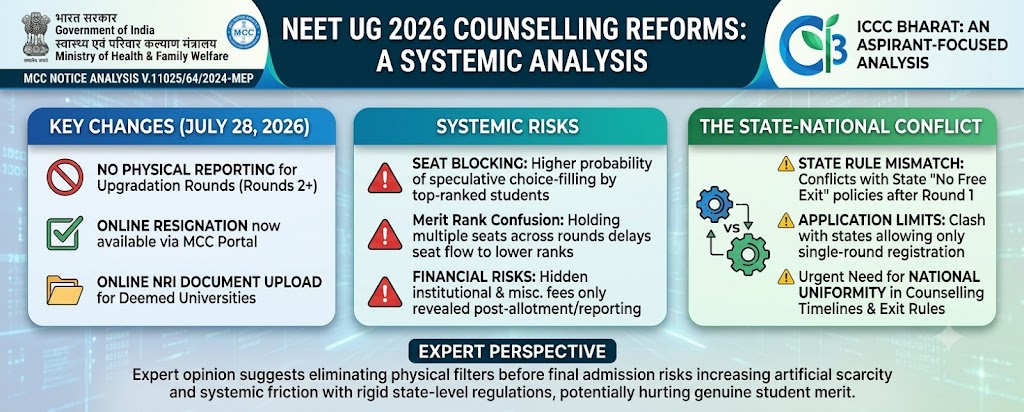
The official letter issued by the Medical Counselling Committee (MCC) introduces three main systemic changes for NEET UG 2026:
- No Physical Reporting for Upgradation
- Online Resignation Facility
- Online NRI Document Verification for Deemed Universities
While intended to streamline the process, these changes carry significant unintended consequences that could impact merit placement and seat allotment flow across national and state counselling systems.
1. Increase in Artificial Seat Blocking & Spurious Choice Filling
- Removal of Physical Friction: Previously, physical reporting acted as a natural filter. Requiring a candidate to physically travel to an allotted college forced them to evaluate the institution’s infrastructure, geographic feasibility, hidden/miscellaneous fees, and overall environment before locking down a seat for upgradation.
- Risk of “Blanket Choice Filling”: Eliminating this physical checkpoint encourages students to casually fill many choices—including distant colleges or expensive deemed university seats—without genuine intent to join.
- Impact on Top Ranks: High-ranking candidates will retain and hold multiple high-demand seats across rounds at zero logistical effort. This temporarily “freezes” top-tier seats, delaying their movement down the merit chain and denying lower-ranked candidates visibility of genuine vacant seats.
2. Friction Between Central (MCC) & State Counselling Timelines
- Mismatch in Exit Rules: The MCC rule allows online resignation and seamless participation in subsequent rounds without visiting the college. However, several states enforce strict “no free exit” rules after Round 1 or impose heavy exit penalties.
- State Application Restrictions: States like Andhra Pradesh and Telangana permit registration primarily before Round 1, while state bodies like KEA (Karnataka) have rigid multi-round entry frameworks.
- The Dilemma for Candidates: A candidate holding an MCC seat via the online portal without physical reporting will face immense decision anxiety:
- Should they surrender the MCC seat online not knowing their status in the state round?
- Will holding the online MCC seat disqualify or penalize them under their respective state’s domicile rules?
3. Transparency Gaps: Hidden Fees & Institutional Reality
- Financial Surprises: Many private medical institutions and deemed universities carry unlisted miscellaneous expenses, hostel surcharges, or bank guarantee requirements that are only disclosed during physical reporting.
- Delayed Decision-Making: Under the new system, candidates may keep upgrading online based solely on prospectus data, only to discover hidden fee structures or lacking hospital infrastructure at the final admission stage—leading to last-minute resignations and chaotic mop-up/stray vacancy rounds.
Summary of Systemic Impact
| Parameter | Previous System | New System (2026 Policy) | Direct Consequence |
| Upgradation Effort | Requires physical travel to allotted college. | 100% Online (No physical visit required). | Spikes casual/speculative choice filling. |
| Seat Velocity | Fast resolution; uninterested candidates forfeit early. | Delayed Seat Clearance; seats locked until late rounds. | High merit-rank confusion and seat blocking. |
| State Integration | Candidates physically commit, making state choices clearer. | Desynchronized with rigid state exit/entry rules. | Cross-counselling overlap & legal/procedural confusion. |
Key Takeaway: For this policy to function smoothly without causing widespread chaos, MCC must standardize counselling schedules and exit policies across all State DMEs (Directors of Medical Education). Without uniform rules on free exits, security deposits, and registration windows nationwide, the online reporting facility risks creating severe seat-blocking and anxiety among high-merit candidates.