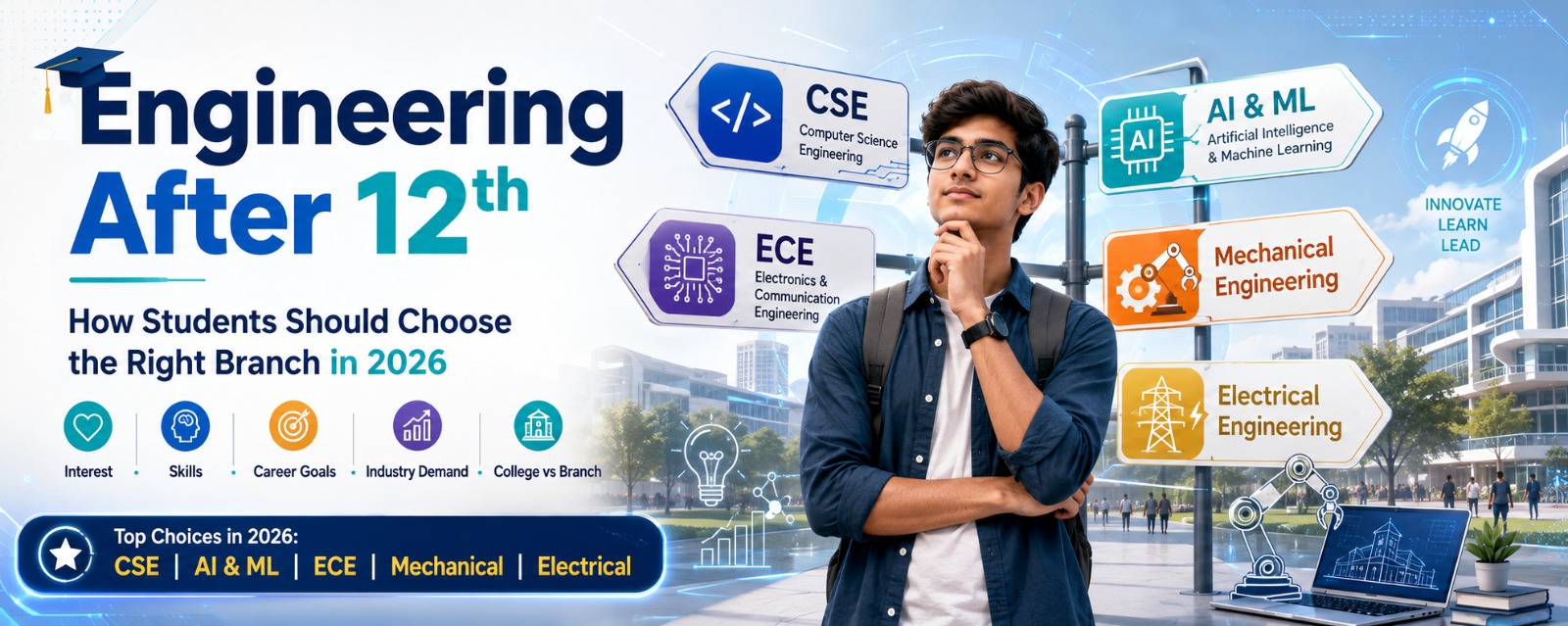
Choosing an engineering branch after Class 12 is one of the most important decisions in a student’s academic journey. With hundreds of colleges, multiple engineering streams, changing industry trends, and new career opportunities, many students get confused about which branch will be the right choice for their future. In 2026, engineering is not only about selecting a popular branch. Students must understand their interests, skills, career goals, and future industry demands before making a decision.
1. Understand Your Interest Before Choosing a Branch
Many students choose a branch only because it has a high cutoff or because their friends are choosing it. However, every engineering branch requires different skills and interests.
Ask yourself:
- Do you enjoy coding and technology?
- Are you interested in electronics and innovation?
- Do you like machines, design, and manufacturing?
- Are you interested in healthcare, research, or biotechnology?
Choosing a branch based on interest helps students stay motivated throughout their engineering journey.
2. Top Engineering Branches to Consider in 2026
Computer Science Engineering (CSE)
CSE continues to be one of the most preferred engineering branches because of opportunities in software development, artificial intelligence, data science, cybersecurity, cloud computing, and technology companies.
Career Areas:
- Software Development
- AI & Machine Learning
- Data Science
- Cyber Security
- Cloud Technologies
Artificial Intelligence & Machine Learning (AI & ML)
AI has become one of the fastest-growing technology fields. Students interested in programming, mathematics, and problem-solving can explore this branch.
Career Opportunities:
- AI Engineer
- Machine Learning Engineer
- Data Analyst
- Research Roles
Electronics & Communication Engineering (ECE)
ECE has gained strong popularity because modern technologies depend on electronics, semiconductors, communication systems, IoT, and embedded technologies.
Career Opportunities:
- Semiconductor Industry
- Embedded Systems
- VLSI Design
- Telecom Sector
- Software Industry
Mechanical Engineering
Mechanical engineering remains important with growth in automation, robotics, electric vehicles, and advanced manufacturing.
Career Areas:
- Robotics
- Automobile Industry
- Manufacturing
- Product Design
Electrical Engineering
Electrical engineering plays a major role in power systems, renewable energy, electric vehicles, and automation.
Career Areas:
- Power Sector
- EV Technology
- Renewable Energy
- Automation
3. College vs Branch: Which One Matters More?
One of the biggest questions students face is:
“Should I choose a top college with a different branch or a lower-ranked college with CSE?”
The answer depends on:
- Career goals
- Interest in the branch
- Placement opportunities
- Higher education plans
- Skills development
A reputed college can provide better exposure, networking, and opportunities. At the same time, choosing a branch you enjoy can help you build a successful career.
4. Don’t Choose a Branch Only Based on Placements
Placements are important, but they should not be the only deciding factor.
Students should also consider:
- Future growth of the field
- Personal interest
- Learning opportunities
- Industry requirements
- Scope for specialization
A student who develops strong skills can create opportunities in almost any engineering field.
5. Importance of Skills in 2026
The engineering world is changing rapidly. Companies are looking for students with practical knowledge along with academic qualifications.
Students should focus on:
- Programming Skills
- Internships
- Projects
- Communication Skills
- Industry Certifications
- Problem Solving Ability
A degree provides the foundation, but skills create career opportunities.
6. Future-Focused Approach for Engineering Selection
Before finalizing your engineering branch, research:
- Industry growth
- Job opportunities
- College reputation
- Alumni success
- Curriculum updates
- Internship exposure
A well-informed decision today can shape your career for many years.
Choosing an engineering branch after 12th is not about following trends blindly. The right choice is a combination of interest, career goals, college opportunities, and future industry demand.In 2026, students who choose wisely and continuously upgrade their skills will have excellent opportunities across multiple engineering fields.Choose a branch where you can learn, grow, and build the career you dream of.